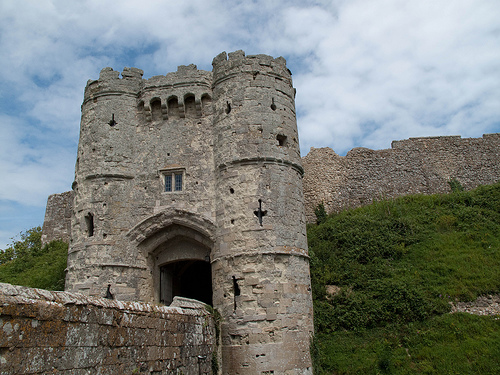
Location: Newport, Isle of WightMap
Constructed: 12th century
Tel.. 01983 522107
Entrance Fee:
Adult- £7.50, Child- £4.50, Family (2 adults, 3 children) £19.50
Open: Apr-Sept: 10am- 5pm
Oct- 4th Nov: 10am- 4pm
5th Nov- 17th
Feb: 10am- 4pm Sat, Sun
18th Feb- 24 Feb: 10am- 4pm
25th Feb- 28th
March: 10am- 4pm
Closed: 1 Jan, 24- 26 Dec
Carisbrooke Castle, perched on a prominent hilltop above Newport on the Isle of Wight, England, is one of the island’s most historically significant sites. For over 1,000 years it has served as a fortress, royal residence, administrative center, and prison, evolving through layers of Anglo-Saxon, Norman, medieval, Tudor, Stuart, and Victorian history. Today it is managed by English Heritage as a major tourist attraction and museum, symbolizing the Isle of Wight’s strategic importance in English defense and politics.
Early Origins: Prehistoric, Roman, and Anglo-Saxon Foundations
(Pre-1066)
The site shows evidence of human activity long before
the castle itself. There may have been pre-Roman occupation, and
traces suggest a possible late Roman building or fort (part of
broader coastal defenses). A 6th-century pagan Anglo-Saxon cemetery
has been excavated nearby, with graves uncovered during
archaeological work.
The Anglo-Saxon Chronicle records that
Wihtgar (cousin of King Cynric of Wessex) was buried here around AD
544. By the late 7th or 8th century, the Jutes or Anglo-Saxons
likely controlled a stronghold. Around AD 1000 (c. 998–1009), a
rectangular Anglo-Saxon burh (fortified enclosure) was built as a
refuge against Viking raids. This featured an earthen bank later
faced with stone, enclosing large timber buildings. Remnants of this
Saxon lower enclosure wall are still visible today on the west side.
Norman Conquest and the Motte-and-Bailey Castle (11th–12th
Centuries)
Following the Norman Conquest in 1066, the existing
burh was adapted into a Norman castle to secure the Isle of Wight.
William Fitz Osbern (Earl of Hereford and a close ally of William
the Conqueror) likely established the first Norman foundation,
incorporating the Saxon defenses. The site appears in the Domesday
Book (1086) under the name Alwinestone (or similar variants).
By
around 1100, the powerful de Redvers family took control. Richard de
Redvers (or his son Baldwin) transformed it into a classic
motte-and-bailey castle: a massive artificial motte (mound) topped
with a shell keep, surrounded by deep ditches and a bailey
(courtyard) with stone curtain walls. The keep, reached by 71 steps,
offered commanding views. The castle chapel (dedicated to St
Nicholas) probably occupied its present site by this time.
During
the Anarchy (civil war between King Stephen and Empress Matilda,
1135–1153), Baldwin de Redvers (a supporter of Matilda) made a stand
at Carisbrooke in 1136. He surrendered when the castle’s water
supply ran dry—a vulnerability that would later prompt major
improvements. By this period, the banks had stone walls, and the
basic layout was established.
The de Redvers Era and
Transition to Crown Property (12th–13th Centuries)
The de Redvers
family held the lordship of the Isle of Wight and Carisbrooke for
nearly two centuries. Countess Isabella de Fortibus (1237–1293), the
last of the line and one of medieval England’s most powerful women,
was responsible for much of the visible medieval fabric. She made
Carisbrooke her principal residence, building or greatly enhancing
the great hall, her private chamber, a private chapel, and other
domestic buildings around a central courtyard. She may even have
installed some of the earliest glass windows in Britain. On her
deathbed in 1293, she sold the castle and estates to King Edward I
for a substantial sum. It has remained Crown property ever since.
Edward I and his successors (including Edward II) refortified the
site as tensions with France grew at the start of the Hundred Years’
War. Domestic buildings from the 13th century (with 16th-century
upper floors) survive in altered form.
Late Medieval
Challenges and Tudor Decline (14th–16th Centuries)
The castle
faced its only serious military test in 1377 during a French raid on
the Isle of Wight. Local hero Peter de Heyno (or Heynoe) reportedly
shot the French commander with an arrow, helping repel the
attackers.
In 1467, Anthony Woodville (Lord Scales, later Earl
Rivers and brother-in-law to Edward IV) received the castle. He
added the grand Entrance Gate (Woodville Gate), with its drum
towers, creating the impressive gateway still seen today (extended
in the 14th century with round turrets).
By the reign of Henry
VIII, Carisbrooke’s military importance waned as the king
prioritized coastal “Device Forts.” The castle became more of a
residence for appointed governors and wardens.
Elizabethan
Fortifications Against Invasion (Late 16th Century)
Queen
Elizabeth I revived the castle’s defensive role amid fears of
Spanish invasion. In 1583 she appointed her cousin Sir George Carey
as Captain (later Governor) of the Isle of Wight. Carey rebuilt
decayed domestic quarters, inserting an upper floor in the hall
block, adding St Peter’s Chapel, and constructing “Carey’s Building”
with 17 rooms and a long gallery.
Between 1597 and 1602, Italian
engineer Federigo Giambelli (or Genebelli) designed and built a
sophisticated trace Italienne artillery fort—a low, rectangular
rampart with powerful bastions surrounding the old medieval castle.
Costing around £4,000, this outer earthwork defense was completed
just after the Spanish Armada threat but was never tested in battle.
The outer gate bears the date 1598 and Elizabeth I’s arms.
The English Civil War: Imprisonment of Charles I (17th Century)
Carisbrooke’s most famous chapter occurred during the English Civil
War. In 1642 it fell to Parliamentary forces and served as a prison
for Royalists. In November 1647, King Charles I escaped house arrest
at Hampton Court Palace and fled to the Isle of Wight, placing
himself under the protection of Governor Colonel Robert Hammond.
Instead, he was held at Carisbrooke for about 14 months (until late
summer 1648).
He was housed relatively comfortably in the
Constable’s Chamber (part of the hall range) with his own servants
and even a bowling green laid out for his recreation in an eastern
enclosure. However, he made two failed escape attempts:
In
March 1648, he tried to squeeze through a window but became wedged
in the bars.
In May 1648, he used a hacksaw and acid on the bars,
but the governor interrupted the plot.
Negotiations with
Parliament took place in Newport, but they failed. Charles was moved
to the mainland, tried, and executed on 30 January 1649. His two
youngest children were later confined here: Princess Elizabeth (aged
14) died of illness in the castle in 1650; his youngest son, Henry,
was also held briefly.
Post-Restoration to Victorian Revival
(17th–19th Centuries)
After the Restoration (1660), the castle
lost its frontline military role as defenses shifted to the coast.
It served occasionally as a governor’s residence, with repairs by
figures like Lord Cutts and the Earl of Cadogan. By the 19th century
it had fallen into disrepair, becoming a romantic ruin and tourist
draw. It briefly housed the Isle of Wight Artillery Militia. The
Office of Works took charge in 1856, with architect Philip Hardwick
beginning (but not completing) restorations.
Princess
Beatrice and 20th-Century Restoration (1890s–1944)
In 1896, Queen
Victoria’s youngest daughter, Princess Beatrice, was appointed
Governor of the Isle of Wight. With local historian and architect
Percy Stone, she oversaw extensive restorations. The gatehouse was
repaired and converted into the Carisbrooke Castle Museum (opened
1898 as a memorial to her husband, Prince Henry of Battenberg, who
died in the Ashanti campaign). Beatrice used the castle as a summer
residence from around 1913 until her death in 1944, adapting the
hall range and Constable’s Lodging. The Chapel of St Nicholas was
rebuilt in quasi-medieval style in 1904 as an island war memorial.
Modern Era and Today
Since 1944 the castle has been a public
monument under English Heritage. The museum (now in the hall range)
tells the Isle of Wight’s story. Key surviving features include the
motte and keep, deep wells (one 200+ feet deep with a famous
donkey-powered wheelhouse—originally worked by prisoners or humans,
donkeys since at least 1696, with a tradition of names beginning
with “J” possibly linked to Charles I), the Elizabethan bastions,
gatehouse, and domestic ranges.
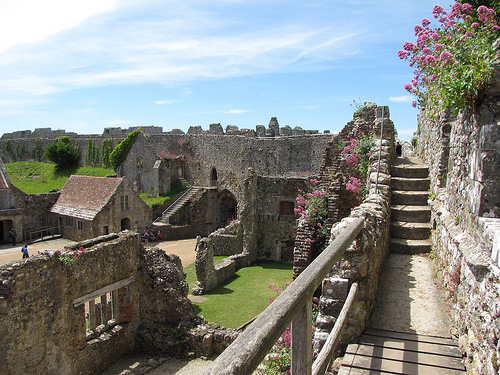
The castle’s architecture reflects successive phases of construction
driven by changing military threats, ownership, and domestic needs.
Anglo-Saxon Origins (c. 1000): The site began as a rectangular
earthen burh (fortified enclosure) with an earthen bank later faced in
stone, enclosing timber buildings. This served as a refuge against
Viking raids. Fragments of the Saxon lower enclosure wall survive on the
west side near the base of the later Norman earthworks.
Norman
Conquest and Motte-and-Bailey (c. 1100–1136): Shortly after 1066, the
burh was adapted into a classic motte-and-bailey castle. William
FitzOsbern (or more likely Baldwin de Redvers under Henry I) raised a
massive conical motte (artificial mound) in one corner of the Saxon
enclosure and dug deep ditches. The bailey (courtyard) was enclosed by a
curtain wall. By 1136 the banks were faced with stone, and a shell keep
(a simple circular or polygonal stone wall around the motte summit, with
lean-to buildings inside) was built atop the motte because the unstable
mound could not support a full tower. This keep served as the ultimate
refuge.
13th–14th Centuries (de Redvers and Isabella de Fortibus):
The de Redvers family (holding the lordship from c. 1100) and especially
Isabella de Fortibus (last of the line, d. 1293) transformed the
interior into a comfortable aristocratic residence. She created the
central courtyard layout with the Great Hall, her private chamber block,
and a chapel. Stone curtain walls and towers were strengthened. After a
French siege in 1377, the gatehouse was significantly upgraded with
massive rounded drum towers (c. 1335–36). William de Montacute later
remodelled the great hall and chamber block.
Tudor/Elizabethan Era
(late 16th–early 17th centuries): Under Governor Sir George Carey
(1583–1604), domestic buildings were rebuilt because many had decayed.
Carey added an upper floor to the hall range and St Peter’s Chapel, plus
his own mansion with 17 rooms and a long gallery. In response to the
Spanish Armada threat, Italian engineer Federigo Giambelli (also known
as Gianibelli) designed extensive trace Italienne (star-shaped)
artillery fortifications (1597–1602): a low, roughly rectangular rampart
nearly a mile long with five powerful bastions, wide ditches, and
stone-faced banks. These outer earthworks were never tested in battle.
Later Modifications: The castle saw repairs, partial demolitions, and
restorations in the 18th–20th centuries. The Chapel of St Nicholas was
rebuilt in Georgian style (1738) then quasi-medievally (1904) as a war
memorial. Victorian and Edwardian work under architects like Percy Stone
restored the gatehouse and other structures for museum use. Princess
Beatrice (Queen Victoria’s daughter) used parts as a summer residence
until 1938.
Overall Layout
The castle occupies a roughly oval
hilltop site with an inner bailey (central courtyard) containing most
domestic buildings, surrounded by a stone curtain wall and towers. The
motte and keep dominate one side. An outer ward and extensive
Elizabethan bastioned earthworks enclose a larger area. A main gatehouse
provides the primary entrance, with a postern (rear) gate. Walkable
curtain walls allow a full circuit (except where interrupted by the
motte). Modern amenities (shop, tearoom) occupy south-east areas.
A
scale model in the museum illustrates the medieval layout clearly: inner
bailey with hall and lodgings, motte keep, gatehouse with drum towers,
and outer defenses.
Key Architectural Features
The Motte and
Keep
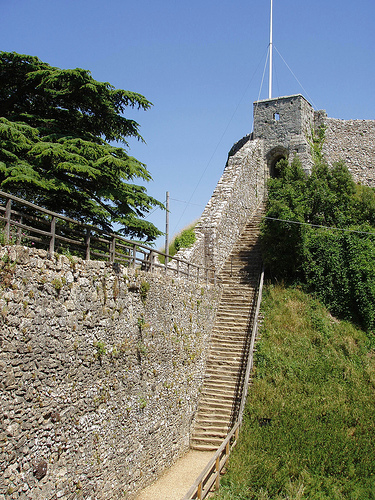
The most striking element is the tall, conical motte topped by a
shell keep. A steep flight of 71 stone steps leads up the motte to the
entrance. The keep itself is unroofed today (ruinous upper levels), with
a central well inside for siege use. The shell keep’s circular wall
provided 360° defense while enclosing lean-to accommodation. From the
top you get panoramic views over the Isle of Wight.
Gatehouse and
Main Entrance
The impressive main gatehouse (late 13th century core,
drum towers added c. 1335–36) is the most photographed feature. It
consists of a rectangular central tower flanked by two large, rounded
drum towers with battlements and arrow slits. Defensive elements include
murder holes (for dropping missiles), portcullis grooves, and drawbridge
mechanisms. The outer gate bears the date 1598 and Elizabeth I’s arms.
The structure was restored with a roof and upper floor in the 1890s.
Curtain Walls, Towers, and Defenses
Thick stone curtain walls
(mostly 12th–14th century) encircle the inner bailey and are largely
intact, allowing visitors to walk the full perimeter. Projecting towers
(including south-west and south-east) provided flanking fire. The
Elizabethan outer fortifications added low, angled bastions and wide
ditches optimized for cannon, representing a shift from medieval
vertical defense to Renaissance artillery-resistant design.
Domestic Buildings and Inner Bailey
Around the central courtyard
(inner bailey) are the residential core:
Great Hall (13th century,
remodelled multiple times): The principal living and feasting space;
upper floor added in the Tudor period.
Great Chamber and Constable’s
Lodging: Adjacent private quarters and administrative rooms.
Carey’s
Mansion (late 16th century): Ruined but visible; included a long gallery
for exercise and display.
Many of these are open to visitors and
partly furnished, with the Isle of Wight Museum in the hall range.
Chapels
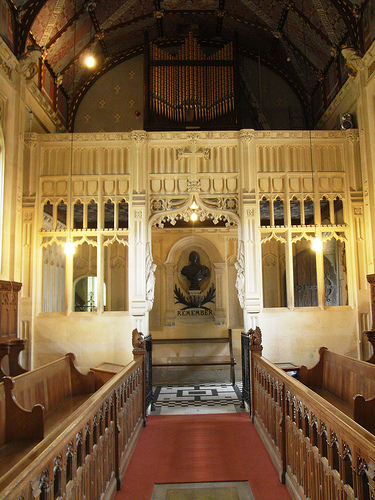
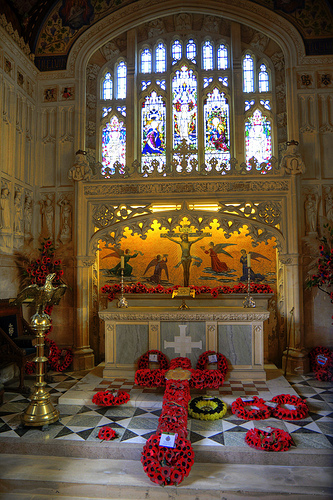
The Chapel of St Nicholas (near the gatehouse) was
rebuilt multiple times and now serves as a memorial.
Chapel of St
Peter (south-east range) was incorporated into domestic buildings with
an upper floor in the Tudor period.
The Well and Donkey Wheel
A famous 200-foot-deep well in the inner bailey is housed in a
well-house with a working 16th-century donkey wheel (a large wooden
treadwheel powered by donkeys walking inside it to draw water). It
remains operational as a visitor demonstration.
Other Elements
A postern gate and various service buildings (armoury, powder magazine).
Princess Beatrice Garden and bowling green (added during Charles I’s
imprisonment in 1647–48).
Modern restorations preserve the romantic
ruined aesthetic while making key areas accessible.
Practical Essentials
Address: Castle Hill, Newport, Isle of Wight,
PO30 1XY.
Opening Times (as of 2026): Generally open daily 10am–5pm
(last entry 4pm) in spring/summer/early autumn. Reduced hours in winter
(e.g., shorter days or weekends only). Always check the official English
Heritage site for your date, as they vary.
Tickets: Book online in
advance for a ~15% discount and guaranteed entry. Prices are typically
around £13–14 for adults (standard/on-the-day), with child, family, and
concession rates available. English Heritage members enter free (bring
your card). Tickets are all-day and valid for the full site.
Getting
There:
By Car: Onsite parking (pay-and-display for non-members; free
for EH members) about 50–100m from the entrance, with ~100 spaces
(including disabled bays closer in). Arrive early on busy days/bank
holidays as it fills quickly. Alternative village parking available.
By Bus: Southern Vectis routes (e.g., 7, 12, 38) stop nearby on
Carisbrooke High Street; it’s a short but steep uphill walk from there.
Ferries to the Isle of Wight + local transport make it accessible from
mainland UK.
Pro Tip: If you’re mobility-impaired or traveling
with young kids, drive or take a taxi for the hill.
What to See
and Do (In-Depth Highlights)
Plan your visit to flow logically: start
at the gatehouse/exhibition, explore the grounds, climb for views, meet
the donkeys, and end with the museum/garden/chapel.
Gatehouse
Exhibition & Interactive Fun — Begin here with a film and virtual tour
of the castle’s 1,000+ year history (Anglo-Saxon defenses against
Vikings → Norman motte-and-bailey → Elizabethan updates). Kids can dress
up as soldiers and try mini-cannon activities.
Walk the Battlements &
Climb the Keep — A highlight for panoramic 360° views across the Isle of
Wight. The walls are walkable (with some handrails), but expect steep,
uneven stone steps and heights. The keep (on a steep motte) involves 70+
steps for the best vistas. Not suitable for all (see accessibility
below). Great for photos and imagining medieval life.
Meet the
Donkeys — The castle’s star attraction. Donkeys (names often starting
with “J” in honor of Charles I) demonstrate the 16th-century treadwheel
to draw water from a 49m (161ft)-deep well. Demonstrations are short,
welfare-focused, and voluntary for the animals. There’s a fun film
narrated by a cartoon donkey (voiced by Phil Jupitus). Very
family-friendly and memorable.
Princess Beatrice Garden — A peaceful
Edwardian-style garden (designed by Chris Beardshaw) with period
planting in blue/red/gold (her heraldic colors), water features,
orchard, and sculptures. Relax here or view it from the battlements. A
lovely contrast to the fortifications.
Castle Museum (Great Hall,
Chapel, Lodgings) — Managed separately but included. Covers island
history with Charles I artifacts, Princess Beatrice items (she lived
here and founded the museum in 1898), and more. Interactive and
informative.
St Nicholas’ Chapel — A tranquil 1904 rebuild
commemorating Charles I (with war memorial elements). Beautiful and
reflective.
Bowling Green & Royal Escape Sites — See where Charles I
played bowls and attempted (failed) escapes, including the window where
he got stuck.
Duration Recommendation: 3–4 hours to explore
without rushing; 1–2 hours for a quick visit.
Facilities
Tearoom: Above the old carriage room — light lunches, sandwiches, cakes,
ice cream, hot/cold drinks, kids’ menu, and dietary options
(vegetarian/vegan/gluten-free). Picnic on the lawns or benches is
encouraged.
Toilets: In the courtyard (including disabled and
baby-changing).
Shop: Souvenirs, books, local items.
Dogs: Welcome
on leads in grounds (not museum/café, except assistance dogs). Water
bowls available.
Best Time to Visit & Crowd Tips
Season:
Spring/summer for longer hours, gardens in bloom, and donkey demos.
Shoulder seasons (e.g., May or September) balance weather and crowds.
Time of Day: Arrive early (before 11am) or later (after 2pm) to avoid
any peak busier periods. It rarely feels crowded.
Weather: Check
forecasts — walls and grounds can be slippery when wet. Sunny days
enhance views.
Events: Look for family trails (e.g., folklore
creatures), mystery missions, or seasonal activities on the EH site.
Accessibility & Practical Tips
Mobility: Grounds/pathways are
mostly flat (gravel/tarmac/grass) with seating. Disabled parking close
by. Lower areas, well house, ground-floor museum, and chapel are
accessible. Upper museum floors, full wall walk, and keep involve steep
stairs — not wheelchair-friendly. Wheelchair loan available; ask staff.
Families: Highly recommended — dressing up, donkeys, trails, picnics,
and open spaces. Pushchairs manageable on lower levels.
What to
Bring: Comfortable walking shoes (uneven/steep areas),
weather-appropriate layers, binoculars/camera for views, picnic.
Download any EH app or site map in advance.
Photography: Excellent
opportunities from walls/keep; respect any restrictions.
Combine
With: Osborne House (Queen Victoria’s nearby home), other island
attractions, or a full Isle of Wight day.
The Tragic Tale of Elizabeth Ruffin and the Haunted Well
One of
the castle’s most enduring and poignant legends revolves around
Elizabeth Ruffin, a young woman whose spirit is said to haunt the famous
well house. According to the most detailed local account, Elizabeth was
the daughter of the Mayor of Newport in the early 17th century. Born
into privilege, she was arranged to marry a man of status, but she fell
deeply in love with someone else. Family disapproval, heartbreak, and
shame drove her into despair. One evening in 1632, she wandered alone
into Carisbrooke Castle’s silent courtyards and reached the great well.
Accounts vary slightly: some say she deliberately climbed onto the stone
rim and jumped; others describe an accidental slip while in emotional
distress. Her body sank into the depths, and her death was recorded by
Isle of Wight diarist Sir John Oglander.
Variations in folklore add
drama: some tellers claim she was the daughter of the castle’s Governor
with a secret romance, or that she was murdered rather than dying by
suicide or accident. In the 20th century, human bones were reportedly
found in the well during maintenance work, which some locals interpret
as confirmation of her remains.
Her ghost is most often seen in the
well house (where donkeys still demonstrate the treadwheel mechanism
today). People gazing into the dark water for long enough report seeing
her pale, floating face reflected back at them. Other phenomena include
unexplained sobbing in the castle chapel (where her spirit is said to
drift between the well and chapel), sudden cold drafts in locked rooms,
rustling skirts with no one present, and overwhelming feelings of
sadness near the well. The well’s shadowy depths and the rhythmic creak
of the wheel add to the atmosphere, making it a focal point for
paranormal investigators.
The donkey wheel itself has become part
of local lore, sometimes loosely tied to Charles I’s imprisonment (he
supposedly named donkeys after his “J” signature habit), though this is
more tradition than strict legend.
The Grey Lady and Her Spectral
Companions in the Moat and Grounds
The moat area is frequently cited
as the castle’s most haunted zone. A “Grey Lady” (sometimes described as
a Victorian lady in grey or wearing a long dark cloak) is regularly
sighted strolling the grounds and especially the moat. She is often
accompanied by a pack of up to four ghostly hounds and a man in a brown
leather jerkin or tunic—possibly her husband or a former owner/soldier
from the castle’s long history. They appear as if surveying their old
domain, perhaps former residents ensuring the site is cared for.
Sightings include:
A woman strolling the moat who was approached by a
young man in a leather jerkin; he chatted casually for several minutes
before vanishing mid-conversation without explanation.
A “huge man in
a long white gown” also seen in the moat.
The Grey Lady and her
entourage moving silently through the grounds or near the battlements.
These figures are not tied to a specific historical person but are
interpreted as echoes of past owners or staff, their timeless clothing
adding to the mystery. The moat’s earthworks and isolation amplify
reports of a strong “presence” felt even by skeptics.
The
Chilling Carisbrooke Reaper
A more recent but particularly unsettling
legend involves the so-called Carisbrooke Reaper. A group of friends
exploring the castle at night reportedly encountered a tall figure in
all black on the first-level walkway of the castle walls (illuminated by
a nearby traffic light). He carried a great scythe, warned them sternly
to leave, and dramatically produced a lit candle from beneath his cloak.
His voice was deep and unsettling; his face was hidden by a dark shroud,
evoking the classic Grim Reaper archetype. The fact that he spoke in
something close to modern English suggests he may date to only a few
centuries ago and once held significant power at the castle. This
encounter is considered one of the most chilling tales associated with
the site.
Other Hauntings and Royal Connections
Some accounts
mention the ghost of Princess Elizabeth, the 14-year-old daughter of
King Charles I. She was imprisoned at the castle with her father and
died there in 1650 (likely from illness); her body is buried in Newport
Minster. A few ghost walks and local stories claim she still lingers in
the rooms where she was held, though this is less consistently reported
than the others.
King Charles I himself does not appear in most
haunting reports, despite his year-long captivity and multiple failed
escape attempts (including one where he got stuck in a window). However,
a colorful local legend claims a secret tunnel once connected the castle
to the Castle Inn in Newport (about a mile away). Supposedly, Charles
used it to slip out for quiet drinks before returning to his cell. No
archaeological evidence supports the tunnel, but the story persists as
Isle of Wight folklore.
Non-Ghost Local Legends: Heroism and
Defense
Not all legends are supernatural. A celebrated tale of
bravery involves Peter de Heyno during the French raid of 1377. As the
French attacked, de Heyno (sometimes called a local hero or archer)
fired a silver arrow from a specific arrow-loop in the castle walls,
striking and killing the French commander. This shot reportedly turned
the tide, forcing the invaders to retreat. The precise loophole is still
pointed out to visitors, blending verifiable medieval siege history with
heroic folklore.
Carisbrooke’s location and long military past have
inspired other tales of defense and resilience, but the ghostly stories
dominate modern local lore.