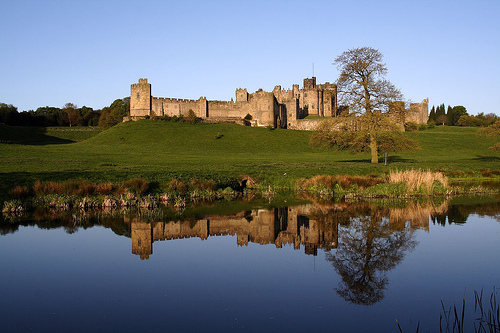
Location: Alnwick, Northumberland Map
Constructed: 11th century
Alnwick Castle, located in the market town of Alnwick in Northumberland, England, is a magnificent medieval fortress renowned as one of the finest and most intact castles in Britain. Situated approximately 35 miles (56 kilometers) north of Newcastle upon Tyne and 5 miles (8 kilometers) inland from the North Sea coast, it stands as the ancestral seat of the Percy family, the Dukes of Northumberland, who have resided there for over 700 years. Perched on a strategic bluff overlooking the River Aln, this imposing structure blends formidable defenses with palatial interiors, reflecting its dual role as a military stronghold and aristocratic residence. Today, managed by the Northumberland Estates, Alnwick Castle is a major tourist attraction, celebrated for its historical significance, architectural grandeur, and its starring role as Hogwarts in the Harry Potter films.
Norman Origins and the de Vesci Era (Late 11th–Early 14th Century)
The castle’s story begins shortly after the Norman Conquest. Around
1096, Ivo de Vesci (also spelled Yvo or Yves de Vescy), a Norman baron
from Vassy in Calvados, France, erected the first parts of Alnwick
Castle—initially likely a wooden motte-and-bailey structure—to control a
key crossing of the River Aln and assert Norman authority over the
volatile northern borderlands.
By the mid-12th century the castle had
evolved into a substantial stone fortress with a distinctive layout: two
concentric rings of buildings rather than the more common square keep
found in many early Norman castles. It was first documented in 1136 when
King David I of Scotland captured it during one of the many border
conflicts; contemporary chronicles described it as “very strong.”
The
de Vesci family held it through turbulent times. It faced repeated
Scottish assaults:
In 1172 and 1174, King William the Lion of
Scotland besieged Alnwick. During the second siege, William was captured
outside the castle walls in the Battle of Alnwick (1174), a major
English victory.
In 1212, King John ordered the castle demolished
after accusing Eustace de Vesci of plotting against him (along with
Robert Fitzwalter), but the order was never carried out at Alnwick.
The de Vesci line ended without male heirs when John de Vesci died in
1297 (some accounts place the end around 1310). The estates passed
briefly to Antony Bek, Bishop of Durham, who sold the castle in 1309 to
Henry de Percy, 1st Baron Percy.
The Percy Era Begins: Medieval
Fortress and Border Powerhouse (14th–16th Centuries)
The Percy
purchase in 1309 marks the start of the family’s 700+ year association
with Alnwick—the longest continuous ownership of any major English
castle by one family. Henry Percy and his son (also Henry, 1299–1352)
immediately launched a massive rebuilding program, transforming the
modest stone structure into a major border fortress. Surviving
14th-century elements include the Abbot’s Tower, Middle Gateway, and
Constable’s Tower.
The design balanced defense and comfort: a central
shell keep entered via a grand Romanesque archway flanked by
semi-octagonal towers, surrounded by an outer bailey with ten main
towers (many D-shaped for better defense) connected by curtain walls, a
long barbican, and elaborate gatehouses. It became a model for other
northern “palace-fortresses” such as Bamburgh and Raby.
The Percys
were key players in Anglo-Scottish wars and English politics. The most
famous member was Henry “Hotspur” Percy (1364–1403), son of the 1st Earl
of Northumberland. Immortalized by Shakespeare in Henry IV, Hotspur
rebelled against Henry IV; the castle was surrendered to the king under
threat of bombardment in 1403, and Hotspur was killed at the Battle of
Shrewsbury.
During the Wars of the Roses (1461–1464), Alnwick changed
hands multiple times between Lancastrians and Yorkists. It was one of
the few private castles actively defended in the conflict, involving
sieges, Scottish relief forces, and betrayals before finally falling to
the Yorkists.
Later Percys were entangled in Tudor rebellions. Thomas
Percy, 7th Earl of Northumberland, was executed for treason in 1572
after the Rising of the North. The castle gradually fell into disuse as
the family spent more time in southern properties; by the 17th century
it was in serious decline and even used by Oliver Cromwell to house
Scottish prisoners after the Battle of Dunbar (1650).
18th–19th
Century: From Ruin to Romantic Palace
After centuries of neglect, the
18th century brought dramatic revival under the Percy line (continued
through female inheritance). In 1766, Hugh Smithson (who married the
Percy heiress and took the name Percy) was created 1st Duke of
Northumberland. He and his successors commissioned leading architects
and landscapers:
Robert Adam, James Paine, and Daniel Garrett for
interiors in Strawberry Hill Gothic style.
Capability Brown for
landscaping the parks.
In the mid-19th century, Algernon, 4th
Duke of Northumberland, disliked the “fairytale Gothic” and hired
architect Anthony Salvin (1854–1865) for a £250,000 restoration. Salvin
stripped away much of Adam’s work, rebuilt in a more authentic medieval
baronial style, added the Prudhoe Tower and palatial accommodation, and
created the current grand exterior. Interiors were then opulently
redecorated in Italian Renaissance style by Luigi Canina.
Many of the
stone soldier figures on the battlements date from this period (or the
mid-18th century), replacing the need for a real garrison.
20th–21st Centuries: Modern Uses and Public Access
In the 20th
century the castle adapted to new roles:
During WWII it housed
evacuees (Newcastle Church High School for Girls).
From 1945–1977 it
operated as Alnwick College of Education (teacher training).
Since
1981 it has hosted a branch campus of St. Cloud State University
(Minnesota) for study-abroad programs.
Norman Origins (late 11th–12th century)
The castle was founded
around 1096 by Ivo de Vesci (Yves de Vescy), a Norman baron, shortly
after the Conquest. It began as a motte-and-bailey structure on a
naturally defensive site overlooking the River Aln crossing, with steep
ravines to the south and east. Early descriptions note it as a “very
strong” stone fortification by 1136. Unusually for the period, it never
featured a traditional square or rectangular keep—making it one of the
earliest English castles to adopt a shell-keep design instead. This set
the template for its concentric layout that persists today.
Medieval Expansion (13th–15th centuries)
Under the Percy family (from
1309), especially in the 14th century, Alnwick was transformed into a
major Anglo-Scottish border fortress. Henry de Percy and successors
added extensive stone fortifications, creating the classic concentric
plan with two rings of buildings. Key additions included:
The
central shell keep rebuilt with ten tightly clustered towers around a
small inner courtyard (unlike most plain circular shell keeps).
A
strong outer curtain wall enclosing the large bailey, punctuated by
multiple towers and gatehouses.
The impressive barbican and main
gatehouse (one of the finest surviving examples in Britain), plus
semi-octagonal towers flanking entrances for improved flanking fire.
These elements created a formidable defensive system tested in
sieges during the Wars of the Roses and Scottish campaigns. Battlements
were adorned with carved stone figures of soldiers (some original
medieval, more added in the 18th century). The design balanced military
strength with residential use, influencing other northern
“palace-fortresses” like Bamburgh and Raby.
Georgian Remodelling
(18th century)
After periods of neglect, the 1st Duke of
Northumberland (formerly Sir Hugh Smithson) initiated major works.
Architects Daniel Garrett, James Paine, and especially Robert Adam
(joined by Capability Brown for the grounds) introduced Strawberry Hill
Gothic interiors—romantic and picturesque rather than Adam’s usual
neoclassical style. Stone soldier figures were added to the battlements,
and a lower terrace was created along part of the bailey wall to open
views into the park. The exterior retained its medieval silhouette, but
interiors became more domestic.
Victorian Transformation (19th
century)
The most dramatic changes came under Algernon, 4th Duke of
Northumberland (1854–1865). Architect Anthony Salvin was commissioned
for a £250,000 restoration to “medievalise” the exterior in a
convincingly baronial style, removing Georgian additions and
adding/rebuilding elements for authenticity (including much of the shell
keep’s tower work and the large Prudhoe Tower). Simultaneously, Italian
architect Luigi Canina (with assistant Giovanni Montiroli) redesigned
the principal interiors in a lavish Italian Renaissance (Cinquecento)
style, inspired by 16th-century Roman palazzi. This created the opulent
State Rooms visitors see today, featuring imported marbles, gilded
ceilings, woodcarvings, silk damask, and the Camuccini Collection of
art.
The result is a striking contrast: a rugged medieval fortress
exterior enclosing sumptuous Victorian-Italianate state apartments.
Overall Layout and Defensive Architecture
Alnwick follows a
classic concentric plan with two main rings of buildings:
Outer
bailey (large courtyard) enclosed by a curtain wall with ten principal
towers (clockwise from the keep): Postern Tower, Constable’s Tower,
Record Tower, Warder’s Tower, middle gatehouse, Auditor’s Tower, Clock
Tower, main gatehouse, Abbot’s Tower, and Falconer’s Tower. Many are
D-shaped (for better resistance to artillery and flanking fire) or
rectangular (for accommodation). Smaller turrets include Hotspur’s
Chair, West Garret, and Aveners’ Towers.
Inner ring / shell keep at
the center, surrounding a compact courtyard. This keep is formed by ten
tightly-packed towers (not a plain wall), entered via an elaborate
Romanesque archway flanked by two semi-octagonal towers (14th century).
Medieval arches survive over the well and gateway; much of the visible
fabric (including the prominent Prudhoe Tower with its ground-level
loggia) is Salvin’s 19th-century work. Link buildings connect the keep
to a south-wall range of additional accommodations in the bailey.
Key defensive features include:
The elongated barbican leading to
the main gatehouse (defended by semi-octagonal towers).
Natural
topography (river, ravines) enhanced by high stone walls.
Strategic
placement of towers for crossfire.
About one-sixth of the bailey
wall was lowered in the Georgian period for park views, with stable and
service yards outside. The castle is built primarily of local stone,
giving it a warm, golden hue.
Interiors and State Rooms
The
public State Rooms occupy the inner keep and are among Britain’s finest
Victorian-Italianate ensembles. Canina’s work features:
Grand
Staircase with marble and granite.
Lower and Upper Guard Chambers.
Library (housed in the Prudhoe Tower) with inlaid oak bookcases, a
gallery, and painted ceiling.
Drawing Room, Saloon, and Dining Room
with red silk damask walls, intricate gilded/plaster ceilings, Italian
marble fireplaces, and family portraits.
China Gallery displaying
fine porcelain.
These rooms are richly decorated with paintings
(Titian, Canaletto, Van Dyck), sculpture, and pietra dura
cabinets—creating a palazzo-like opulence inside the medieval shell.
Unique Aspects and Legacy
Alnwick stands out for its early
adoption of a multi-towered shell keep (no square keep), its exceptional
state of repair as a lived-in fortress, and the dramatic stylistic
layering—medieval military exterior versus Renaissance-inspired
interiors. It has doubled as Hogwarts in the Harry Potter films, its
silhouette instantly recognisable. Today it remains a family home while
welcoming visitors to explore its battlements, towers (now housing
museums), and grounds landscaped by Capability Brown.
Best Time to Visit
Season: Open late March to late October (closed
in winter). In 2026, it reopened around late March.
Grounds: 10am–5pm
daily (until 5:30pm in July/August); last admission ~3:45pm.
State
Rooms: 10:30am–4:30pm (last entry 4pm).
Other areas like the Great
Kitchen, Artisans Courtyard, and museums have similar hours.
Peak
times: Summer school holidays (July–August) get busy with families and
events. Book ahead and arrive early.
Shoulder seasons: Spring
(April–June) for milder crowds and blooming grounds; autumn
(September–October) for fewer people and golden foliage.
Tickets are
annual passes (valid 12 months from first visit with unlimited
re-entry), so you can split your visit over multiple days if staying
nearby.
Pro tip: Check the "What's On" calendar on the official
site for special events like broomstick training, archery, birds of prey
displays, live history groups, or exhibitions (e.g., on the American
Revolutionary War).
Tickets and Pricing (2026 rates)
Buy
online for discounts and the annual pass benefit:
Adult (17–59): £22
online / £24.45 gate
Concession (60+ or students): £17.90 / £19.90
Child (5–16): £11.60 / £12.90
Under 5: Free
Family options
available (e.g., 2 adults + up to 4 kids: £64.20 online)
Discounts: 25% off for Northumberland residents (with proof), free carer
tickets, HHA/English Heritage discounts, 20% off for public transport
users, etc.
Recommendation: Book online in advance, especially for
peak times. Tickets include most activities (some like broomstick
training may need timed slots).
Getting There and Parking
By
car: Just off the A1; well-signposted. Use postcode NE66 1HB for visitor
entrance or NE66 1NG for admissions. Shared car park with Alnwick
Garden: £3.75 all day (card only).
Public transport: 5-minute walk
from Alnwick Bus Station (X15/X18 from Newcastle). Nearest train station
is Alnmouth (~4 miles away; then bus/taxi). 20% discount with valid
bus/train ticket.
It's walkable from Alnwick town centre (7 minutes).
What to Expect and Key Highlights
Plan for 3–5+ hours (or more if
combining with the separate Alnwick Garden). The site is large with
uneven/steep surfaces in places.
State Rooms: Opulent interiors
with art, furniture, and history. No photos inside.
Harry Potter
spots: Outer Bailey (flying lessons/broomstick training), Inner Bailey,
courtyards. Join the free "Alnwick on Location" film tour (30–45
minutes, included).
Activities: Have-a-go archery (weather
permitting), broomstick training (timed, popular with kids), Dragon
Quest, artisans courtyard with crafts/games, museums (including
Fusiliers).
Grounds: Battlements, Gun Terrace, etc. Download the map
on-site or online.
Food: On-site cafés with sandwiches, pizzas,
salads, cakes (locally sourced). Treehouse Restaurant in the nearby
Garden is a highlight. Picnicking allowed in spots.
Note: The
Alnwick Garden (with Poison Garden, water features, treehouse) is
separate—separate tickets and entrance (short walk away). Many visitors
do both in a day.
Practical Visiting Tips
Arrive early:
Especially in summer for parking, popular activities, and to beat crowds
in State Rooms.
Wear comfortable shoes: Lots of walking on
cobblestones, grass, and stairs. Weather in Northumberland can be
changeable—layers and rain jacket recommended.
Accessibility: Limited
in historic areas (uneven ground). Wheelchair access in parts of
grounds; free motorised vehicles bookable in advance. Free carer entry.
Accessible toilets available.
With kids: Excellent—broomstick
training, archery, Dragon Quest, and events keep them engaged. Family
tickets save money.
Photography: Allowed in most outdoor areas and
some interiors (check rules); great Harry Potter photo ops.
Combine
with Alnwick town: Charming market town with shops, cafés, and nearby
attractions like Bamburgh Castle or coastal walks.
Re-visits: Use
your annual pass freely (show ticket + ID). No need to re-book for
returns.
Stay nearby: Alnwick has good options for an overnight or
multi-day stay to fully explore.
The Alnwick Vampire: Britain’s Early Revenant Legend
The
castle’s most famous supernatural tale dates to the 12th century
and comes from medieval chronicler William of Newburgh (c.
1136–1198) in his Historia rerum Anglicarum (History of English
Affairs), written around 1196. Newburgh, a respected historian
who drew on eyewitness testimony (including from an aged monk
familiar with the events), described a revenant (an animated
corpse) tied to the lord of the castle—referred to in the text
as “Anantis,” widely interpreted by folklore and local tradition
as Alnwick (phonetically and contextually linked, though some
scholars note a possible Scottish parallel in Annan).
The
story begins with a man of “evil conduct”—a retainer or servant
(sometimes described as a hunchback or even the lord/master
himself in earlier folk versions) who had fled enemies or the
law and found refuge at the castle under the lord (likely of the
de Vescy family, pre-Percy owners). He married but grew
violently jealous, suspecting his wife of adultery. Pretending
to leave on a journey, he secretly returned at night, hid on a
roof beam or climbed to spy on her chamber (with help from a
maidservant), and witnessed her with a lover. In shock or rage,
he lost his balance, fell heavily, and was “dashed to the
ground,” breaking his neck or suffering fatal injuries. He died
that night without repenting, receiving last rites, or making
confession—condemning his soul in medieval eyes.
Buried in
the local cemetery (in a shallow grave, per some accounts), he
did not rest. By Satan’s power, the corpse rose nightly from its
tomb. It prowled the streets of Alnwick, accompanied by howling
dogs (echoing European black-dog omens of death), emitting a
foul stench of decay that poisoned the air. The revenant beat
villagers “black and blue,” instilled terror, and spread a
deadly plague or pestilence. Doors were barred from dusk to
dawn; the town nearly emptied as people fled or died. Livestock
perished, and the living suffered mysterious illnesses.
On
Palm Sunday, after a priest’s counsel and a communal feast, two
young brothers—whose father had died in the plague—took matters
into their own hands. They dug up the grave and found the body
grotesquely transformed: bloated to twice its size, corpulent,
ruddy-faced, and engorged with fresh blood (like a leech), with
the burial shroud torn. When struck with a spade, “fresh blood
poured out in streams,” confirming it had been feeding. They
dragged the corpse beyond the town, tore out its heart (or
hacked it apart), built a pyre, and burned it to ashes. The
plague ended instantly, the air purified, and peace returned.
Witnesses, including the brothers and townsfolk, swore to the
events.
Newburgh’s account is significant as one of the
earliest detailed English records of a “bloodsucker” (the first
known use of the term in this context). It portrays a classic
medieval revenant—more zombie-like physical corpse than modern
fanged vampire—but fits early vampire lore: a sinful dead body
that rises to drain life force, causing disease. Earlier folk
versions cast the figure as the lord living underground and
terrorizing peasants. De Newburgh “demoted” it to a retainer,
perhaps to avoid offending powerful families. The tale reflects
medieval beliefs that improper burial, unrepented sin, or curses
could create undead threats, often scapegoated for real plagues
or misfortunes. Locals resolved it through ritualistic
exhumation and fire, sanctioned by the Church.
Today, the
official Alnwick Castle website embraces the legend, noting it
as a cornerstone of the castle’s “haunting past.” It fuels
Halloween events and visitor lore, with occasional reports of
lingering cold spots or shadowy figures near the old graveyard
on misty nights.
The Grey Lady: Tragic Maid of the
Tunnels
The second major haunting is the Grey Lady, a
spectral figure seen drifting through the castle’s dark
underground tunnels, corridors, passages, and occasionally the
chapel or grounds. She is most commonly identified as the ghost
of a young Victorian-era (19th-century) teenage maid who worked
in the castle kitchens.
According to legend, while tending to
duties one day, she accidentally fell down a kitchen chute or
dumbwaiter shaft (a mechanical lift for raising/lowering food
between levels). The dumbwaiter malfunctioned or broke, crashing
down and crushing her to death. Her body was discovered in the
tunnels below. Her restless spirit now wanders the subterranean
areas where she met her end, appearing as a drifting grey-clad
figure. Visitors and staff report sightings while exploring the
tunnels, often describing a forlorn presence, faint sighs, cold
spots, or an eerie atmosphere.
Some alternative versions
identify her as the forsaken wife of a Percy lord, haunting the
chapel area with similar sighs and chills—perhaps a conflation
of sad female ghosts common in British castles. Either way, she
is described as the castle’s most prominent and frequently
sighted ghost.
Other Reported Phenomena
Accounts
occasionally mention additional activity: shadowy soldiers or
knights in the courtyard (echoing the castle’s violent military
past), a murdered monk causing chills in the library, phantom
footsteps, or unexplained cold drafts near battlements. These
are less consistently documented and may blend with generic
haunted-castle tropes. Claims of a ghostly piper or headless
drummer appear in some social media posts but seem misattributed
(more famously linked to other sites like Edinburgh Castle).
Alnwick does not heavily promote ghost tours like some peers,
focusing instead on its history, gardens, and film connections
(it doubled as Hogwarts in the first two Harry Potter films).
Yet the legends persist in local folklore, adding atmospheric
depth—especially during evening visits or misty Northumberland
weather.