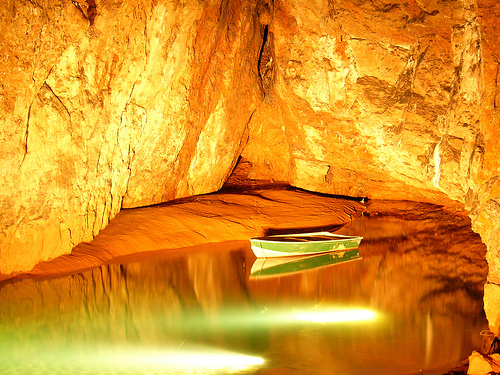
Location: Somerset Map
Human habitation: 50,000 years ago
Age of limestone: 400 million years
Known cave vandals: Alexander Pope
Wookey Hole Caves, located on the southern escarpment of the Mendip
Hills in Somerset, England (near the village of Wookey Hole, north of
Wells), form a major resurgence cave system for the River Axe. This site
stands out as one of Britain's premier examples of karst geology,
renowned for its deep phreatic development, multi-level passages
reflecting long-term base-level changes, and—uniquely—its development
across two distinct rock units: Carboniferous Limestone and overlying
Triassic Dolomitic Conglomerate.
The caves have been extensively
explored (over 4 km of passages mapped, with depths to ~90 m and a total
vertical range of ~150 m) and serve as a show cave in their outer
sections, while upstream reaches require cave diving through sumps. They
highlight classic karst processes in a dipping aquifer within the Mendip
karst system.
Regional Geological Context: The Mendip Hills
The Mendip
Hills originated during the Late Paleozoic. In the Lower
Carboniferous (~370–327 million years ago), warm tropical seas
(~20° south of the equator) deposited thick sequences of
limestone, including the Clifton Down Limestone Formation that
hosts much of the inner cave system. These beds were later
deformed during the Variscan (Hercynian) orogeny (~320–280 Ma),
when tectonic compression folded the strata into a series of
east-west anticlines and synclines. The Mendips became a
mountain range up to ~1,500 m high, with steep dips (often
30–45° south in the Wookey area) and abundant joints, faults,
and bedding planes that later guided groundwater flow.
By the
Triassic period (~252–201 Ma), erosion had reduced the landscape
to a desert-like environment with scree and fan deposits. These
filled valleys incised into the Carboniferous limestone, forming
the Dolomitic Conglomerate (formally part of the Mercia Mudstone
Group Marginal Facies)—a reddish-brown breccia of angular
limestone clasts in a calcareous silt matrix. This unit lies
unconformably on the older limestone and is crudely bedded and
horizontally oriented, in marked contrast to the steeply dipping
Carboniferous strata below.
Pleistocene climatic
fluctuations, including glacial meltwater pulses and base-level
lowering as rivers incised the surrounding lowlands, accelerated
karstification. The caves themselves began forming around 1
million years ago or earlier, though dissolution along joints
likely started much sooner.
Local Stratigraphy and the
Key Unconformity
Wookey Hole is exceptional because the cave
transitions between two aquifers within a single karst system:
Inner sections (beyond ~Chamber 9): Developed primarily in
the steeply dipping (30–45° south) Clifton Down Limestone
Formation (Carboniferous). Water flows downdip along bedding
planes before rising up enlarged joints, producing deep phreatic
loops.
Outer sections (show cave and entrance): Formed in the
Triassic Dolomitic Conglomerate, a well-cemented
"puddingstone"-like fossil scree up to ~100 m thick that infills
an ancient Triassic valley. The current resurgence sits near the
base of this unit at the head of a short gorge created by
headward erosion and cavern collapse.
The angular
unconformity between these units is spectacularly exposed in
places like Chamber 20 (and in the access tunnel linking it to
the show cave). Here, horizontally bedded conglomerate overlies
the inclined limestone, with large clasts visible in the roof
and walls.
Speleogenesis: How the Caves Formed
Wookey
Hole is a solutional (karst) cave formed primarily by chemical
dissolution. Rainwater absorbs CO2 from the atmosphere and soil,
forming weak carbonic acid (H2CO3) that dissolves calcium
carbonate in the limestone and conglomerate:
CaCO3 + H2CO3 →
Ca²⁺ + 2HCO3⁻
This process occurs slowly but relentlessly
over geological time. Most development happened under phreatic
conditions (fully water-filled passages below the water table),
though vadose (air-filled) modification and incision occurred as
base levels dropped.
Key controls and stages:
Structural guidance: Joints, faults, and bedding planes
(especially in the dipping limestone) directed flow. Fractures
aligned NW-SE also influenced rifts in the conglomerate.
Phreatic loops: In the limestone, the stream follows deep loops
(up to 90 m) along bedding before rising via joints. In the
conglomerate, passages form shallower loops linking low
bedding-plane chambers or tall, narrow "rifts" enlarged from
vertical fractures.
Base-level changes: Successive lowering
of the regional water table (tied to Pleistocene surface
lowering south of the Mendips) created abandoned higher-level
passages and multiple relict resurgences. Chamber 20 passages,
for example, represent a former Vauclusian (rising) spring that
may once surfaced in Ebbor Gorge.
Mechanical erosion:
Floodwaters carrying sediment abraded passages (e.g., whirlpool
scour in chambers), especially important in the less soluble
conglomerate matrix.
Multi-phase history: Active streamway,
fossil passages at several levels (~80 m, 72 m, 65 m OD down to
the present ~60 m), and speleothems/sediments record these
changes.
The entire system integrates with upstream
swallet caves (e.g., Swildon's Hole, St Cuthbert's Swallet,
Eastwater Cavern) on the Mendip plateau.
Hydrology and
Catchment
The River Axe resurges here as the second-largest
Mendip spring (after Cheddar Rising), with a catchment of ~46
km² and mean discharge of ~789 liters/second. About 95% is
autogenic (direct percolation through limestone); the rest is
allogenic (surface streams sinking at swallets on the limestone
boundary, e.g., Plantation Swallet). Water temperature remains a
constant 11°C year-round.
Exploration has revealed a series
of phreatic loops and sumps (some >60 m deep), with the furthest
reaches choked by gravel ~1,000 m northeast of the entrance. The
streamway is mostly level in the outer conglomerate but descends
in major loops upstream.
Notable Geological Features and
Morphology
Passage contrasts: Outer (conglomerate) — shallow,
bedding-controlled chambers and rifts. Inner (limestone) — deep
elliptical tubes, scallops indicating paleoflow, and vadose
canyons where loops were incised.
Chamber 20 (SSSI
highlight): Exposes the unconformity; features spectacular
fluting/rillenkarst (dissolution flutes from condensation
corrosion and dripwater), phreatic scalloping (for paleoflow
analysis), condensation corrosion dimples, cave sediments
(fining-upward flood deposits with surge marks), and sparse
Holocene speleothems (stalactites, flowstone gours). A 60 m-deep
phreatic loop is evident here.
Speleothems: Stalactites,
stalagmites, columns, and flowstone (e.g., the famous "Witch of
Wookey" stalagmite). Some older phases were undermined by
subsidence.
Other relicts: Small phreatic remnants in the
conglomerate (e.g., Hyaena Den, Rhinoceros Hole) contain rich
Pleistocene faunas and artifacts, dating back ~100,000+ years.
Scientific Significance
Wookey Hole is designated a Site
of Special Scientific Interest (SSSI) and forms part of the
Mendip Caves SAC. It provides the finest British example of deep
phreatic cave development in steeply dipping limestone,
demonstrates contrasting karst controls in two aquifers
separated by an unconformity, and preserves a record of
landscape evolution through its fossil passages, sediments, and
speleothems. Studies here have advanced understanding of Mendip
karst hydrology and Pleistocene geomorphology.
Geological Formation
The caves originated as a solutional (karst)
system where slightly acidic rainwater percolated through the porous
sedimentary rock of the Mendip Hills—primarily Triassic Dolomitic
Conglomerate (a fossil-rich “puddingstone” limestone scree) that
transitions deeper into Carboniferous Limestone. Over eons, this
dissolved the rock under phreatic (below the water table) conditions,
creating looping passages, chambers, stalactites, stalagmites, and a
subterranean river. The River Axe drains a 46 km² catchment, with most
water autogenic (from direct percolation) and a small allogenic
component from surface sinks. The system maintains a constant ~11°C
temperature year-round. Abandoned higher-level passages and resurgences
(including a possible former Vauclusian spring) indicate shifting water
tables over geological time.
Prehistoric and Ancient Human
Occupation (~50,000+ years ago to Roman era)
Humans (and earlier
hominins) have used the caves for shelter, burial, and ritual for over
45,000–50,000 years, drawn by dry spaces, natural defenses, and stable
temperatures.
Paleolithic era: Lower Palaeolithic evidence includes a
handaxe flake in Badger Hole. Middle Palaeolithic (~57,000–29,000 years
ago) Neanderthal occupation appears in Hyena Den with tools and an
incised red deer tooth dated ~45,626–43,188 BP. Early Upper Palaeolithic
(Aurignacian, ~36,578–34,964 cal BP) and Late Upper Palaeolithic
(Magdalenian/Creswellian) artifacts, including bone projectile points,
were found. Mesolithic human remains (~8000–8500 BC) and Neolithic stone
tools also exist. Cave hyenas (now extinct) shared the space
~35,000–25,000 BCE, leaving fossil accumulations of Pleistocene
megafauna (cave lions, bears, mammoths, rhinoceros, etc.) from when they
drove prey over cliffs.
Iron Age and Roman periods: Celtic farmers
occupied the entrance area ~2,600 years ago (c. 600 BCE onward) for
~600+ years, using animal-fat lamps to explore deeper. They used a deep
chamber as a burial ground (common in Somerset). Iron Age occupation
dates to ~250–300 BC. Romans arrived ~2,000 years ago, building roads,
mining lead in the Mendips (with local cooperation), and treating the
external spring as sacred. A 1st-century hut outside the entrance
evolved into settlement through the late 4th century. Chamber 4 served
as a Romano-British cemetery (2nd–4th centuries AD). Artifacts include
pottery, weapons, ornaments, coins, and a 2020 flood-revealed mass of
human bones (Iron Age to Roman). Lead mining from Roman times later
contaminated the river, affecting downstream paper quality.
These
finds make Wookey one of the longest continuously recorded human
habitation sites in Britain.
Medieval Period and the Legend of
the Witch of Wookey Hole
By the Middle Ages, the caves held mythic
status. William of Worcester visited in 1480 (or 1470), describing a
rock formation near the entrance as the “Porter” and a stalagmite as a
“woman clothed and spinning with a distaff.” Geoffrey of Monmouth called
it one of Britain’s four wonders in the 1130s. A natural well inside was
considered holy.
The famous Witch of Wookey Hole legend emerged in
the early modern period (first clear reference 1628; detailed versions
by mid-18th century), though rooted in medieval folklore. Locals blamed
a malevolent witch living in the caves for blighting crops, sickening
cattle, and causing disappearances. They appealed to Glastonbury Abbey.
Monk Father Barnard (or a similar figure) entered, confronted her curse
with divine protection, blessed River Axe water, sprinkled it while
making the sign of the cross and reciting the Lord’s Prayer. She
screamed, turned to stone—now the famous “Witch Stone,” a stalagmite in
the first chamber (Witch’s Kitchen or Parlour). Variations exist, but
all end with her petrification freeing the land.
In 1912,
archaeologist Herbert E. Balch found an ~11th-century skeleton (male,
25–35 years old) with goat bones and a dagger; it was long displayed as
“the Witch” at Wells and Mendip Museum (though forensic analysis
disproved the female-witch link). “Witch marks” (protective symbols like
W/M for Virgo Virginum) in Chamber 3 date to 1550–1750, reflecting
European witch-hunt fears. The legend likely evolved from a medieval
“spinning woman” stalagmite amid shifting views of magic as satanic.
Early Modern Mentions and Industrial Use (17th–19th centuries)
The caves were known as “Okey Hole,” “Ochies Hole,” or similar by the
17th–18th centuries (possibly from Celtic ogof for cave or Old English
wocig for snare). Geologist John Beaumont first described them in print
in 1681. By the 18th century, they hosted parties and dances (wine
bottles found in excavations); stalactites/stalagmites were sometimes
removed as souvenirs (a spurious tale links one to Alexander Pope’s
grotto).
A corn-grinding mill existed on the River Axe by the
Domesday Book (1086). It became a handmade paper mill around 1610—the
oldest extant in Britain. The current Grade II-listed building dates to
~1860. The river powered production, but lead contamination sometimes
ruined paper quality. Milling remained the primary business into the
early 20th century.
Scientific Exploration, Archaeology, and
Public Opening (Late 19th–Early 20th centuries)
William Boyd Dawkins
excavated Hyena Den in 1859–1874, yielding the first Mendip Palaeolithic
evidence. Herbert E. Balch’s work (1904–1914, with later digs)
transformed understanding: he excavated the entrance, Witch’s Kitchen,
Hell’s Ladder, and Badger Hole, uncovering vast prehistoric and Roman
artifacts. His detailed monographs remain foundational.
Owner Captain
G.W. Hodgkinson (whose family held the land for centuries) opened the
caves as a show cave in 1927 after Balch’s preparatory work, initially
accessing three chambers. This shifted focus from milling to tourism,
though not without controversy (e.g., a 1930s libel suit against
novelist John Cowper Powys).
Cave Diving Pioneering
(1930s–Present)
Wookey Hole is the cradle of British cave diving. In
the 1930s, Jack Sheppard, Graham Balcombe, and Penelope “Mossy” Powell
conducted the first dives using heavy standard dress equipment. On 14
July 1935, Balcombe and Powell reached Chamber 7 (52m depth) from
Chamber 3—the first successful cave dive in Britain. The Cave Diving
Group (founded 1946) advanced techniques here with homemade gear,
aqualungs, and rebreathers. Milestones include:
1948: Ninth
chamber reached.
1955: Bob Davies’ aqualung breakthrough (Chambers
12–13).
1966–1977: Further chambers and depth records (up to 45m+).
Later dives (1985–2005) reached 90m (British Isles record by John
Volanthen and Rick Stanton).
Tunnels added in 1974–75 and 2015 for
access; a 2020 flood revealed more bones.
Tragedies occurred
(e.g., fatalities in 1949 and 1981), but the site drove equipment and
safety innovations.
Modern Tourism and Legacy (Mid-20th
century–Present)
The Hodgkinsons managed until selling to Madame
Tussauds in 1973; later ownership included a 1989 management buyout and
circus owner Gerry Cottle. The paper mill ceased production in 2008.
Today, visitors tour eight chambers via safe walkways and tunnels (no
more river wading). The site includes a museum on prehistory, cave
diving, and papermaking; cheese maturation in the constant-temperature
caves; and attractions like a circus school and theatre. It has featured
in TV (Doctor Who, Most Haunted) and films. The caves remain a Site of
Special Scientific Interest, with ongoing exploration and conservation.
As an SSSI, Wookey Hole supports unique biodiversity. The caves’
stable climate fosters rare fungi and bacteria, while bats,
including lesser horseshoe and greater horseshoe species, roost
in quieter chambers. The River Axe sustains aquatic life like
freshwater shrimp and small fish, adapted to low light.
Fossilized remains of prehistoric fauna—mammoths, hyenas, and
lions—highlight the caves’ role as an Ice Age habitat, with some
bones displayed in the onsite museum.
Above ground, the
site’s ravine and woodlands harbor birds like buzzards and
plants like wild thyme, though the focus remains underground,
where conservation ensures minimal disturbance to delicate
ecosystems.
Planning Your Visit: Tickets, Times, and Booking
Tickets: One
ticket covers the caves plus all attractions (Dinosaur Valley,
adventure golf, soft play, 4D cinema, museum, penny arcade,
mirror maze, etc.).
Current pricing (as of recent data; check
the official site for updates): Value tickets (Mon-Fri outside
peak) start around £21–£25 for adults, £17–£20 for children
(3–15); standard/peak (weekends, holidays) are higher (~£25–£29
adults, ~£20 children). Under-3s free. Seniors get discounts.
Book online in advance for 15% off (by midnight the day before).
Carer tickets are free with proof (Blue Badge, DLA, etc.). Other
discounts include services (NHS, teachers, etc.) and Blue Peter
badges. Tesco vouchers may apply in some cases.
Opening
Times:
Peak (weekends, school holidays, Feb half-term,
Apr–Oct): First admission ~9:30am, last ~3:30pm, attractions
close ~5pm.
Off-peak (Mon–Fri outside holidays): First ~10am,
last ~3pm, close ~4:30pm.
Closed Christmas Day/Boxing Day;
limited winter hours. Check for special events (circus shows,
Halloween, Christmas).
Best Time: Weekdays (Mon–Thu) to
avoid crowds. Arrive early (opening or soon after) for shorter
queues, especially for caves. School holidays and weekends get
busy with queues outdoors (limited shelter). Allow ½ to full
day.
Pro Tip: Buy tickets online and arrive ready to head
straight to the caves (5–10 min uphill walk from main area). You
get re-entry stickers.
What to Expect in the Caves
The
main highlight is the ~35–40 minute tour through ~8 chambers.
Paths are safe with handrails but include ~200 steps, uneven/wet
surfaces, some low sections (duck ~1.3m), and damp air from the
River Axe. Temperature is a constant ~11°C (cool and clammy).
Guided vs. Self-Guided: Outside school holidays, fully
guided tours. During holidays, an intro guide then free-flow
with stationed staff for questions. Well-lit, with legends
(Witch story), geology, and history shared.
Highlights:
Stunning formations, underground river views, cheese aging
tunnel (Wookey Hole Cheddar), and the "Witch" stalagmite. Exit
into Dinosaur Valley (animatronic dinos).
Wild Wookey:
Separate extreme caving (climbing, crawling, abseiling) for
thrill-seekers (book extra).
Visitor Feedback: Many
praise the formations and stories; some note it's atmospheric
but can feel crowded or slippery. Great for kids but engaging
for all ages.
Practical Visitor Tips
Clothing &
Footwear: Wear sturdy, closed-toe shoes (no flip-flops, heels,
or bare feet)—paths are wet/uneven. Bring a light jacket/sweater
for the chill inside. Raincoat/suncream for outdoor queues.
Layers work well.
For Families/Kids: Carry small children or
use lightweight buggies (heavier ones stored; no buggies in
caves). Potty-trained kids: Use toilets before entering (no
facilities inside). Snacks for queues. Circus shows (peak times)
and soft play are big hits.
Health & Comfort: Claustrophobia
or mobility concerns? Caves have narrow/low spots—talk to staff
for support or skip (virtual tour available in the Mill). No
toilets mid-cave. Picnic areas available (food on-site is decent
but pricier).
Accessibility: Caves are not wheelchair
accessible due to steps/terrain (staff can move wheelchairs from
entrance to exit). Other areas mostly accessible with ramps/flat
surfaces. Blue Badge parking, accessible toilets, carer support.
Assistance dogs welcome (with ID/proof). Sensory/ASD
considerations noted on site.
Other: No dogs (except
assistance). Free large car park. Photography usually allowed
(check rules). Site can host weddings occasionally—confirm
dates.
Beyond the Caves: Other Attractions (All Included)
Dinosaur Valley & Grove (animatronics).
4D cinema, adventure
(pirate) golf, soft play, mirror maze, vintage penny arcade.
Museum (cave diving history, archaeology), paper mill demos.
Restaurant, ice cream parlour, picnic spots.
The Witch of Wookey Hole is one of England's most enduring pieces of
Somerset folklore, centered on a dramatic legend of witchcraft, curses,
and petrification in the limestone caves of Wookey Hole, near Wells in
Somerset. The story explains a distinctive stalagmite formation in the
first chamber of the caves, which strikingly resembles a hooded figure
in profile—complete with what looks like a bonnet, forehead, nose, and
chin—often called the "Witch Stone" or simply "the Witch." Nearby
smaller formations have been interpreted as her familiars (a dog, goat,
or kid). The tale blends medieval superstitions about witches, the power
of Christian faith, and the eerie natural geology of the caves, which
have been occupied since the Stone Age and feature underground rivers,
chambers, and dramatic rock formations.
The Most Common Version
of the Legend
According to the version promoted by the Wookey Hole
Caves site and widely repeated in folklore, the story dates back nearly
1,000 years (roughly medieval times). A woman made her home deep in the
caves, which locals viewed as a sinister place—possibly a gateway to
hell. She was accused of being a witch responsible for widespread
misfortune: cattle sickened and died, crops failed, milk spoiled, and
some people even vanished under mysterious circumstances. Villagers grew
terrified and blamed her malevolent magic.
In desperation, they
appealed to nearby Glastonbury Abbey for help. The Abbot dispatched a
monk named Father Barnard (sometimes just "a learned monk" or cleric
from Glastonbury), armed with holy objects like a chalice. He entered
the caves, confronted the witch at the entrance (or deeper in what is
now Chamber 1), and pursued her as she fled. She hurled curses at him,
but he was protected by faith. Scooping water from the River Axe (which
flows through the caves), he blessed it into holy water, recited prayers
(including the Pater Noster), and sprinkled it over her while making the
sign of the cross. She let out a blood-curdling scream, then fell
silent—and was instantly turned to stone. The monk returned victorious,
believing he had lifted the curse on the land. The petrified witch
remains in the cave to this day, "watching" over the river.
Cave
features are named in her honor: the Witch's Kitchen, her Parlour,
Hell's Ladder, and the Lake of Gloom, adding to the atmospheric
storytelling for visitors.
Variations and Backstories
The
legend has many retellings, reflecting oral tradition:
The Jilted
Lover Origin: In popular variants, the woman was once a beautiful young
villager in the Dark Ages or medieval period. Devoted to her lover, she
discovered him with another woman (or he abandoned her). Heartbroken,
she fled to the caves—said by some preachers to lead to hell—where she
turned to dark magic. She developed a bitter hatred for happy couples
and cursed romances in the area, dooming young lovers. One version ties
this directly to the monk: a young man from Glastonbury, engaged to a
Wookey girl, had his relationship ruined by her curse and became a monk
for revenge.
Familiars and Additional Details: She was sometimes
accompanied by a goat and kid (or a dog), whose stone forms are pointed
out nearby. In some tellings, she had nine wicked elves as guardians.
Pre-Christian or Self-Petrification Variant: An older or alternative
folktale (recorded in the early 19th century) describes an evil
sorceress living before Christ's birth. Omniscient and able to turn
anything she touched to stone (possibly aided by the Devil), she heard
of Christ's birth and, knowing witchcraft would end, sorrowfully
petrified her possessions (including dinner and a lion) before turning
herself to stone.
The 18th-Century Poem by Henry Harington: One of
the earliest detailed written accounts is the poem "The Witch of Wokey"
(also known as "Slander; or, the Witch of Wokey"), written around
1748/1755 by Dr. Henry Harington (a Bath physician) and published in the
Gentleman's Magazine. It presents her as a "base and wicked elf"—a
lonely, ugly old hag ("blear-eyed hag") who never found love in her
prime and thus cursed the area out of spite, blighting plants, flocks,
and "marr'd all goodly chear." A "lerned wight" (cleric) from
Glastonbury defeats her with holy water and prayers. The poem adds a
satirical twist: she leaves a curse that women of Wookey (and nearby
Wells) will remain unwed despite their beauty and wit, explaining a
supposed shortage of suitors and playfully urging men from Oxford to
come "revoke the spell." It was reprinted in anthologies and may have
been adapted to promote relocation to Wells.
Historical and
Archaeological Context
The caves themselves are ancient—used since
prehistoric times, with Roman artifacts and evidence of long human
activity. Early descriptions (e.g., by William of Worcester in 1480)
call the stalagmite a "figure of a woman, clad and holding a distaff"
(spinning), with no mention of witchcraft—just a neutral or pagan-like
wonder. The first clear reference to a "witch of Ochies Hole" appears in
1628. The full legend solidified in the 17th–18th centuries, coinciding
with peak European witch-hunt fears influenced by texts like the Malleus
Maleficarum. Protective "witch marks" (symbols like W or M, possibly
invoking Mary or Christ) were later found carved in the caves, dating to
1550–1750, showing real belief in warding off evil there.
In 1912,
archaeologist Herbert Balch excavated and found a medieval skeleton
(initially thought to be the witch's, along with goat remains and
artifacts like a bowl, dagger, and alabaster ball—now in Wells Museum).
Later analysis identified the skeleton as a 25–35-year-old male,
possibly a hermit. This adds a layer of possible real-life inspiration:
an outcast or folk practitioner living in the caves.
Modern
Legacy and Tourism
The legend endures as a tourist draw at Wookey
Hole Caves, where the stalagmite is a highlight of guided tours.
"Living" witch performances (with cackling storytellers) happen during
holidays. It symbolizes the clash between folk magic and Christian
authority, while evoking sympathy for misunderstood women or outcasts.
Some see the witch as having the "last laugh"—her story lives on far
more vividly than the monk's.