
Location: Dorset Map
Tel. 01929 481294
Open: daily
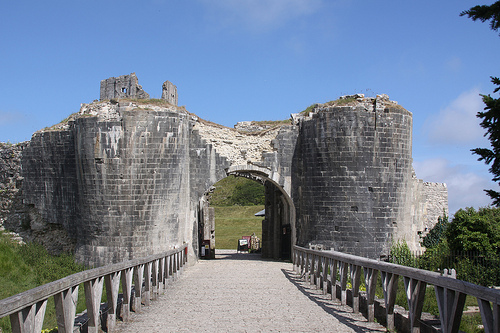
Corfe Castle, perched dramatically atop a steep hill in the Purbeck Hills of Dorset, England, is one of Britain’s most iconic ruined fortresses. It commands a natural gap (or “cutting”) in the chalk ridge—known in Old English as ceorfan, from which the name “Corfe” derives—overlooking the village below and controlling the historic route between Wareham and Swanage. Its ruins, built primarily of local Purbeck limestone, tell a story spanning over a millennium: from a possible Saxon royal residence, through Norman conquest and medieval royal power, to a dramatic fall in the English Civil War. Today, it is managed by the National Trust and draws hundreds of thousands of visitors annually as a scheduled ancient monument and Grade I listed building.
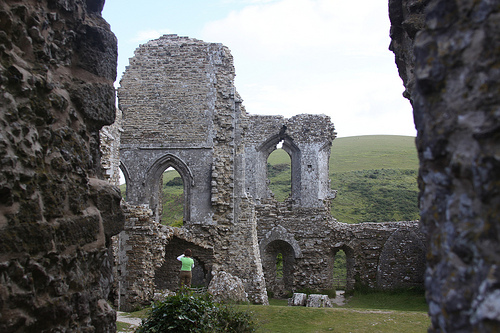
The name Corfe comes from the Anglo-Saxon and means the valley in which the village and the castle ruins are located. Translated, Corfe Castle roughly means valley castle or castle in the valley.
Saxon Origins and the Murder of a King (Pre-1066)
Long before the
Norman Conquest, the hill was a site of Anglo-Saxon activity.
Archaeological evidence, including postholes, points to a large wooden
hall or stronghold used by nobility. It was likely part of a royal
estate associated with Queen Ælfthryth (Elfrida), wife of King Edgar.
The most infamous event here occurred on 18 March 978. The young King
Edward the Martyr (then around 16) visited his half-brother Æthelred
(later “the Unready”) and stepmother Ælfthryth at the site. According to
legend and contemporary accounts, Edward was murdered—stabbed while
still on horseback—amid a plot to secure the throne for Æthelred. His
body was initially hidden but later moved; miracles were reported at his
tomb, leading to his canonisation as a saint (his feast day remains 18
March). A small section of herringbone masonry in the inner bailey may
be a remnant of Ælfthryth’s palace. This violent episode underscores the
site’s early strategic and political importance.
Norman
Construction: An Early Stone Fortress (1066–Early 12th Century)
Following William the Conqueror’s victory at Hastings in 1066, the
Normans rapidly built castles to secure their new kingdom. Corfe was
among the earliest—and unusually, one of the first constructed largely
in stone rather than the typical earth-and-timber motte-and-bailey
design. William established it shortly after the Conquest on the site of
the earlier Saxon structure, within the newly designated royal forest of
Purbeck (a favored hunting ground). The Domesday Book (1086) likely
references it indirectly as the “castle” built by the king in the manor
of Kingston (sometimes called Wareham Castle in records).
The initial
layout featured a stone wall enclosing the inner bailey (ward) at the
hilltop, with timber palisades around the western and southern outer
enclosures. The castle’s commanding position on a 55-metre (180 ft) hill
made it a formidable symbol of Norman power.
Under William’s son,
King Henry I (r. 1100–1135), construction advanced significantly. The
great rectangular stone keep (or Great Tower), measuring about 21 metres
(69 ft) tall and built of high-quality Purbeck limestone quarried
nearby, was completed around 1105 after roughly a decade of work
(progressing 3–4 metres per year). Its gleaming whitewashed appearance
(later ordered in the 13th century) would have been visible for miles,
impressing visitors and asserting royal authority.
Medieval
Heyday: Expansions, Sieges, and Royal Uses (12th–15th Centuries)
Corfe evolved into a major royal fortress, one of England’s key
strongholds. During “The Anarchy” (the civil war between King Stephen
and Empress Matilda, 1135–1154), it was held for Matilda by Baldwin de
Redvers. In 1139, Stephen besieged it unsuccessfully; earthworks known
as “The Rings,” about 290 metres south-southwest, survive as remnants of
his siege castle.
The castle reached its architectural peak under
King John (r. 1199–1216), who used it as a favorite residence, treasury
for southern England (storing crown jewels and valuables), and prison.
Massive spending—over £1,400 recorded in Pipe Rolls—funded extensive
fortifications between 1201–1214, including the outer bailey defenses,
the Gloriette (a luxurious royal apartment in the inner bailey), and
towers such as the Butavant Tower. Political prisoners included Eleanor,
Duchess of Brittany (a rival claimant, held until 1222), Scottish
princesses Margaret and Isabella, and others. John’s reign coincided
with unrest after the loss of Normandy and events leading to Magna Carta
(1215).
King Henry III (r. 1216–1272) continued investments, spending
over £1,000 (including £362 on the keep in 1235–36). He ordered the keep
whitewashed in 1244 (echoing the White Tower in London) and used the
castle for storing munitions, such as 15,000 crossbow bolts dispatched
in 1224. The south-west gatehouse and other high-quality masonry date to
the mid-13th century. A workers’ camp outside the walls grew into the
village of Corfe, granted a market in 1247.
Later medieval kings
maintained it as a royal residence and prison (e.g., Michael de la Pole,
Earl of Suffolk, in 1386). It featured in Wars of the Roses events,
including ransacking in 1450 and troop movements in 1460. The layout
solidified into a roughly triangular plan with the inner ward (keep and
Gloriette), west bailey (with towers), and outer bailey.
Tudor
Transition to Private Ownership (16th–Early 17th Centuries)
By the
Tudor period, the castle’s military role had diminished. In 1572, Queen
Elizabeth I sold it to her Lord Chancellor, Sir Christopher Hatton, for
£4,761—ending nearly 500 years of direct Crown control. Hatton’s
steward, Ralph Treswell, created detailed plans (1585–86), the oldest
surviving surveys. These show further defensive updates, possibly in
anticipation of the Spanish Armada. In 1635, Sir John Bankes, Attorney
General (later Lord Chief Justice) to Charles I, purchased it as a
family home.
The English Civil War and Dramatic Fall (1642–1646)
Corfe’s most famous chapter unfolded during the English Civil War. Loyal
to the Royalist cause, it became one of the last southern strongholds
for King Charles I. Sir John Bankes was away serving the king in Oxford
and London, leaving his wife, Lady Mary Bankes (“Brave Dame Mary”), in
charge with their children and a tiny garrison.
First Siege (1643):
Around 500–600 Parliamentarians under Sir Walter Erle attempted to
capture it. Lady Bankes, initially defended by just five men (later
reinforced to about 80 with local supporters), famously repelled
attacks. Defenders hurled stones and hot embers from the battlements,
inflicting heavy casualties (~100 Parliamentarian dead/wounded) while
suffering only two losses themselves. The six-week siege ended when
Royalist forces relieved the castle.
Second Siege (1645–February
1646): By now, Corfe was isolated. Parliamentarian forces under Colonel
John Bingham laid siege again. It fell not through assault but betrayal:
Lieutenant-Colonel Pitman (a garrison officer) allowed disguised
Parliamentarian troops inside. The defenders surrendered honorably. In
March 1646, Parliament ordered its “slighting”—deliberate demolition to
prevent future use. Sappers mined the walls and used gunpowder
explosives (led by figures like Captain Hughes). The structure’s
exceptional strength meant substantial ruins survived, with stones later
reused in local buildings.
Aftermath: Ruins, Romanticism, and
Preservation (17th Century–Present)
The Bankes family regained the
estate after the 1660 Restoration but never rebuilt, preferring their
new home at Kingston Lacy. The ruins became a romantic landmark admired
by artists and writers (including inspiration for Enid Blyton’s Famous
Five). Ralph Bankes bequeathed the entire estate—including Corfe
Castle—to the National Trust in 1981 (upon his death in 1982). Extensive
excavations (1986–1997) and conservation work have followed, including
reopening the keep with viewing platforms in recent years.
Today, the
shattered towers and walls—leaning dramatically due to the 1646
explosions—evoke its turbulent past. The keep, outer curtain walls,
gatehouses, and bailey enclosures remain visible, offering panoramic
views. Archaeological finds continue to refine our understanding of its
phases.
Corfe Castle is a ruined medieval fortress in Dorset, England,
perched dramatically atop a steep natural mound (about 55 m / 180 ft
high) in a gap in the Purbeck Hills. It commands the strategic route
between Wareham and Swanage and overlooks the village below. Built
primarily of local Purbeck limestone (a durable, pale grey stone
quarried nearby that weathers well but was easy to shape), the castle is
one of England’s earliest examples of stone construction post-Norman
Conquest (most contemporaries used earth and timber).
The ruins today
preserve a complex, multi-phase layout shaped by defensive needs and
royal patronage from the late 11th to 13th centuries. The site forms an
elongated triangle divided into three main enclosures (baileys or wards)
at successively higher levels, each ringed by stone walls. A deep
artificial ditch (added c. 1207 under King John) separates the lower
areas from the higher ones. The castle was slighted (partially
demolished) by Parliamentarian forces in 1646 during the English Civil
War, leaving jagged walls, collapsed towers, and open interiors.
Construction Phases
11th century (Norman foundation, William the
Conqueror / Henry I): Earliest stone phase (c. 1080s–1105). A stone wall
enclosed the hilltop inner ward; outer areas initially had timber
palisades. The massive keep was built c. 1105 (completed for Henry I),
one of the earliest great stone towers in England. Early work
incorporated herringbone masonry (Anglo-Saxon style) in some walls and
halls, suggesting local masons.
Early 13th century (King John,
1201–1215): Major refortification amid political turmoil. £750+ spent on
the Gloriette (royal quarters), west bailey walls/towers, and outer
defenses. Deep ditch dug; bailey walls rebuilt in high-quality masonry.
Mid-13th century (Henry III, c. 1235–1280s): Further expansions—keep
repairs/whitewashing (1244), outer bailey towers/gatehouse, and SW
gatehouse. Over £1,000 invested for strength and royal comfort.
Later
minor works (14th century onward) added or repaired elements, but the
core medieval form remained until the 1646 slighting.
Key
Architectural Features by Area
1. Inner Ward (Highest Summit
Enclosure)
This pear-shaped inner bailey (under ¾ acre) is the oldest
and most fortified core, enclosed by a thick (7½–9½ ft / 2.3–2.9 m)
11th-century curtain wall of roughly squared rubble with sea-worn
boulders (some sections later refaced in fine ashlar). The wall stands
up to 28 ft high in places.
The Keep (Great Tower / King’s Tower,
c. 1105): Central commanding feature, rectangular (43 ft × 48 ft / 13 m
× 14.6 m), rising ~21 m (69 ft) originally. Built of wide-jointed,
well-wrought Purbeck limestone ashlar. It has thick walls, a basement
(no external openings), principal floor, first floor (with chapel
access), and upper levels (later remodelled). Features include:
West
forebuilding (added soon after): Solid base with external stair landing,
semicircular-arched entrance, and integrated stair to upper floors.
South annexe: Two-storey extension with garderobes (latrines with
chutes), guardroom, barrel-vaulted passage, and chapel (dedicated to St
Mary; elaborate semicircular doorway with billet ornament, voluted
capitals, and chip-carved details).
Windows/doors: Original
round-headed openings; some later square-headed insertions (c. 1500).
Floor joist housings and offsets show multi-level timber flooring and
benches.
Defensive/high-status elements: “Appearance door” (for royal
appearances), whitewashed exterior under Henry III, and internal
cross-walls.
A detailed 1586 survey plan (Ralph Treswell) shows
the inner ward layout with the keep, Gloriette, and associated
buildings:
archaeologynationaltrustsw.wordpress.comWest Bailey Corfe
Day 4 Into the Garden | Archaeology National Trust SW
Gloriette
(c. 1202–1215 under King John): Luxurious royal residence in the inner
ward (ruins survive northeast of the keep). Included great hall,
chambers, kitchen, queen’s tower, vaults, and a well. It featured
high-status details like large windows and was the focus of John’s
lavish spending.
2. West Bailey
Higher northwestern enclosure
(separated by ditch from outer bailey). Surrounded by early 13th-century
stone walls with three towers:
North Tower, South Tower, Butavant
Tower (c. 1202–1204): Semi-circular or polygonal, open-backed in places,
with loops/embrasures for archery. Butavant Tower at the acute western
tip.
Contains foundations of the “Old Hall” (late 11th century, later
enlarged).
3. Outer Bailey (Largest Southern Enclosure)
Broad,
gently sloping southern area (~two-thirds of the site). Enclosed by
curtain walls (mixed 12th–13th century rubble with ashlar facing,
battered plinths for stability on slopes) and multiple towers. Key
defenses:
Outer Gatehouse (c. 1280): South entrance with twin
round-fronted towers, recessed segmental-arched gateway, portcullis,
machicolation slot, and guardrooms (one with fireplace). Flanked by a
defended passage.
Horseshoe Tower (c. 1280): Semicircular projection
with three narrow loops (for archery), chamfered corbelling, and
wall-walk.
Plukenet Tower (c. 1270): Half-cylindrical, with
shield-of-arms carving (Alan de Plukenet) and loops.
Other towers (c.
1215–1250): Rounded/angular, with embrasures (segmental heads, splayed
for bowmen), some undermined or slipped due to terrain.
South-West
Gatehouse (mid-13th century): Access to west bailey; tall but now split,
with high-quality masonry and stairs.
Defensive elements
throughout include arrow loops, posterns (side gates), battered plinths,
wall-walks with corbelled parapets, and natural steep slopes augmented
by the ditch and bridges.
Materials and Techniques
Primary:
Purbeck limestone ashlar (facing) over rubble core (often with flint).
Early walls used large coursed rubble; later work featured finer jointed
ashlar, galleting (stone chips in mortar), and chamfered details.
Techniques: Herringbone in earliest phases; barrel vaults, segmental
arches, and offsets for stability on the uneven mound. Many walls have
smooth battered (sloping) plinths and vertical bases for added strength.
The castle combined military strength (towers, ditches, loops
commanding approaches) with high-status royal accommodation (Gloriette,
keep apartments with chapel and garderobes). Today, visitors explore the
ruins via paths through the outer bailey up to the keep platform, with
panoramic views. The National Trust manages the site, and recent
conservation (e.g., 2024 viewing platform in the keep) has improved
access while preserving the dramatic, ivy-clad stonework.
Best Time to Visit
Seasonally: June or September strikes the ideal
balance—milder crowds than peak summer school holidays, easier parking,
and pleasant weather. Summer (July–August) is busiest and warmest (up to
26°C possible), while winter brings bracing winds, shorter days (site
closes earlier), and potential closures in bad weather, but offers
atmospheric, quieter visits (e.g., frosty mornings or sunsets).
Time
of Day: Arrive early (opens ~10am) to beat crowds and secure parking, or
visit in the afternoon when it quiets down. Check for special events
like medieval reenactments, music, or family activities (e.g., early May
bank holiday).
Weather Note: The hilltop is exposed—bring layers,
windproof jacket, sturdy shoes, and sun protection regardless of
forecasts.
Tickets and Opening Hours (2026)
Open daily except
25–26 December (and occasionally 7 March). Typical hours: 10am–4/5pm or
later in peak summer; last entry ~30–60 minutes before closing. Castle
View Welcome Centre, tea-room, and shop have slightly extended hours.
2026 Prices (vary by peak/off-peak; Gift Aid optional):
Adult:
£16–17.60
Child (5–17): £8–8.80 (under 5s free)
Families and
groups available; National Trust members enter free.
Buy tickets
on-site (no advance booking usually needed). Check the National Trust
website for exact dates/hours.
Getting There
By Car (most
common): Via A351 (Wareham–Swanage). Use postcode BH20 5DR (Castle View
car park) or BH20 5EZ.
National Trust Castle View Car Park (main
option): Opposite the castle mound, free for members, pay for others.
~10-minute (steep) walk uphill to the entrance. 90 spaces, 4 disabled
bays, 4 EV chargers (bring your own cable). Fills quickly in peak times.
Alternatives: West Street pay-and-display (larger, ~£3+ for a few hours)
or Purbeck Park/Norden (then steam train option).
Public
Transport: Train to Wareham, then Purbeck Breezer bus #40 (~15 mins). Or
Swanage Railway steam/diesel train direct to Corfe Castle station
(scenic and family-friendly; check timetable). Buses from Poole/Swanage
(#40 or #30). Sandbanks chain ferry from Poole/Bournemouth area.
Cycling/Walking: Sustrans Route 2 or Purbeck Way trails. Cycle racks
available.
What to Expect and Do on Site
The Ruins: Allow
45–90+ minutes. Steep climb up the hill, then explore the outer bailey,
inner wards, keep, and towers. Informative boards, an engaging audio
tour (via phone, following characters from history), and panoramic views
over Purbeck Hills, village, and countryside. Great for photos and
imagination (kids love the "castle" feel).
Village Exploration:
Wander the charming streets with thatched Purbeck stone cottages,
church, museum (small local history), model village (fun 1/20th scale
replica, ~£5 adults), shops, and pubs. Very compact—easy to combine with
the castle.
Facilities: NT tea-room (18th-century cottage with garden
and castle views; cream teas, hot/cold food), shop (gifts, local
produce), toilets (including Changing Places), picnic areas. Dogs
welcome on short leads.
Practical Tips
Parking & Crowds: Peak
summer = arrive early or use alternatives/park-and-ride + train. Display
ticket clearly; many use number-plate systems.
Fitness &
Accessibility: Steep slopes, steps, and uneven paths—wear good footwear.
Not fully wheelchair-friendly on the ruins (mobility scooter available
for lower areas on first-come basis; weather-dependent). Walking poles
to hire, access guides/maps, audio/BSL info, ear defenders, and visual
storyboards available. Contact ahead for needs.
With Kids: Highly
family-friendly—events, open spaces, model village, and adventure
nearby. Under-5s free.
Food & Drink: NT tea-room (views but can be
pricey), village options like The Greyhound Inn (fish & chips, popular),
The Fox Inn (historic, roasts), cafés, bakery. Picnic recommended.
Nearby Attractions (easy day extensions): Swanage Railway, Old Harry
Rocks, Durdle Door/Lulworth Cove (Jurassic Coast), Purbeck
walks/ridgeway trails, Dorset Adventure Park. Combine with a coastal
hike.
Pro Tips:
Download maps/audio tours in advance.
Bring
binoculars for views and wildlife.
For photography: Golden hour
(sunrise/sunset) transforms the ruins.
Stay longer: Overnight in the
village (e.g., Mortons House Hotel or cottages) for a magical evening
atmosphere without day-trippers.
Key Historical Context Fueling the Legends
In 978 AD, young King
Edward the Martyr was murdered at or near the site (then a Saxon
stronghold) — allegedly stabbed on the orders of his stepmother,
Ælfthryth, to secure the throne for her son Æthelred the Unready.
King John (r. 1199–1216) used it as a prison and luxury residence; he
reportedly starved prisoners, including members of the de Braose family.
During the English Civil War (1640s), Lady Mary Bankes (“Brave Dame
Mary”) heroically defended the Royalist-held castle through two sieges
before betrayal led to its fall to Parliamentarian forces in 1646.
Oliver Cromwell’s men then systematically demolished it, leaving the
iconic ruins seen today.
Main Hauntings and Legends
The
Headless (or White) Lady / Lady in White
This is the castle’s most
famous spectre. She appears as a woman in a long white dress, often
described as headless or with her head bowed, gliding along the
battlements, walls, gatehouse, or down toward the stream at the base of
the hill. Many link her to Lady Mary Bankes, who defended the castle but
saw it betrayed and destroyed; she reportedly haunts the site she fought
so fiercely to protect. Sightings occur by visitors and staff, sometimes
on special occasions, where she walks through walls or up non-existent
staircases before fading away. Her presence is said to chill the blood
of witnesses.
Weeping or Starved Child
People report hearing
the heartbreaking sobs or cries of a child coming from a cottage
abutting the castle or within the grounds — with no living child
present. This is often attributed to the young son (or sometimes wife
and child) of William de Braose (4th Lord of Bramber), who fell out with
King John. The family was imprisoned at Corfe, where the child and
mother were allegedly starved to death around 1210.
Strange
Flickering Lights
Mysterious lights (sometimes compared to
Will-o’-the-wisps) move around the ramparts and grounds at night.
Explanations include spirits of fallen soldiers from the Civil War
sieges (Royalists or Parliamentarians) or something older.
Other
Apparitions
A Roundhead soldier (Parliamentarian) has been spotted in
the National Trust tearooms and stockroom near the main gate.
Sounds
of dying men (possibly the 22 French prisoners King John allegedly left
to starve) have been reported from the dungeons.
Phantom Roman
soldiers or an “Army of Purbeck” marching along tracks near the castle
(tied to earlier Roman/Celtic activity in the area).
Some tie Edward
the Martyr’s violent death to residual hauntings, though his primary
ghost lore is associated with his journey to burial in Shaftesbury.
Atmosphere and Modern Interest
The castle’s jagged ruins, perched
on a steep hill and often shrouded in mist, create a naturally eerie
setting that amplifies these tales. It frequently ranks among the UK’s
spookiest locations, attracting ghost hunters. Note that it is not open
after dark to the public, so most sightings occur during daytime visits
or from the village.