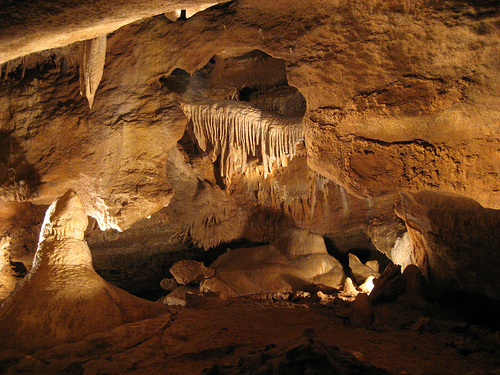
Location: Koněpruské jeskyně Koněprusy
Open: 8am- 4pm Apr-
June
8am- 5pm July- Aug
8am- 4pm Sept
8:30am- 3pm Oct
Closed: Nov- March
Tel. (311) 622- 405
The Koněprusy Caves (Czech: Koněpruské jeskyně), also known as
the Zlatý kůň (Golden Horse) Caves, form the largest and most
significant cave system in Bohemia (the western part of the Czech
Republic). Located in the protected Bohemian Karst (Český kras)
landscape of the Central Bohemian Region, they lie near the village
of Koněprusy, about 25–30 km southwest of Prague and 6–7 km south of
Beroun, close to historic castles like Karlštejn and Křivoklát.
The caves sit inside Zlatý kůň Hill (adjacent to Kobyla Hill), part
of a dramatic karst terrain of cliffs, canyons, and precipices. They
were carved from 400-million-year-old Devonian limestone in a
globally notable Lower Devonian cliff formation. The system spans
roughly 2 km in total length with a 70 m vertical range across three
distinct levels (lower, middle, and upper), connected by passages,
domed chambers, and shafts. Only about 620 m of the middle and upper
levels are accessible to the public via guided tours.
Koněprusy Caves (Koněpruské jeskyně), also known as Zlatý kůň (Golden
Horse), form the largest cave system in Bohemia (Czech Republic),
located in the Bohemian Karst (Český kras) protected landscape area near
the village of Koněprusy, about 25 km southwest of Prague.
The caves
lie within the hill of Zlatý kůň and extend over approximately 2 km in
length with a vertical range (denivelation) of about 70 m. They consist
of three main levels (upper, middle, and lower) featuring passages,
domed chambers, and interconnecting shafts. A public tour covers about
620 m through the middle and upper levels.
Host Rock and Regional
Geological Setting
The caves developed in Devonian-age limestone,
roughly 400 million years old, part of the famous Lower Devonian cliff
or reef complex in the Bohemian Massif.
This limestone belongs to
formations such as the Königsberg and Suchomast limestones (or similar
stratigraphic units in the Prague Basin). The rock is primarily
calcite-rich, often crinoidal (rich in fossil fragments of crinoids/sea
lilies), and highly fossiliferous, containing abundant trilobites and
other marine fossils from the Devonian period when the area was a
shallow tropical sea.
The Bohemian Karst features Silurian-Devonian
carbonate rocks forming the core of a synclinal structure in the Prague
Basin, part of the broader Bohemian Massif. These rocks underwent
significant tectonic deformation during the Variscan orogeny and later
events. The Koněprusy area exemplifies a classic karst landscape
developed on soluble carbonates.
Karst Development and Cave
Formation
The caves reflect polycyclic (multi-phase) karst evolution
tied to the complex geological history of the Bohemian Massif, including
periods of emergence, subsidence, marine transgression, and tectonic
activity.
Primary formation: Dissolution by groundwater, likely
involving both meteoric (rain-derived) and possibly hydrothermal or
confined aquifer processes. Research by Pavel Bosák and others describes
a paleohydrologic model with phreatic and batyphreatic (deep phreatic)
conditions, including upwelling groundwater. Hydrothermal paleokarst
features have been identified.
Timing: Evidence of karstification
dates back to the Jurassic (before the Cretaceous sea), but major cave
development occurred later, with significant activity in the Tertiary
(tens of millions of years ago). A small stream and percolating
rainwater played key roles in shaping passages, especially toward the
end of the Tertiary. Multiple generations of speleothems and collapse
structures indicate repeated cycles of formation, infilling, erosion,
and reactivation.
Morphology: Three-tiered system with passages and
chambers formed along fractures and bedding planes. Collapse structures
are prominent (studied in detail as part of the region's karst
evolution). The system shows vadose (unsaturated zone) and phreatic
(saturated zone) features.
The caves were accidentally discovered in
1950 during limestone quarrying and opened to the public in 1959.
Speleothems and Mineralogy
The caves host one of the most
complete series of karst decorations in the Bohemian Karst.
Common
formations: Stalactites, stalagmites, columns, flowstones, and sinter
lakes (e.g., Jezírko lásky / Little Lake of Love in the Prošek Chamber).
Unique "Koněprusy Roses" (or rosettes): These are distinctive bulbous or
concentric calcite speleothems resembling rose blooms or opal-like
structures. They form through gradual precipitation of calcium carbonate
on underground lake walls or similar settings. While some appear
opal-bearing (especially older generations with silica), many are
primarily calcite; they are rare and considered unparalleled in Europe.
Other minerals: Multi-generation gypsum crusts and crystals, aragonite,
apatite coatings on speleothems, and opal in older decorations
(sometimes with gypsum and aragonite). Gothic arch calcite (a specific
variety) has also been noted.
These reflect varying geochemical
conditions over time, including shifts in water chemistry and possible
microbial influences.
Paleontology and Quaternary Deposits
The
caves serve as an important archive of Pleistocene (Ice Age) history.
Fauna: Thousands of bones from ~200,000–300,000 years ago, including
mastodons, sabre-toothed cats, monkeys, cave bears, deer, reindeer, cave
lions, woolly rhinos, wolves, beavers, hyenas, and horses. Smaller
vertebrate remains date to ~1.5 million years ago in places like the
Prošek Dome.
Human presence: Upper Paleolithic (Magdalenian) remains,
including the famous Zlatý kůň woman (~40,000–45,000 years old, with
genome data), stone tools, and decorative objects.
These deposits
accumulated through natural traps, animal use of the caves, and human
activity.
Broader Context and Significance
The Koněprusy Caves
exemplify polygenetic karst in a tectonically stable but historically
dynamic region. Their development integrates Devonian reef limestones,
long-term dissolution processes, multiple speleogenetic phases
(including possible hydrothermal input), and Quaternary sedimentation.
Collapse features, mineral paragenesis (e.g., opal-gypsum-aragonite),
and rich paleontological records make them a key site for studying karst
evolution in Central Europe.
They are protected, support bat colonies
(e.g., Lesser Horseshoe Bat), and attract scientific interest in
geology, paleontology, mineralogy, and karsology (karst science). The
surrounding Bohemian Karst is a UNESCO-recognized or candidate area for
its Devonian geology and fossils.
Deep Time: Geological and Paleontological Foundations
The
limestone massif dates to the Devonian period (~400 million years ago).
Karst processes—rainwater dissolving fissures over millions of
years—created the three-level system (total length ~2 km, vertical span
~70 m). The main cave development occurred 25–30 million years ago, with
younger dripstone decorations forming later. The upper level was
occasionally accessible via natural openings in antiquity.
During the
Pleistocene (Ice Age), the caves served as a natural trap and shelter.
Animal bones accumulated from ~600,000 to 13,000 years ago, including
cave bears, hyenas, mammoths, and other megafauna. A particularly
spectacular find came in 2007 in the Petrbokova jeskyně: skeletal
remains of a cave bear dated to ~800,000 years old. These fossils made
Zlatý kůň Hill a known paleontological site long before the caves
themselves were entered; quarrying in the 19th and early 20th centuries
exposed bones on the surface.
The First Humans: Upper Paleolithic
Occupation (~45,000 and ~13,000 years ago)
The caves’ most profound
human story begins with the Zlatý kůň woman, one of the earliest
anatomically modern humans (Homo sapiens) in Europe whose genome has
been fully sequenced. Her partial skeleton—primarily skull fragments—was
discovered in the Prošek Dome (Proškův dóm) during initial explorations.
She lived approximately 45,000 years ago (constrained by associated
finds and genetic links to similar-aged individuals at Ilsenhöhle,
Germany). At death she was around 45 years old. The remains were found
with stone and bone tools of the Initial Upper Paleolithic (IUP)
technocomplex—the earliest modern human culture in Europe following the
Out-of-Africa migration.
Her DNA (published 2021) reveals she
belonged to an early-diverging Eurasian population that split before the
main European–East Asian divergence. She carried 2–9 % Neanderthal
ancestry from an admixture event 45,000–60,000 years ago in the Middle
East and was closely related (fifth- or sixth-degree) to people at
Ilsenhöhle, living just a few generations apart. She is not ancestral to
later European hunter-gatherers, representing a population that later
vanished. This makes her the oldest modern human genome sequenced to
date and a key piece in understanding the earliest waves of modern
humans into Europe.
A second, younger human presence is recorded from
the Magdalenian period (~13,000 years ago): skeletal remains of another
woman, also found in the caves.
Medieval Intrigue: The Secret
Forgery Workshop (c. 1469–1472)
In the upper level—today called the
Mincovna (“Mint”)—a short-lived but highly organized counterfeiting
operation ran during the Hussite Wars era. Between roughly 1469 and 1472
(second half of the 15th century), a group of forgers produced fake
silver Haller coins bearing the Czech lion emblem. They used copper
blanks coated with silver amalgam, lived underground (evidenced by
hearths, tools, and personal items), and deliberately concealed their
workshop. A secret entrance was hidden behind a flattened round stone.
The workshop operated only briefly before being abandoned. Its discovery
during 1953–1956 archaeological excavations (led by Radoměrský and
Hejna) provided the first concrete evidence of medieval human use. The
site is now part of the guided tour, with a reconstructed display
showing tools and coin molds. Local legends of hidden treasure almost
certainly stem from folk memory of this illicit mint.
Folklore:
Legends of Greed and Hidden Treasure
Two enduring folktales explain
the hill’s name and the caves’ mystique:
The Golden Horse: A greedy
noblewoman from a nearby castle sought underground treasure guarded by a
spirit who demanded “golden hair and an iron hand.” She commissioned a
golden wig and iron glove, rode into a storm, and vanished. Her maid
(with real golden hair) and strong-handed lover found her petrified into
gold with her horse. The spirit rewarded the couple and named the hill
Zlatý kůň.
The Shepherd Boy: A young shepherd discovered a bearded
man sitting on a pile of money inside a smoking hole on the hill. He
took coins but broke his secrecy vow; villagers beat him and seized the
money. The tale’s “secret entrance” motif aligns eerily with the
medieval mint’s hidden doorway.
The 1950 discovery of the forgery
workshop lent historical credence to these stories.
Modern
Discovery and Exploration (1950)
Until the mid-20th century the full
cave system was unknown despite centuries of quarrying. On 14 September
1950, a controlled blast in the Houbův lom (quarry) on the southeastern
side of Zlatý kůň Hill—intended to supply a cement factory—created a
collapse and revealed a strong air draft. Quarry master Mareš and
colleagues crawled through the narrow opening in October 1950,
discovering the Kuklův dóm, Marešova síň, and the 27-metre-deep
Letošníkova propast (where speleologist Vlastimil Letošník fell 12 m and
broke his leg). Thirteen-year-old Petr Batík joined early explorations.
By November–December 1950 a commission led by National Museum
speleologist Jaroslav Petrbok launched systematic mapping. Explorers
widened passages “meter by meter,” revealing the three-level system,
magnificent dripstone chambers, and the upper-level mint.
Archaeological Surveys and Protection (1950s onward)
1953–1956: Full
excavation of the medieval forgery workshop.
1959: Caves opened to
the public after safety work (620 m illuminated route with 533 stairs
covering middle and upper levels).
1972 onward: Protected within the
Český kras Protected Landscape Area; later declared a national cultural
monument (including all archaeological traces).
21st-Century
Science and Legacy
In 2021, a landmark paper by Kay Prüfer, Cosimo
Posth et al. published the Zlatý kůň woman’s genome—the oldest complete
modern human genome at the time—transforming our understanding of
Europe’s first Homo sapiens arrivals. A hyper-realistic facial
approximation (2023) brought her to life. The caves celebrated their
75th anniversary in 2025, welcoming nearly 100,000 visitors annually.
In essence, the Koněprusy Caves are a time capsule: a
400-million-year-old geological wonder that briefly sheltered Ice Age
humans, hid medieval counterfeiters, inspired legends of golden
treasure, and only revealed its secrets when 20th-century dynamite
cracked open the hill. Today they stand as both a natural monument and
one of the most significant Paleolithic and medieval archaeological
sites in Central Europe.
The Koněprusy (Koněpruské) Caves in the Czech Republic, located in
the Bohemian Karst (Český kras) Protected Landscape Area near Beroun
(about 7 km south), form the largest cave system in Bohemia. They span
over 2 km in length with a vertical range of about 70 m across three
levels (lower, middle, and upper). These Devonian limestone caves
maintain a stable environment: around 10°C (50°F) year-round and near
100% humidity, ideal for specialized cave-dwelling (troglophilic or
troglobitic) organisms.
Wildlife here centers on bats (Chiroptera),
with limited documentation of other current fauna compared to richer
systems like the Moravian Karst. The caves also preserve rich
paleontological evidence of past wildlife.
Bats (Primary Current
Wildlife)
Bats represent the most significant and visible living
wildlife. Up to 10 species have been recorded, using the caves mainly
for hibernation (winter roosting) due to the stable, cool, humid
conditions.
Lesser Horseshoe Bat (Rhinolophus hipposideros): The most
numerous, forming the largest known colony of this species in the
Bohemian Karst. These small bats hang freely and are highly sensitive to
disturbance.
Greater Mouse-eared Bat (Myotis myotis) and other Myotis
species (e.g., Daubenton's bat, Brandt's bat, whiskered bat): Common
hibernators in Czech caves; they often cluster in crevices.
Other
likely or recorded species include various vespertilionid bats (e.g.,
brown long-eared bat, common noctule), typical for Central European
karst systems.
Winter counts (e.g., January surveys) regularly
document hundreds of individuals (around 350+ in recent years). The
caves serve as important hibernacula, protected to minimize human impact
during sensitive periods. Bats contribute to the ecosystem by importing
nutrients (guano) from external foraging, supporting other cave life.
Bats here are trogloxenes (cave visitors that return to the surface for
feeding/breeding), not permanent residents.
Other Invertebrates
and Micro-Organisms
Information on non-bat fauna is sparse, as the
caves are not renowned for high troglobite diversity like some southern
European or tropical systems. However:
Lampenflora (artificial
light-supported growth near tourist paths): Studies document
cyanobacteria, green algae (Chlorophyceae, Trebouxiophyceae), diatoms,
and other microbes. These form the base of a limited food web.
Terrestrial invertebrates: Expected troglophiles (facultative
cave-dwellers) such as spiders, harvestmen, springtails (Collembola),
millipedes, beetles, and possibly cave crickets or diplurans. These feed
on organic debris, fungi, or bacteria. No prominent endemic troglobites
(fully cave-adapted, eyeless, depigmented species) are widely
highlighted for Koněprusy specifically.
Aquatic fauna: Limited
underground water flows or pools may support small crustaceans, but
documentation is minimal.
The nutrient-poor cave environment relies
heavily on bat guano and allochthonous (externally sourced) organic
matter washed in or brought by animals/humans.
Paleontological
Wildlife Record
The caves are a major paleontological site with
fossils spanning ~1.5 million years, offering insight into past
biodiversity far richer than today's:
Pleistocene megafauna
(200,000–300,000 years old or younger layers): Cave bears (Ursus
deningeri and others), hyenas (Crocuta crocuta spelaea), woolly rhinos,
mastodons, sabre-toothed cats, cave lions, deer, reindeer, horses,
wolves, beavers, and more. Hyena dens and prey depots have been
identified.
Small vertebrates: Rodents, bats, and other microfauna in
older deposits (e.g., Prošek Dome).
Early human presence:
Magdalenian-period human remains (~12,870 BP) and tools, alongside
primate remains (e.g., macaque jaw ~650,000 years old).
These fossils
indicate the caves served as dens, traps, or accumulation sites during
glacial/interglacial periods.
Ecosystem Context and Conservation
Trophic structure: Bats form the main energy input; invertebrates and
microbes decompose guano and detritus. Larger mammals occasionally enter
but are not resident.
Protection: Part of a Nature Reserve within the
Bohemian Karst. Access is controlled (guided tours ~620 m of passages,
April–October), with monitoring of bat populations and restrictions to
protect hibernacula. Tourist numbers (~100,000/year) require careful
management to avoid disturbing microclimates or introducing invasives.
Surrounding area: The surface Bohemian Karst supports broader wildlife
(birds, mammals, insects), with the caves acting as a subsurface
extension. Nearby quarries and forests influence connectivity.
Koněprusy Caves (Koněpruské jeskyně) are the longest known cave
system in Bohemia (part of the Czech Republic), located in the protected
Czech Karst (Český kras) nature reserve in Central Bohemia. They lie
about 7 km south of Beroun and roughly 30–40 km southwest of Prague,
making them an excellent day-trip destination, often combined with
nearby Karlštejn Castle.
History and Unique Features
The caves
formed in ~400-million-year-old Devonian limestone through karst
processes (water dissolving rock), creating a multi-level system over 2
km long with a vertical span of about 70 meters. They were discovered in
1950 and opened to the public in 1959.
Key highlights include:
Three levels: The public tour mainly covers the middle and upper floors.
Unique "Koněprusy Roses": Opal-bearing stalactite formations (also
called rosettes), among the oldest cave decorations (up to 1.5 million
years old). These are rare and a major draw.
Paleontological
significance: Fossils from the Ice Age/Pleistocene, including bones of
mastodons, saber-toothed cats, cave bears, woolly rhinos, hyenas, and
more. Evidence of prehistoric human activity (Magdalenian period,
~13,000 years ago) exists nearby.
Historical use: In the 15th century
(around 1460–1470), the upper level housed a secret counterfeiting
workshop ("the Mint") producing fake Hussite coins.
Bats: Home to
several species, including a notable winter colony of lesser horseshoe
bats.
The accessible tour route is about 620 meters long, lasts
50–60 minutes, and involves 533 stairs (including a challenging spiral
staircase at the end). Expect constant ~10.5°C temperature and very high
humidity (96–100%).
Visiting Tips: Practical Information (as of
2026)
Opening Hours (subject to change; always check the official
site):
April–June: Daily 8:00–16:00 (last tour ~16:00).
July–August: Daily 8:00–17:00 (last tour ~17:00).
September: Daily
8:00–16:00.
October: Daily 8:30–15:00.
November: Weekdays only
(tours at 9:00, 11:00, 14:00).
Closed December–March (private/special
tours possible by arrangement).
Tickets and Prices (approximate;
confirm on-site or official site):
Adults: 270 CZK.
Seniors (65+):
210 CZK.
Students (up to 26 with ISIC): 210 CZK.
Children 3–15:
130 CZK.
Under 3: Free (notify at ticket office).
Photography/Video: Free (no extra fee).
English text guide: 50 CZK
refundable deposit.
Tours are in Czech, but you can borrow printed
English (or other) guides or use a free mobile app (download in advance:
"Caves of Czech Republic" on Google Play/App Store) for text/audio in
English/German.
Groups and Timing: Tours run in groups (typically up
to ~20–40 people). Arrive early, especially on weekends/holidays, to
avoid waits. The site has a new visitor center, café (Trilobit), and
small exhibits.
What to Expect on the Tour
Guided only (no
self-guided access). Paths are well-maintained with steps and walkways,
but it's physically demanding: many stairs (up/down), narrow sections,
possible bending for taller visitors, and a steep spiral staircase at
the end.
Cool, damp conditions — bring a light sweater/jacket even in
summer.
Focus on formations, fossils, history, and geology. Guides
are enthusiastic; English speakers rely on handouts or the app.
Not
ideal for those with mobility issues, very young children,
claustrophobia, or severe respiratory conditions due to stairs,
humidity, and enclosed spaces.
Rules: No touching formations, no
littering, stay with the group. Respect the protected area above ground
too.
Getting There
By Car (easiest): ~45–60 minutes from
Prague. Paid parking available near the site (cash, ~2 EUR equivalent).
Follow signs from Beroun.
Public Transport: Train from Prague to
Beroun (~1 hour), then local bus or taxi/shuttle to the caves. Total
~1.5–2 hours. Check current schedules.
Guided Tours from Prague:
Popular option combining with Karlštejn Castle (small-group or private,
~8 hours, includes transport).
Nearby Attractions and Extending
Your Visit
Karlštejn Castle: ~30–45 minutes away by car; perfect
combo.
Hiking: Excellent trails in the Czech Karst. From the caves, a
~5 km loop (yellow trail) to Kotýz hillfort site (Bronze/Iron Age),
Aksamit arch, and Děravá cave. Or the Zlatý kůň nature trail around
quarries with views. Total elevation ~200m; good shoes recommended.
Beroun: Charming town for a stop.
Preparation Tips
Clothing/Footwear: Sturdy, closed-toe shoes with good grip (stairs can
be slippery when damp). Layers for temperature contrast. Rain jacket if
hiking.
Health/Safety: Average fitness needed. Inform staff of any
issues. No food/drink inside.
Best Time: Weekdays or early mornings
to avoid crowds. Flashlight-only special tours on the last Monday of
select months (April–October except July).
Other: Download the cave
app and audio beforehand (Wi-Fi/mobile data may be poor). Cash for
parking/small fees; cards accepted for tickets. Combine with nature
appreciation — the area has great views and flora/fauna.
For
Families: Engaging for kids interested in history/fossils, but assess
stair tolerance.