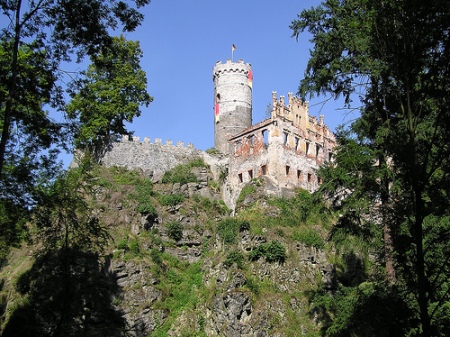
Location: North Bohemia Map
Constructed: 13th century by Přemysl Otakar II
Hauenštejn (also Horní hrad or Hauenstein) is a castle from the second half of the 13th century converted into a castle in the settlement of Horní Hrad near Stráž nad Ohří in the Ore Mountains in the district of Karlovy Vary. It has been protected as a cultural monument since 1964.
13th–15th Centuries: Royal Foundation and Early Ownership
The
castle’s origins remain partly unclear but date to the second half
of the 13th century. Traditional accounts credit King Přemysl Otakar
II (or possibly his son Václav II) with founding it as one of a
chain of royal border fortifications to guard trade routes along the
Ohře valley and protect local mines. An alternative view attributes
the initial build to the first documented holder, Loket burgrave
Mikuláš Winkler (c. 1320), who soon transferred it to the Doksany
monastery.
On 23 January 1336 the monastery exchanged Hauenštejn
(with 23 villages) for a manor at Velichov with King John of
Luxembourg; it remained royal property for decades. Emperor Charles
IV significantly enlarged the estate in 1357 by acquiring additional
villages from the Postoloprty monastery and transferred the castle
to trusted nobles such as Dietrich of Portic (provost of Vyšehrad,
elevated to lord of Hauenštejn and Orlík in 1360). During the reign
of Václav IV and the Hussite Wars it passed through various
castellans and pledges (e.g., to Štěpán of Kobersheim/Harnušmistr in
1420, later contested by Vilém of Illburk). By the late 15th century
the Satanéř family and then the Rous family of Plavna held it as a
hereditary manor before it was divided and sold.
Archaeological
excavations (2001–2002 and later) reveal the original medieval core
was smaller than later versions: a free-standing cylindrical
bergfrit (tower) on a basalt outcrop, a small residential palace on
a terrace, lower palace with Gothic cellars, and a rock-cut moat.
Construction used local basalt with Karlovy Vary tuff mortar; the
site featured a narrow, highly defensible foreyard and wooden bridge
access.
16th Century: Šlik Family and Renaissance Rebuilding
In 1528 the powerful Šlik (Schlick) family—key figures in the
Jáchymov silver-mining boom—acquired the castle and estate in two
transactions. After a destructive fire c. 1600 they undertook an
expensive Renaissance reconstruction. The old Gothic palace was
converted into a bailiff’s residence (preserving vaulted cellars), a
brewery was added, gardens and a wooden water conduit were laid, and
economic buildings (forge, inn, mill, ponds) expanded. Tax records
from c. 1628–1663 describe a rebuilt complex on the rock with
vaulted rooms and an orchard-covered hill. The Šliks held it until
1663, when František Arnošt Šlik sold it for 40,000 Rhine gulden to
Duke Julius Henry of Saxe-Lauenburg; it became part of the larger
Ostrov nad Ohří domain.
17th–18th Centuries: Saxe-Lauenburg,
Baden, and Habsburg Eras
Under Duke Julius Henry (1663–c. 1689)
the complex was modernised: a malt house, stone bridge over the
moat, baroque illusory paintings, and named chambers (Bird Room,
Pearl Hall, etc.). In 1689 it passed by inheritance to Franziska
Sibylla Augusta of Baden. The Baden (August) family held it until
the male line died out in 1771, after which Bohemian estates passed
to the Habsburg-Lorraine dynasty via Maria Theresa. From 1826 it
formed part of the state estates. Architectural changes were
modest—baroque roof details, oriel windows, and painted
interiors—but the core remained the Renaissance palace with Gothic
foundations.
19th Century: Buquoy Family and English
Neo-Gothic Transformation
On 30 October 1837 the estate (with
Měděnec) was sold for 400,100 gold pieces to Countess Gabriele
Buquoy-Longueval as part of state privatisation. The Buquoy family
owned it until 1945 and completely transformed the appearance.
First phase (1840–1850, under Gabriele): The bergfrit
(demolished to 8 m) was raised to 15 m with a romantic crenellated
terrace and machicolations; a pointed-arch ground entrance was
added. The gate building received a neo-Gothic stepped gable. On the
adjacent hill, Bernhard Grueber designed a majestic neo-Gothic
chapel (consecrated 1851).
Second phase (1878–1882, under
Ferdinand Buquoy, possibly by architect Alois Mytteis): The
disparate buildings were unified into a coherent English neo-Gothic
manor inspired by Windsor, Arundel, Belvoir, Lancaster, Oxford
colleges, and Bavarian examples (Hohenschwangau, Lahneck), as well
as Bohemian models (Hluboká, Sychrov, Lednice, Rožmberk). A new wing
and risalit created an honorary courtyard; the Knight’s Hall
(already noted on 1864 plans) gained large pointed windows, elegant
tracery, and a carved wooden beam ceiling resembling Rožmberk’s
Knights’ Gallery. A glazed winter garden, giardinetto garden with
fountain, upper gazebo, arcade corridor, cylindrical spiral
staircase tower (echoing Chambord), turrets, stepped gables, bay
windows, and neo-Gothic fountain replaced the old brewery. The
surrounding landscape became a romantic English-style park with
vistas, terraced orangery, arboretum (still famous for maples),
ponds, bridges, tennis court, and hunting lodges. This high-quality
“neo-romantic academic purism” gave the complex its final romantic
silhouette.
20th Century: Wartime Use, Confiscation, and Ruin
During World War II the castle served as a Hitler Youth centre. To
combat abundant vipers, Aesculapius snakes (Zamenis longissimus, now
known to be native) were introduced; a laboratory produced snake
venom/serum reportedly supplied to Rommel’s African forces.
After
1945 the Czechoslovak state confiscated it from the Buquoys. In 1947
it was refurbished as a recreation centre and dormitory for Jáchymov
uranium miners (much original furniture, ceilings, stoves, and
paintings survived initially). It later housed a juvenile detention
home until 1958, when poor maintenance, isolation, and heating costs
led to closure. Abandoned, it suffered rapid decay and vandalism:
roofs leaked, ceilings collapsed, windows smashed, granite
crenellations thrown down, and valuables stolen. By the 1960s–1980s
it was a near-ruin; authorities debated demolition (preserving only
the tower for tourism) versus costly rescue (estimated
600,000–800,000 Kčs in 1963). It remained protected as a cultural
monument. In 1990 the Ministry of Culture rejected de-listing; in
1992 administration passed to Krásný Les municipality. Sale attempts
for hotel use failed due to the estimated 250 million Kč
reconstruction cost.
21st Century: Private Restoration and
Cultural Revival
In 2000 Pavel Palacký (a descendant of the
renowned Czech historian František Palacký) purchased the complex
from the municipality and began systematic sanitation and
restoration with volunteers and public support. The work continues
today under the General Public Benefit Corporation Horní Hrad. The
site is now open to visitors with self-guided tours of the Gothic
casemates, Knight’s Hall (original carved ceiling), tower climb,
neo-Gothic chapel, wood-sculpture gallery, genealogy exhibition on
the Buquoy-Longueval family, and the sub-alpine park/arboretum. It
hosts cultural events, concerts, historical reenactments, falconry,
and educational programmes, transforming the former ruin into a
living supra-regional cultural centre.
Original 13th–14th-Century Gothic Fortress (Bergfrit Type)
The
castle was founded in the second half of the 13th century—likely by King
Ottokar II or Wenceslaus II—as a royal stronghold guarding trade routes,
a river gorge pass, and nearby silver mines. It followed the classic
bergfrit (cylindrical keep) layout typical of early Bohemian border
castles.
Upper nucleus (on the rocky spur): Dominated by a
free-standing cylindrical defensive tower (bergfrit) built of local
basalt blocks with walls 1.2 m thick at the base, bonded in lime mortar
mixed with Karlovy Vary tuff. The tower stood isolated; its original
entrance is lost (modern ground-level access is recent). A Gothic
terrace wall survives at its base.
Lower nucleus: An oblong
residential palace with lower parts of undoubted Gothic origin. It
included a ground-floor kitchen area (evidenced by a reused rough-hewn
stone quoin in a later window reveal) and two superimposed
barrel-vaulted cellars built into the rock-cut moat in the eastern wing
(mid-14th century, basalt-tuff masonry). These multi-storey Gothic
casemates—extensive underground vaults beneath the western
section—remain accessible today and represent the best-preserved
medieval defensive/storage feature.
Defenses and layout: A massive
rock-cut moat crossed by a gate (recently archaeologically exposed);
narrow courtyard with wooden balcony and external staircase access;
northern perimeter wall encircling the spur; defensive integration with
the opposite volcanic cone (site of the later chapel).
The whole
complex was compact, defensible, and strategically sited on a narrow
rocky ridge, with the courtyard originally 1.75 m lower than today.
Renaissance Rebuild (Šlik Family, after c. 1600 Fire)
In the 16th
century the powerful Šlik (Schlick) family—key silver-mining
magnates—acquired the castle. After a devastating fire around 1600 they
carried out a costly transformation from medieval fortress to
Renaissance residential seat.
The lower southeast palace was
expanded and given wide arcades opening onto the courtyard (ground floor
stables, upper living quarters).
Gothic cellars were reinforced with
longitudinal walls and large arcades for stability.
Facades received
Renaissance detailing: tall profiled brick-mold windows (some with
second-use stone), illusory red-clay “armatura” on corners, and
two-gable forms.
Additional structures: Brewery inside the castle
(with later malt house); wooden bored-pipe aqueduct (1628–29);
half-timbered gables; onion domes on the bergfrit and gate building
(with ridge bell tower).
Interiors evolved toward comfort: named
chambers (Bird Chamber, Green, Yellow, Blue, Pearl/Festive) with later
Baroque illusory paintings.
By the 1620s–1660s the site included
fruit orchards on the castle hill, fish ponds, a mill, and farm
buildings. The courtyard was leveled and outbuildings added.
Baroque and Early Modern Tweaks (17th–18th Centuries)
Minor
modifications under the Saxe-Lauenburg dukes (from 1663) and Baden
margraves (from 1689) included:
New malt house and brewery cellar
in the bridged moat.
Illusory Baroque paintings and window reveals.
Refurbished roofs (shingled), bay windows, and stone consoles.
The
bergfrit received a large onion dome.
The castle remained
essentially a functional seigneurial residence within the larger Ostrov
estate.
Romantic Neo-Gothic / Tudor-Gothic Transformation (Buquoy
Family, 1837–1882)
In 1837 Countess Gabriele Buquoy bought the
property; her son Ferdinand continued the work, culminating in a major
campaign 1878–1882 under architect Alois Mytteis (possibly adapting
earlier plans). The goal was a picturesque English-style Romantic
chateau inspired by Windsor Castle, Arundel, Belvoir, Lancaster, Oxford
colleges, Hohenschwangau, Lahneck, and Czech Neo-Gothic examples
(Hluboká, Sychrov, Lednice, Rožmberk).
Key changes:
Bergfrit
tower raised from 8 m to 15 m, romanticized with a roofless battlemented
terrace on consoles with machicolations, pointed-arch entrance, and
internal oak spiral staircase.
New Neo-Gothic chapel (designed by
Bernhard Grueber, consecrated 1851) on the opposite hill.
Knight’s
Hall (Rittersaal): Added as the centerpiece—large pointed windows with
elegant Gothic tracery, a magnificent carved wooden beam ceiling with
Gothic circles (comparable to the Crusader Gallery at Rožmberk). It
opens onto a terrace with later glass winter garden (cathedral-like
Gothic windows, used for citrus, laurels, etc.).
Linking
architecture: New tract between gate and southeast palace forming a
small honor courtyard; open-helix staircase in a cylindrical tower
(Chambord-inspired); arcades; symmetrized facades with battlements,
defensive turrets, stepped gables, pinnacles, finials, and symmetric
Gothic bay windows.
Overall effect: Five palaces/pavilions totaling
around 130 chambers unified into a spacious, romantic Neo-Gothic
residence with English Tudor-Gothic detailing.
Landscape and
Garden Architecture
The 19th-century designers created one of
Bohemia’s finest English Romantic landscape parks to complement the
chateau’s Tudor-Gothic silhouette. Formal elements (clipped boxwood,
roses, herb garden, central fountain with Gothicizing forms) contrast
with dramatic natural scenery. Three ponds mirror the castle—especially
the Gothic tower—from multiple angles. Terraced gardens,
orangery/greenhouses, orchard, stone-arched bridges, cascades, and
winding paths offer ever-changing vistas. An arboretum (founded 1971,
expanded) features exotic maples and Asian/North American trees. The
valley’s beech forests, rocky outcrops, and stream enhance the
picturesque setting.
Current State and Visitor Experience
Parts of the complex remain ruinous (post-WWII neglect and 20th-century
uses as Hitler Youth center, miners’ hostel, and children’s home), but
key historic interiors and exteriors have been sensitively restored.
Self-guided tours let visitors explore the Gothic casemates, climb the
medieval/Romantic tower for Ore Mountains views, admire the Knight’s
Hall ceiling and chapel, and stroll the parks. The motto “How a Castle
Is Built” perfectly captures its layered story—from 13th-century
defensive bergfrit to 19th-century romantic dream.
There are two paths leading to the castle: the shorter one leads
visitors to the reconstructed Castle Gate, the other leads to the castle
courtyard and offers a view of the castle tower.
Above the castle on
the hill (465 m) is the Hornohradská chapel, from the interior of which
only one wooden bench has been preserved. New benches were purchased for
the chapel, exhibitions are held here. The interior displays a wooden
statue of St. Wenceslas, which was made for the pilgrim Peter "Hroch"
Binder's pilgrimage to the Vatican in 2007, where it was blessed by the
Pope.
At the chapel was Ing. Jaroslav Hejtík (1943–2001) founded a
botanical garden and arboretum in 1971, which is now managed and managed
by his son Jakub. The garden is planted with deciduous and coniferous
trees, some of which come from Japan, China, Korea and North America, as
well as traditional and lesser-known perennials, including rock plants
and medicinal plants.
During the season, a number of events take
place at the castle, such as the Jarní Slunohrad, Wicked Castle and
Folková Ohře music festivals, night tours, summer camps and outdoor
schools.
Since 2014, a group of volunteers from the "Opří se"
association has been returning here roughly four times a year with
children from orphanages. Since 2018, the association has organized
regular international workcamps here in cooperation with the INEX-SDA
organization.