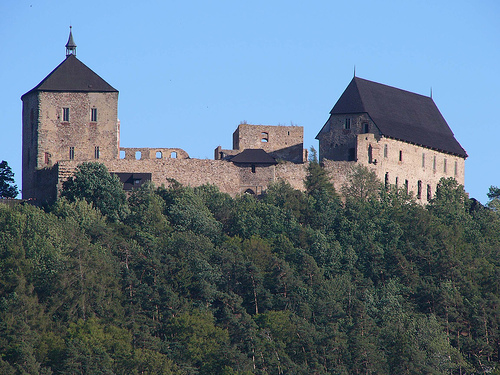
Location: Hrady Točník a Žebrák, 267 51 Zdice, 15 km (9 mi) Southwest
of Beroun
Tel. 311 533 202
Open:
Mar, Apr, Oct: 10am- 12pm,
1pm- 4pm Sat, Sun
May, Jun, Sept: 10am- 12pm, 1pm- 5pm Tue- Sat
Jul, Aug: 9am- 12pm, 1pm- 6pm Tue- Sun
www.tocnik.com
Točník
Castle, a striking example of late Gothic architecture, stands as a
testament to medieval royal luxury in the Czech Republic. Situated in
the municipality of Točník within the Beroun District of the Central
Bohemian Region, the castle perches on a rocky ridge known as Zámecká
hora (Castle Mountain) at coordinates approximately 49°53′13″N
13°53′00″E. It forms a unique pair with the nearby Žebrák Castle,
located just 500 meters away on the same hill, creating one of the
best-preserved castle complexes in the country. Built at the end of the
14th century, Točník was designed more as a comfortable royal residence
than a purely defensive fortress, reflecting the transitional period
between medieval defense systems and Renaissance influences.
The
castle's strategic yet scenic position overlooks the surrounding
landscape, including forested hills and nearby towns like Hořovice. Its
proximity to Prague (about 50 km west) and Pilsen makes it accessible
via the Prague-Pilsen highway, positioning it as an ideal site for
historical tourism and events.
Prehistory and Early Context
Archaeological evidence from 1999
shows settlement on the hilltop during the Hallstatt period (early
Iron Age). A prehistoric hillfort may have existed there, though its
fortifications are hard to distinguish from later medieval ones
without further study.
The site gained royal importance in the
14th century. Nearby Žebrák Castle (founded in the late 13th century
by Oldřich Zajíc of Valdek, later a royal castle enlarged by Charles
IV) served as a key residence and hunting base. A major fire in 1395
damaged Žebrák, exposing its vulnerabilities in position and
defensibility during turbulent times.
Construction under
Wenceslaus IV (Late 14th–Early 15th Century)
King Wenceslaus IV
(Václav IV, Holy Roman Emperor and King of Bohemia, r. 1378–1419)
commissioned Točník as a new, more luxurious and secure private
royal residence and hunting lodge. Construction likely began in the
1380s or around 1395–1398 (some sources cite 1398–1401), using the
royal building workshop. It was largely completed quickly—within
about four years—thanks to innovative techniques.
Key
Architectural Features (transitional late Gothic, blending defense
and comfort):
Built on a three-part ground plan with a massive
moat, bridge, and gate tower.
Two main palaces: the large Royal
Palace (L-shaped, with a grand ceremonial hall on the second floor
measuring ~34 x 15 m—one of the largest in Bohemia at the time,
surpassing halls at Karlštejn, Prague Castle, etc.) for
representation; and the Burgravian Palace for more
private/residential use.
Innovative defenses: System of zwingers
(outer wards), no traditional high keep; the residential palace
placed on the vulnerable front side with multiple escape routes. It
marked a shift from pure medieval fortresses toward more residential
"château-like" concepts.
Wenceslaus stored part of the royal
treasury there by 1400 and issued documents (e.g., privileges for
České Budějovice in 1401). He used it for hunting, feasts, and
occasional diplomacy (e.g., 1409 university meeting; possible 1412
meeting involving Jan Hus).
It served as a safe retreat amid
political instability, though Wenceslaus shifted focus to Nový
Hrádek near Kunratice later. His last recorded visit was in
September 1415.
Hussite Wars and Later Medieval Period (15th
Century)
After Wenceslaus's death in 1419, the castle passed to
his brother Sigismund of Luxembourg. Sigismund removed much
equipment and treasure; it was soon mortgaged (e.g., to Erkinger of
Seinsheim in 1421, leading to Kolowrat control).
During the
Hussite Wars, Točník (with Žebrák) successfully resisted a three-day
siege in 1425 by a large Hussite force (~8,000 men). The Hussites
withdrew and burned nearby towns (Žebrák and Hořovice) instead. It
remained mostly in pledge holders' hands, including the Kolowrats
(who made late Gothic modifications), Lords of Gutštejn, and others.
George of Poděbrady (r. 1458–1471) briefly acquired it to keep it
from firm Catholic control before granting it to loyal Frederick of
Šumburk.
Renaissance and Early Modern Era (16th–17th
Centuries)
In 1509–1522, under the Jagiellonian kings (Ladislaus
and Louis), it passed through owners like John of Wartenberg
(Renaissance alterations) and the Krajíř family (who searched
unsuccessfully for hidden treasure, damaging Žebrák). It went to the
Wallenstein family (1544), then back to royal hands under Maximilian
II and the Lobkowicz family (from 1552), who continued Renaissance
upgrades.
Emperor Rudolph II (r. 1576–1612) reacquired it around
1594–1595 (paying out the Lobkowicz), visited it (the last monarch
to do so), and used it as a state prison. It was administered from
nearby Zbiroh; stewards eventually moved there, accelerating
decline. By 1674, only a janitor remained.
The Thirty Years' War
(1618–1648) caused major damage: Imperial troops under John Kolenec
invaded in 1620, and civilians sheltered there in 1639. It was
prepared (but not effectively used) against Swedish forces. It
remained habitable into the late 17th century (per Bohuslav Balbín
in 1681) but was largely roofed yet uninhabited by 1722.
Decline, Abandonment, and Modern Revival (18th–21st Centuries)
Management shifted (e.g., to mining authorities in Příbram from
1834). Attempts to sell the domain in the mid-19th century led to
owners like industrialist H.B. Strossberg ("railroad king") and the
Colloredo-Mansfeld family.
In 1923, Josef Colloredo-Mansfeld sold
Točník to the Czechoslovak Tourist Club for a nominal sum. The club
began restorations (sometimes crudely by modern standards, e.g.,
concrete floors). It passed to the Czechoslovak Sokol Community in
1945, then the state in 1953. Since 1994/2001, it has been managed
by the National Heritage Institute (with Křivoklátsko castles).
Gradual conservation, safety works, and public access continue.
Today, it is a popular tourist site with scenic views, bear
enclosures in the moat (brown bears Martin and Agáta), events (e.g.,
"In the Sign of the Chalice"), and falconry displays. It has
appeared in films like Bathory, Faust, and Hard to Be a God.
Summary of Significance
Točník exemplifies late medieval Bohemian
architecture at the cusp of castle-to-château transition: balancing
royal luxury, hunting retreat, and defense amid the waning
Luxembourg era and rising Hussite conflicts. Its rapid construction,
innovative layout, and pairing with Žebrák make it a standout
example of Czech royal building under Wenceslaus IV. Though ruined,
its palaces and setting preserve a tangible link to Bohemian history
from the Luxembourg dynasty through religious wars, Renaissance, and
Habsburg rule.
Točník Castle (Hrad Točník) is a late 14th-century royal castle ruin
in the Central Bohemian Region of the Czech Republic, near the town of
Zdice in the Beroun District. It stands on a rocky ridge about 100
meters higher and roughly 500 meters from the older Žebrák Castle,
forming a picturesque pair of ruins that together constitute a protected
national cultural monument.
Built primarily between 1398 and 1401
(first mentioned in 1398) for King Wenceslaus IV (Václav IV) as a more
luxurious and strategically safer private residence after a fire damaged
Žebrák in 1395, it represents a transitional phase in Czech castle
architecture—blending strong defensive elements with advanced
residential comfort and early Renaissance influences.
Overall
Layout and Defensive Features
The castle follows a three-part ground
plan, typical of medieval fortifications but executed with notable
innovations for its era:
Outer defensive structures: A massive moat
(fosse) protected by a defensive wall. Access was originally via a
bridge and gate tower (now largely ruined). The system emphasized
zwingers (outer baileys or enclosures) rather than a single prominent
keep or defensive tower, making Točník one of the early Czech castles to
prioritize layered perimeter defenses over a central tower.
Courtyards and inner areas: It features multiple courtyards, including
an L-shaped residential section. The complex includes stout stone walls,
gates (notably a western entrance gate with heraldic decoration), and a
prismatic (polygonal) tower that offers panoramic views.
Innovations:
Advanced for its time, including an ingenious heating system with
specially designed fireplaces capable of warming much of the castle
(early central heating concept) and robust construction completed
rapidly in about four years.
The castle’s elevated position on a hill
provides commanding views of the surrounding countryside and Krivoklát
hunting forest, enhancing both its defensive and aesthetic appeal.
Key Buildings and Architectural Details
Royal Palace (Královský
palác): The most significant structure, located in the residential
section on an L-shaped ground plan with a side wing. This was the
private royal residence, built on the edge of the moat for security and
with multiple escape routes.
Exterior: The front façade is
austere and fortress-like—firmly closed with barred windows and corner
bossage (reinforced stonework). White stucco frames around windows
provide the main decorative softening. It reflects late Gothic style
with some early Renaissance touches.
Interior: Contrasts sharply with
the exterior’s severity. Irregular spaces allowed for creative vaulting
by royal craftsmen, creating "attractive, even exciting" interiors. The
second floor housed a massive ceremonial hall (approximately 34 x 15
meters), larger than contemporary great halls at Karlštejn, Prague
Castle, or Křivoklát. Lower floors were residential. Vaulted ceilings,
high-quality stonemasonry in windows and portals, and functional layouts
highlight advanced late medieval craftsmanship.
Burgravian Palace
(Purkrabský palác or Great Palace): Used primarily for representation
and housing important guests/officials. It features a large hall for
entertaining and shows more conventional design compared to the
innovative Royal Palace. Later decorated with graffiti (sgraffito),
typical of Renaissance modifications.
Other elements:
Prismatic tower.
Various ruined structures, walls, and outbuildings.
Later additions like a Baroque chapel converted from the former
representation hall in the 18th century.
Styles and Modifications
Primary style: Late Gothic, with a focus on residential luxury alongside
defense. It marks a shift from purely military medieval castles toward
more comfortable royal seats.
Renaissance alterations: Initiated by
Jan of Wartenberg and continued by the Lobkowicz family in the 16th
century, including modifications to palaces and decorative elements like
sgraffito.
Baroque influences: Limited, mainly the chapel conversion.
The castle was not heavily expanded after the early 15th century but
underwent repairs and adaptations until its decline.
Condition
and Current State
Točník is a ruin but one of the best-preserved
Czech castle complexes of its kind, thanks to gradual restoration since
the 1920s (owned by the Club of Czech Tourists from 1923, now managed by
the National Heritage Institute). Parts of the Royal Palace (including a
museum), the Great Palace with graffiti, gates, and the tower are
accessible. Roofs have been partially restored on key buildings, and
interiors show preserved vaults, windows, and structural details. The
site includes modern visitor facilities while maintaining its historic
atmosphere.
Točník Castle (Hrad Točník) is a late 14th-century Gothic royal
residence built by King Wenceslas IV (Václav IV) as a more comfortable
and secure alternative to the nearby, fire-damaged Žebrák Castle. It
stands on a rocky ridge in Central Bohemia, about 50-60 km southwest of
Prague near the village of Točník (Beroun District), offering a
picturesque "twin castle" experience with Žebrák just 500 meters away.
This transitional castle blends defensive medieval elements with
luxurious residential features, making it a highlight for history,
architecture, and nature enthusiasts. It features preserved palaces, a
massive ceremonial hall, Renaissance modifications, graffiti, a
prismatic tower with views, gates, a moat, and even resident bears in
the moat area.
History in Brief
Construction: Built ~1398–1401
after a 1395 fire at Žebrák. Wenceslas IV used it as a private residence
and moved part of the royal treasury here.
Key Features: Royal Palace
(with a huge 34x15m great hall for representation) and Burgravian
Palace. It includes advanced vaults, L-shaped layout, defensive
moat/bridge, and later Renaissance/Baroque adjustments.
Later Years:
Passed through noble families (Kolowrats, Lobkowicz, etc.), used as a
prison, damaged in the Hussite Wars and Thirty Years' War, abandoned in
the 17th century. Restored since the 1920s (sold to the Czech Tourist
Club in 1923) and now managed by the National Heritage Institute (NPÚ).
It has been a filming location for movies like Bathory and others.
Opening Hours and Tickets (as of 2026)
Check the official site
for updates, as hours are seasonal.
Free-flow (self-guided) basic
tour (recommended; printed texts/maps in multiple languages, including
English):
June 1–Aug 31: Tue–Sun 9:00–18:00
Sept: Tue–Sun
10:00–17:00 (open Mon Sept 28)
Oct 1–Nov 1: Sat–Sun 10:00–16:00 (open
Wed Oct 28)
Opens weekends from March; closed in deep winter.
Guided tours: Available mainly in July–August (Czech; check for English
options or private arrangements).
Ticket Prices (cash/cards
accepted; similar for free-flow or guided):
Adults (25–64): 160 CZK
(~€6.50 / $7)
Seniors 65+, Youth 18–24, Disabled: 130 CZK
Children
6–17: 50 CZK
Under 5: Free
Free for companions of disabled/school
groups, certain cards (NPÚ, ICOMOS, etc.)
Online tickets
available via the official site. No major reservations needed for
individuals, but groups should check.
Duration: Allow 1–2+ hours for
a relaxed visit (longer if combining with Žebrák or trails). You can
linger as desired in free-flow mode.
Getting There and Parking
By Car (easiest from Prague): ~45–60 minutes via D5/E50 highway toward
Plzeň, exit toward Hořovice/Zdice/Točník. Follow signs. Parking lot is
available directly beneath the castle (paid, ~60 CZK; can fill up on
busy days/weekends). A path leads uphill from there (steep but
manageable, ~10–20 minutes).
Public Transport: Bus from Prague (~50
minutes, inexpensive). Train to Žebrák station then walk/hike (~2 km
pleasant trail between castles).
Hiking/Biking: Popular area with
marked trails in rolling hills/forests (part of Křivoklátsko Protected
Landscape Area). Combine Točník + Žebrák for a rewarding short loop
(steep sections; good shoes recommended). Cyclists note: roads are tough
but accessible.
Tip: Avoid Mondays outside special dates (e.g., some
holidays). Arrive early or mid-week for fewer crowds.
What to
Expect and Visiting Tips
Terrain and Accessibility: Hilly, rocky site
with uneven paths, stairs, and climbs (tower, palaces). Physically
demanding—wear sturdy shoes and prepare for elevation. Not ideal for
wheelchairs or severe mobility issues.
Highlights:
Royal
Palace interiors/exhibits (museum, typology of Czech castles, large
model, stone gallery with coats of arms, royal treasury replicas).
Great hall, graffiti in Great Palace, western/eastern gates,
moat/bridge, prismatic tower (panoramic views of countryside and
Žebrák).
Wildlife: Brown bears (Agata and Martin) in the moat
paddock—family-friendly with observation trails. Also ducks, sheep,
goats, pigs, rabbits, and a small sandbox for kids.
Nature trails
around the site.
Photography: Excellent for landscapes,
architecture, and atmospheric ruins. Golden hour or clear days are best
for views.
Weather: Exposed site—bring layers, rain gear, sunscreen,
and water. Can be windy/chilly even in summer.
Facilities:
Snacks/refreshments on-site; restaurant (e.g., Hostinec Krále Václava
IV) in the village below. Toilets available. Pets allowed on leash
(except chapel).
Best Time: Late spring to early fall for full access
and pleasant weather. Summer for longest hours and possible events.
Combine with Žebrák for a half-day outing, or nearby Hořovice/Zbiroh
châteaux.
Crowds: Less touristy than Prague-area castles; busier on
weekends/holidays. English info available but Czech
dominant—download/print guides or use translation apps if needed.
Practical Advice
Food/Drinks: Light snacks at the castle; full
meals in the village. Picnic options in surrounding nature.
Family/Kids: Engaging with animals, open spaces, and short trails—great
for children.
Safety: Standard castle rules (no climbing ruins, stay
on paths). Watch footing on steep/uneven areas.
Nearby: Žebrák ruins
(shorter climb, tower views), hiking in Brdy/Protected Area, other
Central Bohemian castles. Perfect day trip from Prague.
Pro Tips:
Bring cash for parking/snacks if needed. Check official site
(hrad-tocnik.cz) or contact (+420 778 761 741, tocnik@npu.cz) for latest
events, guided options, or accessibility updates. Pair with a Czech
lunch for an authentic experience.