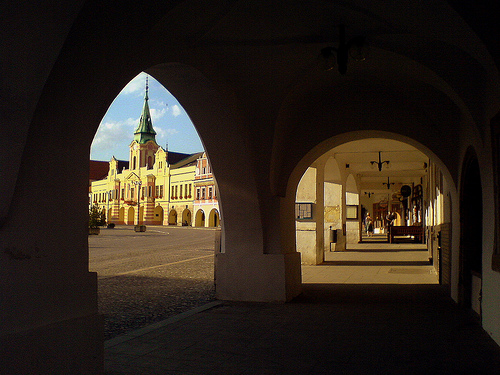
Location: 35 km North of Prague, Central Bohemia Map
Info: Namesti Miru 11
Tel. 3315 625 503
Mělník (also spelled Melnik in English) is a historic town in the
Central Bohemian Region of the Czech Republic, located approximately
27 kilometers (17 miles) north of Prague. It sits at an elevation of
215 meters (705 feet) above sea level, on the right bank of the Elbe
River (known locally as the Labe) at its dramatic confluence with
the Vltava River. This strategic position places the town in the
Polabí lowlands, with the southwestern part in the Central Elbe
Table and the northeastern part in the Jizera Table. The highest
point in the area is the hill Chloumeček at 282 meters (925 feet).
Covering an area of about 25 square kilometers (9.7 square miles),
Mělník has a population of around 20,278 as of early 2025, with a
density of roughly 812 people per square kilometer. The town's
location at the river junction has historically made it a key trade
and defensive hub, while today it offers stunning panoramic views of
the rivers, surrounding vineyards, the sacred Říp Mountain
(associated with Czech legends), and the Central Bohemian Highlands.
Mělník is renowned for its well-preserved historic center, which
is protected as an urban monument zone, blending medieval,
Renaissance, and Baroque architecture. It is one of only two
wine-growing regions in Bohemia (the other being around Litoměřice),
with viticulture dating back over a millennium. The town's name
derives from the Slavic word for "mill" or "miller" (mlýn),
reflecting early milling activities along the rivers, though some
sources link it to the local sandy soil (mlín meaning "sandy" in old
Czech). As a former royal dowry town for Bohemian queens, it holds
significant cultural and historical importance, recently celebrating
its 750th anniversary of documented town status in 2024.
1. Mělník Chateau (Zámek Mělník) – The Town’s Dominant Landmark
The Mělník Chateau (often called Melnik Castle) is the town’s most
iconic sight, perched on a ridge above the rivers and vineyards. It
originated as a wooden fort (Pšov) in the early Middle Ages and evolved
into a stone structure by the late 10th century. It later became a
Gothic castle and received Renaissance and later modifications.
Key
historical notes:
It served as a residence for Bohemian queens
and princesses (a “dowry town”).
Legend links it to Saint Ludmila
(grandmother of Saint Wenceslas), who supposedly resided here.
Emperor Charles IV promoted winemaking here by importing vines from
Burgundy.
It passed through families like the Černíns and has been
owned by the Lobkowicz family (with interruptions) since the 18th
century. It was returned to them after the Velvet Revolution in 1992.
What to see:
Opulent interiors with Lobkowicz family collections
(furniture, paintings, etc.).
A beautiful Renaissance courtyard with
arcades.
Extensive historic wine cellars (some dating to the
11th–14th centuries) with massive oak vats (one holds ~130,000 liters).
Wine tastings are available.
The chateau restaurant offers panoramic
views of the river confluence, St. Ludmila Vineyard, Říp Mountain, and
the Central Bohemian Uplands.
The chateau is a “zamek”
(chateau/palace) rather than a defensive “hrad” fortress, emphasizing
elegance over fortification.
2. Church of St. Peter and Paul
(Chrám sv. Petra a Pavla)
This church stands right next to the
chateau and forms Mělník’s skyline silhouette with its tall tower. It is
one of the oldest functioning churches in Bohemia, with foundations
possibly dating back ~1,000 years (11th century). The current structure
includes late Gothic and later elements; fires in 1555 and 1681 led to
restorations.
Highlights:
Climb the tower for sweeping views
of the town, rivers, vineyards, and distant hills (including Říp
Mountain, a key Czech national symbol).
The interior features Gothic
elements and rich decoration.
Access to the tower and crypt is often
seasonal or by arrangement.
3. Mělník Ossuary (Kostnice)
Located in the crypt beneath the Church of St. Peter and Paul, this is
one of the largest ossuaries in the Czech Republic (alongside
Sedlec/Kutná Hora). It contains the remains of up to 15,000 people of
various ages, genders, and origins. Bones were gathered here from old
cemeteries and battle sites, especially from the Thirty Years’ War era,
and arranged in the early 20th century.
It offers a somber,
atmospheric contrast to the town’s scenic beauty. Visits are usually
possible in summer or for groups by prior arrangement.
4. Mělník
Underground (Mělnické podzemí) and Medieval Well
Beneath the historic
center lies a network of medieval tunnels (some 13th century) connecting
buildings. The highlight is the widest well in the Czech Republic.
Guided tours start from the Tourist Information Center and provide a
cool, mysterious glimpse into the town’s subterranean past.
5.
Pražská brána (Prague Gate) and Galerie Ve Věži
This 16th-century
clock tower and gate on the southern side of the old town now houses a
café and art gallery spread across multiple floors. It offers nice views
and a unique experience (orders can be hoisted up by pulley). It’s a
pleasant spot for coffee with a view of the chateau and church.
6. Town Square (Náměstí Míru) and Historic Center
The main square
features arcaded buildings, the Town Hall, and a former Capuchin
monastery. The streets leading to the chateau (especially Svatováclavská
ulice/St. Wenceslas Street) are lined with historic houses showing
Renaissance, Baroque, and Art Nouveau details. The area is a protected
urban monument zone.
7. Vineyards, Wine Culture, and River
Confluence
Mělník is the heart of Bohemia’s winemaking. Vineyards
(including the historic St. Ludmila Vineyard) slope down from the
chateau. Local wines (often whites and some reds from varieties like
Müller-Thurgau or Burgundy-inspired grapes) can be tasted at the chateau
or nearby wineries.
The confluence of the Vltava and Elbe is best
viewed from the chateau terrace or nearby viewpoints. The rivers create
a scenic backdrop, with the Elbe continuing north toward Germany.
Other Notable Sights
Regional Museum — Covers local history.
St. Ludmila’s Church — Features a rare wooden bell tower.
Views and
surroundings — Boat trips on the Elbe, walks along the rivers, or short
trips to nearby sites like Říp Mountain.
Why Visit Mělník?
Wine heritage: One of Bohemia’s two main wine
regions. Vineyards have been cultivated here since the 9th–10th century
(linked to Saint Ludmila).
Stunning location: Panoramic views over
the river confluence, Říp Mountain, and the Central Bohemian Uplands.
Compact and walkable: Perfect for a half- to full-day visit, with a
beautiful historic center, castle, church, and underground tunnels.
Less touristy: Feels authentic compared to busier Czech destinations.
Best Time to Visit
Spring (April–June) and early autumn
(September): Mild weather, blooming vineyards or harvest season, fewer
crowds.
Summer: Great for outdoor terraces and river views, but can
be warm.
Mělník Vintage (Burčák festival): Usually mid-to-late
September — a highlight with young wine, music, and festivities.
Avoid deep winter if you want to enjoy outdoor viewpoints fully.
How to Get There from Prague
Bus (recommended): Direct buses (e.g.,
line 369) from Praha-Ládví metro station (Red Line C). Takes 40–50
minutes. Get off at Mělník-Fibichova (near the top of the hill, close to
the center). Frequent service.
Train: From Prague Masarykovo or Main
Station, with a possible change. Takes about 1 hour; station is a 15–20
minute walk downhill to the center.
Car: Easy 30–45 minute drive via
D8 highway. Parking available near the center or castle (some paid).
Boat: Seasonal river cruises from Prague — scenic but slower.
Tip:
Use the IDOS app or website for public transport schedules.
Wine
Tasting and Food
Castle wine cellars are the star — try local
varieties like Riesling, Müller-Thurgau, Pinot, or Ludmila-labeled
wines.
Other cellars and shops in town for tastings.
Food:
Traditional Czech (svíčková, goulash, duck) paired with wine. Chateau
restaurant for views; town square spots for casual meals. Local brewery
for beer lovers.
Tip: Book castle tours/wine tastings in advance,
especially in peak season or for groups.
Practical Tips
Tourist Information Center: Legionářů or nearby — open roughly
9:00–17:00. Helpful maps, tour bookings, and underground tickets.
Walking: The town is hilly — wear comfortable shoes. Everything is
compact and walkable.
Money & Language: Cards widely accepted, but
cash useful for small vendors. English spoken in tourist spots; basic
Czech phrases appreciated.
Safety: Very safe, like most of Czechia.
Accessibility: Some cobblestones and hills; castle and church have
steps.
Where to Stay
Good for a day trip, but overnight lets
you enjoy sunset/sunrise and fewer crowds.
Options: Hotels near the
square, chateau-area guesthouses, or modern spots. Charming B&Bs and a
few boutique options.
Day Trip Itinerary Suggestion (from Prague)
Morning bus → Arrive, visit castle + wine tasting.
Lunch with a view.
Afternoon: Church/ossuary, underground tour, square stroll, tower café.
Late afternoon: Vineyard walk or viewpoint.
Evening bus back (or stay
for dinner/sunset).
Prehistory and Early Slavic Settlement (Pre-10th Century)
The area
around Mělník shows evidence of prehistoric habitation, including a
Celtic fort from around the 1st century AD. In the 5th–6th centuries,
during the migration period, Slavic tribes settled here. The local
Pšovans (or Psyovians) tribe established their main settlement,
originally called Pšov, on a hill above the river confluence.
The
name "Mělník" derives from the Slavic word mělnit (to crumble),
referring to the crumbling Cretaceous rocks of the local hill. According
to the Chronicle of Bohemians by Cosmas of Prague, the last Pšovan
prince Slavibor married his daughter Saint Ludmila to Bořivoj I, the
first historically documented Bohemian duke (from the Přemyslid
dynasty). Legend holds that Ludmila resided here and raised her grandson
Saint Wenceslaus (Václav), who tended vineyards. This ties Mělník deeply
to Czech national saints and identity.
Medieval Period: From
Stronghold to Royal Dowry Town (10th–15th Centuries)
The first
written evidence appears on silver denarius coins of Princess Emma (wife
of Boleslav II), who died in 1005/1006, mentioning Civitas Melnic. A
wooden fortress likely stood here earlier, replaced by a stone structure
by the late 10th century (remnants survive in the castle's southern
tower).
In the 13th century, under the Přemyslids, a Gothic castle
was built. King Ottokar II granted town status in November 1274. It
later became one of nine dowry towns (věnná města), properties assigned
to Bohemian queens for their financial security. This made Mělník a
favored residence for queens and princesses—reportedly up to 23 over the
centuries. It often served as a residence for widowed or retired royal
women.
Emperor Charles IV (r. 1346–1378) elevated its importance. He
declared it a royal dowry town, expanded privileges, and imported vines
from Burgundy to boost viticulture (which had begun informally in the
late 9th century, possibly linked to Saint Ludmila). His last wife,
Elizabeth of Pomerania, lived there until 1393 and likely commissioned
the castle chapel (originally dedicated to Saint Louis, now to Saint
Ludmila).
In 1449, the town gained self-governance rights through a
council and mayor. By the early 16th century, it gained fame for its
wines.
Renaissance, Wars, and Decline (16th–18th Centuries)
The castle underwent Renaissance transformations in the 16th century.
However, the Thirty Years' War (1618–1648) devastated the town. Mělník
supported the Bohemian Revolt (1618–1620) modestly, leading to property
confiscations and forced re-Catholicization. By 1628, the population was
mostly Catholic. Swedish and Saxon armies raided it, alongside fires
(e.g., 1646, 1652, 1681) and plague. The church, castle, and town hall
suffered damage.
The castle became desolate and was pledged in 1646,
then sold in 1687 to Heřman Jakub Černín of Chudenice, who rebuilt parts
of it. In the 18th century, further damage came from wars and a major
fire in 1765 that destroyed dozens of houses, the town hall, and the
Capuchin monastery. Baroque reconstruction followed.
Lobkowicz
Era and Modern Development (18th–20th Centuries)
In 1753, the Černín
heiress Marie Ludmila married into the Lobkowicz family, transferring
ownership. The Lobkowiczes (a prominent Bohemian noble house) held it
until 1948, restoring and enriching it with art, furniture, and a wine
museum in the late 19th century.
Industrial growth arrived in the
19th century: Mělník became a district town in 1850, a sugar factory
opened in 1869, a railway in 1874, an Elbe bridge in 1888, and a port.
These boosted its economy beyond agriculture and wine.
20th Century:
The castle was nationalized after the 1948 Communist coup. Winemaking
and traditions suffered under the regime. Post-1989 Velvet Revolution,
the Lobkowicz family regained the property in 1992 and restored it. The
historic center remains well-preserved as an urban monument zone.
Winemaking Heritage
Mělník names the Mělnická wine region, one of
Europe's northernmost. Viticulture dates to the 9th century but
flourished under Charles IV. The castle's cellars and surrounding
vineyards (including the famous Ludmila label) remain central. Saint
Wenceslaus is the patron of winemakers. Annual wine festivals continue
the tradition.
Mělník (pronounced roughly "MYEL-neek") is a historic town in the
Central Bohemian Region of the Czech Republic, known for its strategic
position at the confluence of the country's two longest rivers: the
Vltava (Moldau) and the Elbe (Labe).
Location and Regional
Context
Coordinates: Approximately 50°21′7″N 14°28′30″E.
Distance
from Prague: About 27–35 km (17–22 mi) north of Prague, making it an
easy day trip.
It serves as the capital of the Mělník District (okres
Mělník), which covers 701 km² (about 271 sq mi) and has around 115,000
inhabitants.
The town sits in the Polabí lowlands (the Elbe Lowland),
a broad, fertile plain in northern Bohemia. This positions it within the
broader Bohemian Massif, characterized by rolling hills, plateaus, and
low mountains encircling the country, with river valleys cutting
through.
Topography and Terrain
Mělník's town proper rises on
a hill above the right (eastern) bank of the Elbe, offering panoramic
views of the river confluence, surrounding lowlands, and distant hills.
Key details include:
Elevation: Town center around 215 m (705 ft)
above sea level; municipal average ~193 m. Highest point in the
immediate area is Chloumeček hill at 282 m (925 ft). Lowest points near
the riverbeds approach 153 m.
Municipal area: 24.96 km² (9.64 sq mi),
with varied terrain: flatter lowlands along the rivers transitioning to
gentle hills.
Geomorphological zones: Southwestern parts in the
Central Elbe Table; northeastern in the Jizera Table. The broader
district includes parts of the Ralsko Uplands (north, more
hilly/forested) and Lower Ohře Table (west).
The landscape features
fertile alluvial soils from river deposits, ideal for agriculture and
viticulture. Nearby, volcanic and sandstone formations appear in the
Central Bohemian Uplands (České středohoří), including visible landmarks
like Říp Mountain (a prominent isolated hill with historical
significance). The northern district parts are hillier and more
forested.
Hydrology: The River Confluence
The defining
geographical feature is the confluence of the Vltava and Elbe (one of
the largest in Central Europe). The Vltava, the longest river entirely
in Czechia (~433–440 km), drains southern Bohemia before joining the
Elbe here. The Elbe then continues northward through Germany to the
North Sea.
Mělník hosts one of the Czech Republic’s largest river
ports, with significant container transshipment and historical
importance for inland navigation. A canalized channel affects the exact
meeting point, but viewpoints from the castle and terraces offer
impressive vistas.
The rivers create a dynamic floodplain
environment, supporting agriculture but also influencing settlement
patterns and flood risks. The district has limited other water bodies.
Climate
Mělník experiences a temperate continental climate,
typical of inland Central Europe, with warm summers and cold winters. As
part of a wine-growing region (one of Europe's northernmost), it is
among the drier and warmer spots in the Czech Republic, comparable to
southern Moravia. This supports viticulture on the sandy/gravelly soils
along the rivers.
Surrounding Landscape and Land Use
Agricultural dominance: The Polabí lowlands are a key farming area with
fields, vineyards (Mělnická wine sub-region), and orchards. The district
has extensive agricultural land (~459 km²).
Forests: About 19% of the
district (~133 km²), more prevalent in northern hilly areas. Part of the
Kokořínsko – Máchův kraj Protected Landscape Area extends into the
north.
Views and features: From elevated points like the Mělník
Castle or Prague Gate, one sees the river junction, St. Ludmila
Vineyard, Říp Mountain, and the volcanic peaks of the Central Bohemian
Highlands. Industrial sites (e.g., power plants, chemical facilities)
are visible in the distance.
Human and Historical Geography
The name "Mělník" derives from a Slavic word meaning "to crumble,"
referring to a hill of Cretaceous rocks. Slavic tribes (Pšovans) settled
here early, leveraging the defensive hilltop and river transport/trade
advantages. It became a royal dowry town and a center for winemaking
since the Middle Ages (vines reportedly introduced from Burgundy under
Charles IV).
Today, the compact historic center on the hill contrasts
with port facilities and modern development along the rivers. The
geography has shaped its economy: river trade, agriculture, wine
production, and some industry.
Historical and Cultural Identity
Mělník’s history dates back over
a millennium, making it one of the longest continuously inhabited places
in Czechia. It was first mentioned in 1006 and promoted to town status
in 1274. It became a dowry town (or widow’s town) for Bohemian queens,
reflecting its royal significance. Many Bohemian princesses and queens
resided here, tying it deeply to early Czech statehood.
Legends link
it to key figures in Czech history and Christianity. Saint Ludmila
(grandmother of Saint Wenceslaus, patron saint of Bohemia and
winemakers) belonged to the local Pšovans Slavic tribe and is said to
have planted vines here. According to tradition, vines from Moravia or
Burgundy (brought by Charles IV) were cultivated, with St. Wenceslaus
himself tending them. This royal and saintly heritage infuses the town
with a sense of deep national and spiritual roots.
The town endured
challenges like the Thirty Years’ War, fires, plagues, and later
industrial shifts, but its historic core remains well-preserved as an
urban monument zone. Architecturally, it blends Renaissance, Gothic, and
Baroque elements, visible in colorful townhouses, fortifications, and
landmarks.
Wine Culture and Festivals — The Heart of Mělník
Viticulture defines Mělník’s cultural identity. The Mělnická wine
sub-region produces notable whites (e.g., varieties like Mělník Green or
Ludmila) in a warm, dry microclimate. Winemaking traces back to the
9th–14th centuries and remains vibrant today.
The annual Mělník
Vintage Wine Festival (Mělnické vinobraní), typically in mid-to-late
September around St. Wenceslaus’ feast, is a major highlight. It
features:
Wine tastings and sales from local and regional producers.
Music on multiple stages (folk, rock, classical).
Historical parades
(e.g., Charles IV-themed), craft markets, children’s programs, and
gastronomic specialties.
Fireworks and a festive atmosphere in the
historic center and castle grounds.
This event embodies Czech
traditions of harvest celebrations, blending food, drink, music, and
folklore. Wine cellars under Mělník Chateau (owned by the Lobkowicz
family) offer tours and tastings year-round, connecting visitors to
centuries of heritage.
Architecture and Key Landmarks
Mělník
Chateau (Zámek Mělník): A Renaissance-style landmark overlooking the
river confluence, with Lobkowicz family art collections, a Gothic
chapel, and historic wine cellars. It evolved from a 9th–10th century
wooden fortress through Gothic and Baroque phases.
Church of Saints
Peter and Paul: Features a large ossuary (one of Czechia’s biggest, with
remains of 10,000–15,000 people) and beautiful interiors. Its tower
offers panoramic views.
Náměstí Míru (Peace Square): The lively
central square with Renaissance/Neo-Renaissance houses, the Town Hall
(with Gothic and Baroque details), and the former Capuchin monastery.
Prague Gate (Pražská brána) and remnants of fortifications, medieval
underground tunnels (with a notable well), and viewpoints over the
rivers and Říp Mountain (a symbolic Czech site).
The setting—hilltop
position with vineyards, rivers, and views of the Central Bohemian
Uplands—enhances its romantic, scenic appeal.
Local Traditions,
Cuisine, and Daily Life
Mělník’s culture aligns with broader Czech
traditions but emphasizes wine over the beer culture dominant elsewhere.
Festivals celebrate harvest, history, and community with folk music,
crafts, and gastronomy.
Cuisine features classic Czech dishes like
vepřo-knedlo-zelo (roast pork with dumplings and sauerkraut), goulash,
svíčková (beef in cream sauce), and potato pancakes, often paired with
local wines. River influences may add freshwater fish, and seasonal
events highlight pairings with young wines or St. Martin’s goose.
The
town remains predominantly Czech ethnically and linguistically, with a
secular-leaning population typical of modern Czechia (low religious
affiliation, though Catholic history lingers in architecture and
festivals). It supports a mix of agriculture, wine, industry (e.g.,
manufacturing, hospital), and tourism.
Contemporary Culture and
Atmosphere
Mělník feels like a living history book—compact, walkable,
and less crowded than Prague. Residents and visitors enjoy riverside
strolls, castle events, cultural center programs, and the regional
museum. It balances quiet provincial charm with vibrant seasonal
tourism, especially during wine festivals.
Its royal past, winemaking
legacy, strategic river location, and preserved architecture create a
distinctive Bohemian identity: proud of Slavic roots, Christian
heritage, and hospitality centered on good food, wine, and scenic
beauty.