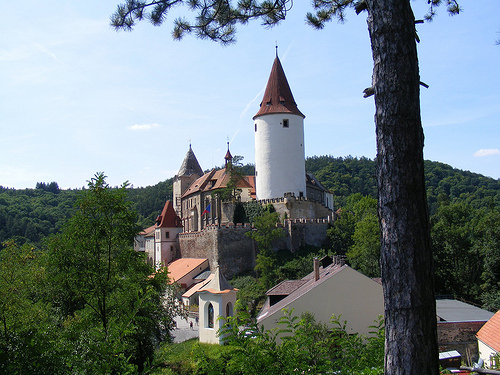
Location: 13 km (8 mi) Southeast of Rakovnik Map
Constructed: 13th century
Tel. 313 558 120
Open:
Mar
9am- 12pm, 1pm- 3pm Sat, Sun
Apr- Oct: 9am- 12pm, 1pm- 3pm
Tue- Sun
Nov, Dec: 9am- 3pm Sat, Sun
Křivoklát (Pürglitz in German) is one of the oldest and most important medieval castles of Czech princes and kings. It is located at an altitude of 285-290 meters above sea level on a rocky promontory above the Rakovník stream, a tributary of the Berounky river in the territory of the town of Křivoklát in the Rakovník district in the Central Bohemian region. The castle is owned by the Czech Republic and is open to the public. It has been protected as a cultural monument since 1965, and in 1989 it was entered on the list of national cultural monuments of the Czech Republic. It is managed and made available to the public by the National Institute of Monuments.
Early Origins (11th–13th Centuries)
The site’s history dates
back to the late 11th or early 12th century. The first written
mention appears in the Chronica Boëmorum (Chronicle of the
Bohemians) by Cosmas of Prague (c. 1119–1125), describing Křivoklát
as a lesser country seat (a smaller princely residence) subordinate
to the court at nearby Zbečno, about 4 km away. Přemyslid princes
used these forest seats as resting places during hunts in the
surrounding woods. The name “Křivoklát” likely derives from an old
Czech word related to “pine scrub” or similar vegetation.
Initially a wooden structure, it evolved into a stone castle between
roughly 1230 and 1240 during the reigns of Kings Přemysl Otakar I
(1198–1230) and Wenceslaus I (Václav I, 1230–1253). Archaeological
research (2004–2006) confirmed the stone castle stood on the site of
the earlier wooden dwelling. The upper castle, with its small early
windows, dates to this period.
During the reign of Přemysl Otakar
II (1253–1278), known for territorial expansion, the castle
underwent major expansion. It was enlarged upward with a new level
featuring a grand hall and chapel, transforming it into a
full-fledged High Medieval royal seat. This marked its shift from a
simple lodge to a more monumental fortress and residence.
Peak as a Royal Residence (14th–Early 16th Centuries)
Křivoklát
flourished under the Luxembourg dynasty. King Wenceslaus IV (Václav
IV, r. 1378–1419), a passionate hunter, was particularly fond of the
castle and spent significant time there. He rebuilt and expanded it
substantially: a new rectangular residential building was added,
along with towers like Huderka and Prochoditá, a new north wing to
the upper castle, and strengthened fortifications with ramparts and
corner turrets. It served as an important royal residence and
refuge. Notably, Wenceslaus IV had the Czech crown jewels
temporarily stored here for protection during the Hussite Wars.
The castle played a role in turbulent times. It was conquered by
both Hussite and Catholic forces during the Hussite Wars (early 15th
century). The future Holy Roman Emperor Charles IV (as a child) was
reportedly imprisoned here for about three years in the early 14th
century (under different circumstances during dynastic struggles),
an experience that left a mark despite his later visits.
In the
late 15th and early 16th centuries, under King Vladislaus II
(Vladislav Jagellon, r. 1471–1516) of the Jagiellonian dynasty, the
castle received its most distinctive Late Gothic form, largely
preserved today. Reconstruction between 1490 and 1500, led by
burgrave Jan Hrozek of Proškovice (possibly involving architect Hans
Spiesse), focused on the upper castle. This included monumental
remodeling and the stunning Gothic chapel (Chapel of the Coronation
of the Virgin Mary), one of the finest examples of Vladislaus Gothic
with intricate sculptural ornamentation, tracery, and details. The
castle became a magnificent royal residence once more.
Decline into a Prison (16th–18th Centuries)
After the
Jagiellonian era, Křivoklát’s role shifted. It was used primarily as
a prison for prominent or high-security inmates, leading to neglect.
Notable prisoners included:
Jan Augusta (and Jakub Bílek),
bishops/leaders of the Unity of the Brethren (Bohemian Brethren),
imprisoned for 16 years after the 1548 uprising against the
Habsburgs; Augusta endured harsh conditions in a dark cell.
Edward Kelley (or Edward Kelly), the English alchemist and courtier
of Emperor Rudolf II, incarcerated around 1591 after killing a man
in a duel.
During the Thirty Years’ War (1618–1648), Saxon
soldiers ransacked the castle. In 1658, it was mortgaged to the
Schwarzenbergs and then the Wallensteins (Waldsteins). Emperor
Charles VI sold it to the Fürstenberg family in the early 18th
century.
The castle suffered multiple fires over the centuries,
contributing to deterioration.
Fürstenberg Era and
Reconstruction (19th–20th Centuries)
The Fürstenbergs owned
Křivoklát from the 18th century until 1929. A major fire in 1826
devastated the roofs and interiors, leaving it in poor condition. In
the mid-19th century, spurred by archaeologist and art historian Jan
Erazim Vocel, they initiated extensive reconstruction under
architect Josef Mocker (known for Gothic Revival work). Further
alterations occurred in the 1930s under Kamil Hilbert after the
Czechoslovak state purchased it in 1929.
These efforts restored
its Gothic character while adding features like the large library
(assembled in the 18th century with ~52,000–53,000 volumes in
multiple languages).
Modern Era
Today, Křivoklát is a
museum and popular tourist site open year-round, with guided tours
showcasing the Gothic chapel, royal and knights’ halls, library,
hunting weapon collections, medieval art, Fürstenberg museum, towers
(including the climbable 13th-century Great Tower), black kitchen,
and ramparts offering panoramic views. It hosts events like medieval
festivals (Křivoklání), summer programs, and Christmas markets.
It has also served as a filming location, notably for Halsey’s 2021
visual album If I Can’t Have Love, I Want Power.
The castle served as a dreaded state prison after the accession of
the Habsburgs to the Czech throne. However, it also served as a prison
before. Famous prisoners were:
Otto II Olomouc (1085–1126), in 1110
he was imprisoned here by the Czech prince Vladislav I.
Jindřich of
Šumburk, Vyšehrad canon, imprisoned in 1318
Henry of Habsburg, Duke
of Austria, from 1322 for one year
Charles IV (1316–1378), in early
childhood. Karel was taken from his mother Eliška Přemyslovná, who was
planning a rebellion against her husband Jan Luxemburgský. And so was
Charles IV. transferred to Křivoklát. The stay of Charles IV can be
viewed in this sense. like in prison.
four leaders of the rebellion
of Kutnohorské havíř in August 1496. Three of them were executed in the
courtyard, the fourth escaped when he stunned the executioner. Another
ten leaders of the uprising were executed on the site of today's Church
of the Assumption of the Virgin Mary in Poděbrady.
Jan Augusta
(1500–1572), bishop of the Fraternal Unity, was imprisoned in the castle
for sixteen long years (1547–1563). He was guarded by twenty guards from
Germany so that he could not negotiate with them. He tried to escape,
was caught and tortured.
Jakub Bílek (1516–1581), brother priest and
secretary of Jan Augusta, described August's hardships, imprisoned for
thirteen years.
Edward Kelley (1555–1597), an English alchemist who
gave Emperor Rudolph II. he promised the elixir of life and the
transformation of base metal into gold. When he killed one of the
courtiers, Rudolph ran out of patience and was imprisoned here.
1109–1110 mention of a hunting station in the Kosmos Chronicle
1319–1323 forced stay of the later emperor Charles IV.
1335 Blanca of
Valois gave birth to her daughter Margéta here
1380 Wenceslas IV.
received the delegation of the English king Richard II at the castle.
1422 fire
1597 fire
1643 fire
1655 (1658) mortgaged to the
Schwarzenbergs
1685 sold to the Valdštejn family
1723/1733–1734/1756 passed to the Fürstenbergs by marriage
1826 fire
1929 Maximilian Egon II. sold the castle to the state
1951
termination of operation of the brewery
? in the administration of
the State Monument Institute of Central Bohemia
1994 (July) – 2000 in
the administration of the State Castles of Křivoklátsk (SHK,
contribution organization established by the Ministry of Culture of the
Czech Republic, together with the castles, Krakovec, Točník and Žebrák)
2001–2002 in the administration of the State Monument Institute of
Central Bohemia, based in Prague
2003 (January 1) in the
administration of the National Monument Institute
The castle stands on a false promontory formed by ancient mountain debris and clay-like slates, which were used as building material. The Rakovnický stream flows around the steep slopes of the spur on three sides, and easy access remains only on the eastern side.
The construction site of the castle has an approximately triangular
plan. It was protected by a perimeter wall and another transverse wall
divided it into a larger lower and smaller upper castle (castle core).
The entrance gate was located under the square tower in the southwest
corner. Along the western wall stood a building that probably served as
the burgrave's house. A rectangular hall palace was built behind the
transverse wall and a large round residential tower (donjon) connected
to the walls at the eastern end. The palace was later rebuilt many
times, and the Romanesque windows on the ground floor have been
preserved from its oldest phase. The ramparts at the base of its donjon
are reinforced in such a way that they fill the entire space of the
corner, thus forming a massive edge. After the middle of the thirteenth
century, residential premises and farm buildings were further expanded.
A two-room building was added to the southern wall, and the rest of
the lower courtyard was divided into several parts by transverse walls.
In the northern corner, where the well is located, there were
outbuildings, among which was a simple dugout. In the palace, the
passage of a new gate to the upper castle was created, which is equipped
with a sedilia and arched by two fields of a cross vault. The new
passage was necessary because the other sides of the courtyard of the
upper castle began to be filled with the construction of new palaces.
Among them is the older flat-ceilinged south wing, whose ground floor
still had Romanesque windows.
These modifications were smoothly
followed by further expansion of the representation spaces. In the lower
courtyard, next to the northern wall, a second palace precinct connected
with the power ambitions of Přemysl Otakar II began to be created, in
which important visitors were to be accommodated. It was formed by two
opposite palace wings, which squeezed a narrow courtyard between them.
The southern side was closed by an arcade with an entrance from the
lower courtyard. In the west wing there was a large hall and a wooden
chamber. A northern wing with a toilet tower was created in the castle
core, and the eastern side was enclosed by a wall. A small courtyard and
a trapezoidal courtyard enclosed by the palace wings were thus created
under the large tower. It was surrounded on all sides by a single-story
arcaded walkway. On the first floor of the western palace, a large hall
was created, arched by four fields of six-part vaults and lit by eight
tracery pointed windows. On the floor of the southern palace there was a
smaller hall, several rooms with barrel vaults and cross vaults, and the
entire wing ended with a chapel. The northwest corner of the lower
castle was occupied by a square tower.
At the beginning of the fourteenth century, the castle burned down.
The younger palace precinct in the lower castle quickly disappeared, and
the other buildings were only kept in serviceable condition. Extensive
reconstruction was started by Wenceslaus IV, who liked Křivoklát
especially at the beginning of his reign and after 1390 began to give
preference to other castles.
Modifications of Wenceslas IV.
touched the whole castle. A Passage Tower with a new gate was built
approximately halfway along the length of the southern wall. Because of
it, the terrain in a large part of the lower courtyard had to be
lowered, and therefore its division by transverse walls disappeared,
with the exception of the wall that separated the well courtyard. The
old gate has been removed. The entire castle was surrounded by a new
fence wall. In the northern corner, it was connected to the narrow area
of the so-called Manx house, which consisted of an elongated courtyard
and a well-built palace topped by a square tower. A new access road
protected by a pair of gates led to the castle along the southwest side
of the palace. A rectangular building, perhaps also topped with a tower,
was built in the southwest corner. Along the western wall of the lower
courtyard, a new burgrave building equipped with a large hall on the
first floor was built. It was built by the court smelter according to
well-executed architectural details. The lowering of the terrain of the
lower courtyard forced the modification of the gate to the upper castle,
the level of which had to be significantly lowered. At the same time,
the northern wing of the palace was also rebuilt.
During the
Hussite Wars, the castle was heavily damaged. Due to its condition, the
burgrave's building served only as a granary, and the burned-out area of
the Manx house was never restored. Repairs took place only during the
reign of King George of Poděbrady. The protruding building in the
southwest corner was shortened and a three-room building of the new
burgrave was built along the northern wall of the lower castle.
Křivoklát was the only royal castle that King Vladislav Jagiellonian
had in Bohemia. He therefore devoted considerable attention to its
reconstruction, and the modifications made to the residential part of
the castle turned it into a residence that was among the best residences
in Central Europe. At the same time, the defense system was modernized,
in which a number of modern elements of active defense were used. The
reconstruction was directed by masters Benedikt Rejt and Hans Spiess.
The castle core was completely rebuilt. The arcades and the dividing
wall between the courtyard and the courtyard under the great tower were
pulled down. The individual floors of the palaces were connected by a
new four-legged staircase. With the exception of the ground floor, the
northern palace wing was also demolished and rebuilt. The Great Hall in
the Western Palace received a new vault and a bay window above the
passage of the gate. Its facade is decorated with reliefs of Vladislav
Jagiellonian and his son Ludvík. Decorative architectural details,
including the so-called Manx loggia at the gate and the altar in the
chapel, come from the workshop of master Hanuš Špiss. The large tower
was also modified, gaining a new entrance on the first floor, which was
accessible from the northern palace wing. Its floors were connected by a
staircase in the strength of the wall. Both the palace and the tower
were finished with half-timbered or half-timbered defensive mezzanines
with a number of bay windows.
In the lower castle, the buildings
along the northern wall, including the wall itself, were demolished. The
old tower in the northern corner was replaced by the prismatic Huderka
tower with a brick helmet. Along the original wall, a number of Manx
houses with kitchens were built, and just below the castle core, a
second kitchen object, which was partially pushed into the fence.
Passage through the fence is made possible by an arched corridor. The
development along the western wall also expanded. The castle brewery was
located to the west of the Passage Tower and connected to it was the
newly built two-story Hejtmanský dům.
The main line of defense
became a fence wall with covered shooting galleries and bay windows. It
was protected by a number of progressive elements of active artillery
defense, such as a battery tower, a bollwerk or a round Golden Bastion
on the southwest corner. The gate in the Passable Tower was secured by a
new rampart with casemates. The access road to it was protected by a
moat with a low gate tower. It was later replaced by a stage gate in the
transverse wall, which was demolished only in the nineteenth century.
During the Renaissance, almost no construction was done on the
castle. Until King Ferdinand I had small repairs made to the windows,
fireplaces and interior doors so that the castle could be lived in.
Emperor Rudolph II he had some buildings fitted with sgraffito plaster,
but otherwise he did not attend to the castle, and even after the fire
in 1597 he had only the most necessary repairs carried out. A project
for a larger repair was drawn up in 1638, but it did not take place.
Only a fire that destroyed 38 rooms made King Ferdinand III. for repair,
which lasted until 1644. Only the large tower remained unrepaired. The
southern palace wing was repaired again in 1685. Around 1756, the
Fürstenbergs had the great royal hall divided into two floors. A number
of rooms were created in the lower one, and the upper one began to serve
as a warehouse.
The fire of August 18, 1826 destroyed practically
the entire castle. Repairs began only in 1856 and, with many breaks,
lasted until 1921. From 1929, the Czech state continued them, but the
interruption caused by the Second World War meant that they were not
completed until 1952.
Late Gothic Chapel of the Coronation of the Virgin Mary from the time
of King Vladislav II. Jagiellonian is located in the southern wing of
the castle core. It replaced the older St. Wenceslas chapel from the
thirteenth century. Instead of the original straight end, it got a
polygonal closure and was covered by a net vault. In the side walls
there are rows of seats separated by a helical central column and
decorated with mitred arches with crabs. The portal to the sacristy is
decorated with a relief plant ornament.
The altar is a work of
art from the period after 1490, the author of which is an unknown master
who probably came from the circle of Hanuš Spiess from Frankfurt am
Main. It has the form of a winged ark with a wood carving of the
Coronation of the Virgin Mary in the central part, which is complemented
by painted scenes from the life of the Virgin Mary and saints. The
author of the paintings is an unknown painter referred to as the Master
of the Crooked Altar. The gaze of the Virgin Mary is directed to the
large stone seat on the right in the presbytery, where there used to be
a place intended for the monarch and his family. Above the seat there
were originally two coats of arms of the Kingdom of Bohemia, but during
the restoration of the chapel at the beginning of the twentieth century,
they were removed and replaced with Fürstenberg family coats of arms.
The large tower in the castle core is one of the less common donjons, as residential towers in Bohemia were usually square. It has been part of the castle since the first construction phase. It is 42 meters high and twelve meters in diameter. Originally, the tower was entered through a portal at the level of the second floor from the southern palace wing via a drawbridge. The wooden structure to which the bridge adjoined burned down in the last big fire of the castle in 1826 and was not restored later. Secondarily, a new portal was opened on the first floor, which was entered from the northern palace wing. The entrance on the ground floor, which leads to the starvation chamber, dates from 1750. After breaking through it, six skeletal remains were found here. The defensive function of the tower is also evidenced by the strength of the walls. On the courtyard side, where there was no real danger, it measures about 2.5-3 meters. On the outside, where the tower is connected to the wall, the width of the wall reaches up to ten meters.
Křivoklát Castle (Hrad Křivoklát) is one of the oldest and most
historically significant royal castles in the Czech Republic, located
about 40-60 km west of Prague in the Central Bohemian Region, in a
picturesque protected landscape area along the Berounka River valley
surrounded by dense forests.
It originated in the 12th century as a
hunting lodge for Czech princes and kings (Přemyslid, Luxembourg, and
Jagiellon dynasties) and later served as a notorious prison for
political and religious figures. It was reconstructed multiple times,
notably after fires, with significant 19th-century work under the
Fürstenberg family. Today, it's a national cultural monument known for
its well-preserved Gothic features, impressive interiors, and
atmospheric, less-crowded feel compared to more touristy sites like
Karlštejn.
Why Visit and Best Time
Highlights: A stunning
late-Gothic chapel (one of the best-preserved in Europe, with a 1490
winged altar), the second-largest Royal Hall in Czechia (after Prague
Castle), a vast Fürstenberg Library (over 50,000 volumes), picture
gallery, museum, prisons/dungeon with torture replicas, ramparts, and a
climbable 13th-century round tower offering panoramic forest views.
Atmosphere: Authentic medieval vibe with fewer crowds, local visitors,
occasional performances (falconry, shows), and film-set potential (used
in movies like The Brothers Grimm).
Best time: Late spring to early
autumn (May–September) for full opening hours, pleasant weather, and
events. It’s open year-round but with reduced hours in winter. Avoid
Mondays when it’s typically closed. Visit early in the day for English
tours and to beat any groups.
Getting There
By train (easiest
public option, ~1–1.5 hours from Prague): From Praha hlavní nádraží
(main station) or Smíchov to Beroun (change there), then local train to
Křivoklát station. Use the IDOS app or České dráhy (cd.cz) for
schedules—cheap round-trip tickets. From the station, follow the short
nature trail/pedestrian path (a few minutes' walk, across a bridge)
uphill to the castle.
By car: ~45–60 minutes from Prague. Parking is
available ~250m above the castle (follow signs; there’s a pedestrian
bridge option).
Organized tours: Private car tours from Prague or
combined with other sites are popular for convenience.
Opening
Hours and Tours (as of 2026 info—always verify on official site)
The
castle is generally open Tue–Sun. Key options include:
Gothic Palaces
– short tour (~60 min): Second courtyard, silversmithery, prisons,
dungeon, chapel, Knight’s Halls, etc. Starts around 9:00–17:00 in peak
season.
Castle Palaces – long/basic tour (~80 min, most popular):
Adds library, picture gallery, Fürstenberg Museum. Highly recommended.
Castle Grand Tour (~100 min): Most comprehensive, including ramparts and
Large Round Tower (72 narrow, winding steps—steep!).
Self-guided:
Outer areas, walls, and tower often accessible separately.
Tours
are mostly in Czech with printed English guides (or occasional English).
Book online via the official site if possible
(weblist-npu.colosseum.eu). Max group sizes apply.
Ticket prices
(approximate, check official for current; discounts for seniors, youth,
children 6–17, disabled):
Short: ~210–260 CZK adult.
Long:
~240–300 CZK.
Grand: ~260–360 CZK.
Family tickets or combos may be
available. Outer courtyard often free.
In-Depth Visiting Tips
Duration: Plan 2–4 hours total (tour + courtyard exploration, lunch,
views). Grand tour + extras can fill half a day.
What to expect on
tour: Guided walks through historic rooms. Key stops include the Gothic
chapel (note wooden details like rats on pews—symbolism?), Royal Hall
(royal audiences, throne positioning for dramatic effect), library
(impressive collection used by historians), prison cells (e.g., Jan
Augusta’s 16-year confinement, alchemist Edward Kelley), and lapidarium.
Learn about secret marriages, royal history, and famous prisoners.
Accessibility: Limited—mainly the 1st courtyard with assistance. Steep
stairs, uneven surfaces; not ideal for mobility issues. Check official
for details.
Photography: Allowed in most areas (no flash in
sensitive spots). Great shots from ramparts/tower.
With
kids/families: Engaging for history buffs; courtyard activities,
possible events. Family discounts help.
Weather/season: Dress in
layers—castles can be cool/damp. Good shoes for stairs and paths. Winter
visits are possible but shorter.
Practical: Toilets, small shops
(souvenirs, books, ceramics), café/snack bar in courtyard. Mint your own
coin or try archery if available. Pets restricted.
Combine with
nearby: Easy day trip; pair with Karlštejn (another castle) or forest
hikes. Stay overnight in town for a relaxed vibe (hotels like Sýkora).
Food and Amenities
On-site: Hradní krčma or similar for Czech
classics (soups, sausages, hearty meals) in a medieval setting.
Nearby: Restaurace pod Hradem, Hotel Sýkora, or village spots. Picnic in
the scenic surroundings.
Extra Tips for a Great Visit
Arrive
early for the best English tour slot and fewer crowds.
Check the
official website (hrad-krivoklat.cz/en) for exact schedules, events
(festivals, markets, performances), and online tickets.
Download the
IDOS app for trains; bring cash/CZ cards for tickets/food.
Respect
rules: No touching artifacts, quiet in interiors.
For your travel
website (ermakvagus.com), note the rich Russian/Central European
historical ties and Gothic details—great for detailed guides with
photos.