Location: Central Bohemia
Regional Museum
Location:
Brandlova 27
Tel. 321 723 841
Open: Tue- Sun
Kolín (German: Kolin, Köllein, Collin) is a city in the Kolín
district in the east of the Central Bohemian Region, located on the
Elbe River. It is also a municipality with extended scope.
Approximately 33 thousand inhabitants live here and it has an area
of 35 km² with an average altitude of 220 meters. It lies about 60
km east of Prague on both banks of the Elbe.
Kolín was
probably founded before 1261 by Přemysl Otakar II. The preserved
historical core is protected as a city heritage reserve. In 1845,
Kolín was connected to an important railway between Prague and
Olomouc, this fact is very important for the further prosperity of
the city, and from the second half of the 19th century the city
underwent rapid industrialization.
Cologne is an important
railway junction. The chemical, automotive, engineering, food,
printing and metallurgical industries are represented here.
In honor of the local music composer František Kmoch, the Kmochův
Kolín International Brass Music Festival takes place in Kolín, and
the work of the photographer Jaromír Funke is commemorated by the
Funke Kolín Photography Festival.
Since 1989, the historic core has been declared a city
monument reserve. It has preserved the original medieval
floor plan. On Charles Square there are Baroque houses, a
neo-Renaissance town hall, a plague column and a fountain.
The southwestern part consists of a former Jewish ghetto
with a synagogue from the 17th century. The center is
surrounded by a double belt of walls (partially preserved)
with a fence. The advanced part of the city fortifications
on the right bank of the Elbe is called the Powder Room. It
dates back to the 15th century, and later served as a
gunpowder warehouse.
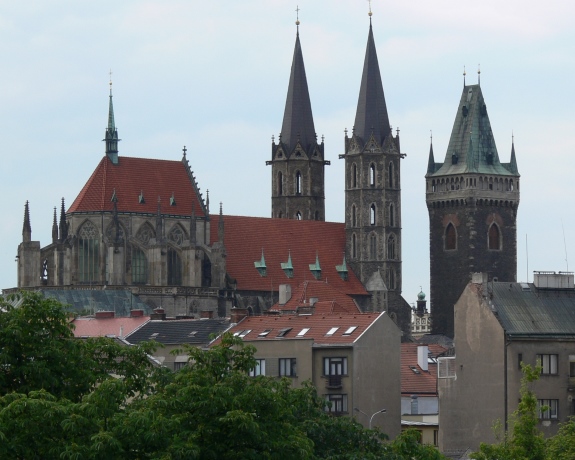
The dominant feature of the city
is the church of St. Bartholomew, originally early Gothic
from the second half of the 13th century. Petr Parléř
participated in its reconstruction into a Gothic cathedral
at the end of the 14th century. It is a national cultural
monument. Other churches in the city are the Baroque Church
of St. Vitus na Zálabí (originally Gothic from the 14th
century), the Church of the Holy Trinity with a Capuchin
monastery, the Church of St. John the Baptist, now used by
the Orthodox Church, the Church of the Czechoslovak Church
from 1932 and the ruins of the Church of All Saints near the
railway station. Houses at the Zlatého jablka on Charles
Square or Budilova's villa in Bezručová Street are listed
buildings.
West of the city center is the second
oldest and second largest Jewish cemetery in Bohemia from
1418 with more than 2,600 tombstones. It is here
also
the tombstone of the son of the well-known Prague rabbi Löw
from 1599. There is a new Jewish cemetery in Zálabí, founded
at the end of the 19th century. It was extensively damaged
during the Second World War and during the construction of
the bridge over the Elbe.
In front of the gymnasium
building, a restored monument to Tomáš Garrigu Masaryk has
been standing since 1990. It was found in 1989 under coal
and old tires in the cellar of the Nelahozeveské castle
together with the T. G. M. monument by Břetislav Benda from
1946 for Brandýs nad Labem.
Since 2007, the renewed
Kolín beet groove has been in operation. You can pay for a
ride around Cologne along this line. Today it is about four
kilometers long. Today, a well-known Cologne building is
also the defunct Cologne waterworks, as well as the
"sixteenth floor" known among the locals, the tallest
building in Cologne, with a pharmacy on the ground floor. In
addition, there are architecturally valuable interwar
buildings of the gymnasium (originally a business academy)
or the Cologne railway station.
From the second half
of the 19th century, the city developed dynamically as the
industrial center of central Polabí, thanks to which it
became the largest city in eastern central Bohemia. A number
of industrial monuments from this period have been preserved
today:
The castle brewery with a malt house in the
grounds of the Cologne castle, first mentioned in 1531,
rebuilt by the prominent economic expert František Horský
from Horskyfeld between 1865 and 1873. Currently, some
buildings have been repaired, others were needlessly
demolished by the city.
Radimského or the so-called
Podskalský mill on the Podskalské embankment at Zálabí,
first mentioned in 1285, rebuilt in 1870 and 1923. The mill
was operated from 1851 by the famous Radimský family from
Cologne, whose members included prominent politicians and
artists. The most famous representative is the painter
Václav Radimský. Currently, the mill is maintained, but it
is dilapidated.
Formánek's mill with a machine shop and
foundry in Rybářské street, first mentioned in 1285, rebuilt
in 1879. The owner was, among others, Josef Formánek, mayor
of Cologne from 1868 to 1890. Today used as warehouses and
workshops for smaller businesses. The area is currently
dilapidated.
The Cologne factory for coffee substitutes,
famous as the so-called Cologne chicory, built in 1894 by
the well-known politician and architect Čeňko Křička. Later,
she switched to making sweets. A silo was added in 1987.
Still functional today with exceptionally well-preserved art
nouveau elements and a 35-meter high brick chimney.
Vavruška Sodovkarna. The company was originally founded as
an oil pressing factory by Ignác Selikovský in 1856, taken
over by the Fischer brothers in 1861. In 1912, Otakar
Vavruška bought the building and started the production of
lemonades here under the Koli brand to this day. Extensions
took place in 1951–1953, but most of the buildings were
preserved in their condition after the fire of 1877.
Joint sugar factory, joint-stock company, built in 1864 by
the Pardubice builder Karel Krátký east of the railway
station. Most of the buildings were demolished in 2010. Only
a small production building and a building for officials
remain today.
The Kolinea confectionery and chocolate
factory in the street on the coast east of the center,
founded in 1896 by Karel Cyvín, extended between 1940 and
1942. Production ended in the 1950s.
Joint-stock factory
for the production of artificial fertilizers and lučebka on
Pražská Street, the so-called Lučebka. Founded in 1871.
Continuous additions. Still functional today, it produces
building and industrial chemical products.
Czech
joint-stock company for refining kerosene in Ovčárecká
street in Zálabí, or Petrolka, since 1925 part of the Vacuum
Oil Company, later KORAMO. Built between 1902 and 1903,
modernized between 1929 and 1939, restored in 1945 after air
raids during the Second World War. Still functional and
well-preserved, part of the Unipetrol concern.
Joint-stock company for the processing of potassium lye in
Havlíčková Street, the so-called Draslovka. Founded between
1907 and 1908, rebuilt in 1935, restored after air raids in
1947. Still functional and well-preserved, it mainly
produces and processes hydrogen cyanide. There are also two
valuable brick factory chimneys, 64 and 35 meters high, in
the area. The original building of the so-called new
distillery from 1871 has also been well preserved between
the potash plant and the railway.
Wiesner's machine shop,
founded between 1870 and 1875 in Rybářská Street No. 56 next
to the Cologne station. It mainly produced equipment for
sugar factories. It ceased to exist in 1936, at the
beginning of the 1950s the production of ovens was moved
here. Furnaces are manufactured here under the Elektroteplo
brand to this day. The entrance building with decorative
elements on the facade, situated in a picturesque corner
next to the branch of the Elbe river, is particularly well
preserved.
Masaryk bridge, lock and hydroelectric plant.
The bridge was built between 1924 and 1927, the power plant
in 1931. The entire complex is still functional, the
hydroelectric power plant was reconstructed between 2011 and
2012 and fitted with new technology, including turbines.
The footbridge to Kmochův ostrov, built in 1885. The stone
pillars were made by the Cologne builder Josef Sklenář, the
iron structure was supplied by the Vojtěšská huť in Kladno.
Still fully functional today.
The ESSO power plant in
Tovární street in Zálabí, built by architect Jaroslav
Fragner in 1932. A very valuable functionalist building,
after 1948 it was used as a heating plant. It is still
functional today. The factory replaced the original Křižík
steam power plant near the station from 1911, of which only
the small building No. 271 in Pod Hroby Street has survived
to this day.
In addition to the above mentioned,
there are a number of other well-preserved sites in Kolín,
e.g. Stanislav Orl's chemical factory in Brankovická street
in Zálabí, the Fram car factory in Ovčárecká street in
Zálabí, the Prchal-Ericsson / Tesla site or the ironworks of
Josef and Prokop Červinkov in Havlíčková street,
Veletovského brickyard in Plynárenská street and the
Kašparides brothers' machine shop in Polepská street.
However, a potentially very attractive industrial heritage
is still not systematically developed, despite its abundant
presence. On the contrary, some demolitions have already
taken place, in addition to part of the buildings of the
castle brewery (spilka, barley grounds), in 2007 the
valuable site of the printing house of J.L. Bayer, which
included buildings from the end of the 19th century and from
the 20s of the following century, was also demolished. The
Futurum department store was built in its place, but it was
designed without any connection to the history or
architecture of the famous company.
In addition to
the two Jewish cemeteries, the city in the Zálabí district
is home to the Municipal Cemetery (1880) and an Evangelical
cemetery. Another public burial ground is the cemetery in
Sendražice and the columbarium in the church of the
Czechoslovak Hussite Church.
Kolín (often spelled Kolin in English) is a charming, underrated town
in the Central Bohemian Region of the Czech Republic, about 47–60 km
east of Prague on the Elbe (Labe) River. With around 33,000 inhabitants,
it offers a compact, well-preserved historic center, impressive Gothic
architecture (including work by Peter Parler), a rich Jewish heritage,
riverside vibes, and easy day-trip access.
It serves as an ideal
low-key alternative or add-on to the more popular Kutná Hora, with fewer
crowds and a genuine provincial Czech atmosphere. The historic core is
protected as an urban monument reserve, featuring Gothic, Renaissance,
Baroque, and early 20th-century styles.
Brief History
Kolín
was founded in the 13th century by King Ottokar II (Přemysl Otakar II),
relocating from flood-prone Starý Kolín. It thrived on trade routes to
Moravia and early silver mining (before Kutná Hora dominated). A Jewish
community settled in the 14th century. Key events include damage in the
Hussite Wars and Thirty Years' War, the 1757 Battle of Kolín (Seven
Years' War, Austrian victory over Prussians), and 19th-century
industrialization boosted by the Prague–Olomouc railway (1845).
The
town saw WWII impacts (e.g., refinery bombing; Zyklon B production
nearby). Today, it's known for the Toyota plant in the industrial zone,
but tourism highlights its heritage.
Best Time to Visit
Spring
(April–June) and Fall (September–October): Mild weather, fewer crowds,
beautiful light for photography.
Summer: Ideal for river activities
and festivals like the Kmochův Kolín brass music festival (honoring
local composer František Kmoch), but warmer and potentially busier.
Winter: Quieter, with possible Christmas markets, but colder and shorter
days.
Weather is temperate continental; check forecasts for rain. The
Elbe can influence local conditions.
How to Get There and Around
From Prague: Very easy by train (frequent departures from Praha hlavní
nádraží or Masarykovo nádraží, 35–60+ minutes). Kolín station is a short
walk from the historic center. Use the Czech Railways site (cd.cz) for
schedules.
It pairs perfectly as a stop en route to/from Kutná Hora.
Buses are options but trains are more convenient. Driving via D11
highway takes ~45–60 minutes. Parking is available near the center.
Local transport: The old town is highly walkable. Rent a bike for river
paths or use local buses/taxis for outskirts (e.g., aquapark, Jewish
cemetery). The water tower offers views, and there are boat cruises on
the Elbe (e.g., Kolinea from Kmoch Island).
Top Attractions and
Things to Do
1. Karlovo náměstí (Karlovo Square) and Old Town
The
heart of Kolín: a picturesque main square with colorful burgher houses
in Gothic, Renaissance (sgraffito), and Baroque styles. Highlights
include the Neo-Renaissance Town Hall (rebuilt 1887 from a 15th-century
Gothic building) and the Marian Column (1682, plague memorial). Wander
the winding cobbled streets for photogenic lanes and hidden corners.
2. Church of Saint Bartholomew (Chrám sv. Bartoloměje)
The standout
landmark: a majestic Gothic church (13th–14th century) with
contributions by Peter Parler (Prague's St. Vitus Cathedral, Charles
Bridge). Climb the bell tower for panoramic views. Impressive interior
and exterior; one of Czechia's finest Gothic examples.
3. Synagogue
and Jewish Quarter
The Renaissance/Baroque synagogue (1696,
second-oldest/most valuable in Bohemia after Prague's Old-New) features
beautiful restored interiors and exhibitions on Jewish history. The
nearby old Jewish cemetery (15th century, one of Bohemia's
largest/oldest, ~2,500 tombstones) is atmospheric—get the key from the
synagogue. The preserved ghetto adds depth.
4. River Elbe and
Surroundings
Stroll tree-lined promenades, picnic, or cycle. Visit
Kmoch Island (park, playground, stage). Consider a boat cruise. Nearby
remnants of fortifications (e.g., Práchovna bastion) and the
functionalist water tower (1928, now an observation tower).
5. Other
Sights
Former castle/brewery remnants (late Gothic/Renaissance, now
mostly town-owned).
Gallery of the City of Kolín and museums (e.g.,
archaeology at Dvořák Museum, hygiene exhibition in Červinkov House).
Modern architecture: Masaryk Bridge (with hydro plant), Rondocubist
houses, Gymnázium building.
Aquapark for families.
Day Trip
Itinerary Suggestion (4–6 hours):
Arrive by train → Square and Town
Hall → Church of St. Bartholomew → Synagogue + Jewish sites → River
walk/lunch → Optional tower or gallery → Depart (or continue to Kutná
Hora).
Food and Drink
Enjoy traditional Czech fare: svíčková
(beef in cream sauce), goulash, pork knuckle, dumplings, and beer. Local
spots feature fresh Elbe-influenced options. Try trdelník or local
cheesecakes/cafés. Farmer's markets for artisanal goods. Czech beer is
excellent—pair with hearty meals.
Practical Tips
Accommodation: Limited but includes hotels, guesthouses, or day-trip
from Prague. Check for river views or central locations.
Safety:
Generally very safe (low crime). Standard precautions for pickpockets in
any tourist area; the town feels relaxed.
Language: Czech primary;
English/German more common in tourist spots. Learn basics (ahoj = hello,
děkuji = thank you).
Money/Accessibility: Euros sometimes accepted
but use CZK. ATMs available. Most sites are walkable; check for
stairs/towers.
With Kids: Aquapark, river activities, playgrounds on
Kmoch Island.
Events: Kmochův Kolín festival, historical battle
commemorations, cultural programs. Check infocentrum-kolin.cz.
Pro
Tips: Wear comfortable shoes for cobblestones. Download offline maps
(e.g., Maps.me). Visit the tourist info center (Na Hradbách 157) for
maps/guides. Combine with Kutná Hora for a full day.
According to the opinion of linguist Milan Harvalík, the name Kolín
is derived from the neighboring village of Starý Kolín, which used to be
called "Kolín" and the epithet "Starý" was given to it only later, after
the creation of today's city of Kolín; it used to be called "New
Cologne" (in the German environment the epithet "Neu" lasted longer).
According to Harvalík, the basis of the word "Kolín" is the personal
name "Kola" (which was the homely address of the bearer of the medieval
name "Kolimír") or "Chola" (according to the old Czech expression
"choliti", today the word "chlácholit"), to which a possessive suffix
was added "-in", which gave rise to the combination in the sense of
Chol's court, Chol's castle or Chol's property.
According to
other sources (presented, for example, on the city's official website),
the name comes from the Old Czech word "koliti", i.e. "to hammer pegs,
stakes", and is related to the location of Staré Kolín in the often
flooded area at the confluence of the Klejnárka and the Elbe, in the
vicinity of which she used wooden stakes to strengthen the soil. Later,
a more advantageous location was chosen for the developing market
settlement on a higher ground 7 km westward. The new settlement (and
later royal city) retained the name of the original settlement.
There are other, less likely interpretations. The name could also be
derived from its location on a high place, a hill - in Latin "colinus",
which, of course, contradicts the existence of Staré Kolín. According to
another theory, the Latin form of Colonia is related to the arrival of
German colonists in Bohemia.
Kolín was founded by relocation before 1261 (first written
mention) probably by Přemysl Otakar II. However, this area has
been inhabited continuously since prehistoric times, the
presence of Slavs can be documented as early as the 6th century
AD. By order of King Přemysl Otakar II. the city fortifications
were built from a double belt of stone walls. The medieval city
was also protected by the mighty river Elbe, but its opposite
bank was also fortified. A remnant of the fortification system
is the Zálab bastion, the so-called Powder Room, from the 15th
century.
In 1413, the city burned down and in 1421 it was
conquered by the people of Prague together with the Oreb
Hussites, who burned down the Dominican monastery. Six years
later, the town fell into the hands of the orphan governor Jan
Čapek of Sán, who held it until 1434. Then the town and the
surrounding church estates were controlled by the Tábor priest
Bedřich of Strážnice, who built the Lapis refugii castle on the
ruins of the monastery in 1437 and on the opposite rock behind
the Elbe, a high defensive tower. The castle was later rebuilt
into a castle by the Žerotín family and from the 19th century it
was used only as farm buildings and a brewery.
In 1454,
Bedřich allied himself with the Catholic opponents of the land
administrator Jiří z Poděbrady, lord of Hradec and Rožmberk.
Bedřich from Strážnice ruled the Cologne estate until 1458, when
Jiří z Poděbrady was elected king of Bohemia and banished
Bedřich to his Potštejn castle. Jiří from Poděbrady donated an
ungelt (market fee) in the gates and on the bridge, as well as a
yard in Křečhoř to the town.
After the death of the Czech
king George of Poděbrady in 1471, the city was in the possession
of his son Viktorin, prince of Minstrberk. He opposed the newly
elected King Vladislav Jagiellon and invited his brother-in-law,
King Matthias of Hungary, to Cologne. Hungarian troops held
Cologne until 1473. Then the city passed into the hands of
Viktorín's brother Hynek (apparently after the assembly in
Benešov, when Hynek became the administrator of the land). But
he also became Vladislav's opponent, after Vladislav did not
fulfill his promise to marry Hynk's sister Ludmila, and in 1476
he ceded the city to Matyáš for 20,000 guilders. In May and June
1477, Matyáš made two unsuccessful attempts to occupy the city.
At the convention in Jihlava (1486), Matthias finally returned
Cologne to King Vladislav.
But the city was considered
part of the Cologne castle and estate, whose governors or
registered holders themselves renewed the city council and
exercised influence over the political and judicial
administration of the city. This was changed in 1519 by King
Ludvík Jagiellon, who in his decree included Cologne again among
the royal cities.
However, not only good times awaited
him. In 1547, the city was heavily fined by King Ferdinand for
participating in the estate rebellion. The development of the
city was also damaged by fires in 1579, 1587, 1589, 1597 and
1617 and the plague in 1568, 1582, 1598 and 1613. And in 1618,
the people of Cologne took part in the estate uprising, for
which they were affected by the confiscation of the city's
estates after the Battle of Bílá Hora and by taking away many
privileges.
It wasn't until 1628 that the city was
declared Catholic and Ferdinand II. he returned most of his
privileges and also returned the confiscated estates. The city
further suffered great damage in the Thirty Years' War, when it
was repeatedly plundered by the Swedes in 1634, 1639–1640, 1643
and 1648. The city was hit by plague epidemics in 1625, 1633,
1640 and 1649.
The War of the Austrian Succession
(1740–1748) again severely damaged the city, as did another
seven-year war in the years 1756–1763, when the Battle of
Cologne (June 17, 1757) was fought, in which the Prussian King
Frederick II. defeated. Only the reforms of Maria Theresa
brought calm and development to the city. However, in 1796, the
city was almost completely destroyed by a great fire.
After the Napoleonic Wars, the city experienced growth and
prosperity. In 1845, Kolín was connected to the important
railway between Prague and Olomouc, this fact is very important
for the further prosperity of the city. From the second half of
the 19th century, the city underwent rapid industrialization.
The first (1856–1873) created food plants (oil mills,
distilleries, sugar factories, breweries, steam mills) connected
to the fertile agricultural background of the city, and a
logging factory producing fertilizers for the peasants. At the
turn of the 19th and 20th centuries, following on from the
previous plants, new factories with progressive branches were
established, this time mainly with a chemical focus. In the 20th
century, the city became one of the centers of the chemical
industry in the Czech lands.
At the time of the national
revival, Kolín was one of the first cities with a patriotic
movement. On December 28, 1890, Prof. T. G. Masaryk in front of
more than 400 listeners, among whom there was also a large
representation of the Jewish community, which previously leaned
more towards the Old Bohemians. Masaryk's lecture, which he gave
at the Civic Club in Cologne on July 6, 1895, on the occasion of
the 480th anniversary of Hus's burning, was also widely
attended. He prepared the lecture for print under the title Jan
Hus, our revival and our reformation.
In 1932, a thermal
power plant with the highest chimney in Bohemia was completed.
The power plant was designed by the architect Jaroslav Fragner
(along with a number of other buildings in the city). As of this
year, eight hotels were registered in the city (Central, Grand,
Lidový dům, Pošta, U černého kône, U Přemysla, Veselý), three
cafes (Arco, Lidový dům, U Amerikána), 12 financial
institutions, a trade committee, a sugar factory, two
distilleries, seven brickyards, 11 factories (including Hellada
soaps, Vacuum Oil Company mineral oils, Sedláček machines, also
chemical, coffee products or three for confectionery). The
district office, the district court, the district gendarmerie
headquarters, the main customs office, the tax administration,
the cadastral land surveying office, the state real gymnasium,
the business academy, the regional industrial school and also
the district hospital operated here.
Jewish settlement in Kolín dates back to the first half of the
14th century, with the earliest written records appearing in the
city’s official books in 1377. Over the following centuries, the
Jewish community grew into one of the largest and most
influential in Bohemia, holding significant economic, cultural,
and religious importance until the mid-19th century. Kolín was
sometimes referred to as the “Jewish town” due to its prominent
yeshiva (Talmudic academy), active Chevra Kadisha (burial
society), and a long line of respected rabbis, including
relatives of the renowned Prague scholar Rabbi Judah Loew (the
Maharal).
The Old Jewish Cemetery, founded around 1418,
stands today as the second most important Jewish burial ground
in Bohemia after Prague’s Old Jewish Cemetery. Located near the
historic Jewish quarter, it features over 2,600 gravestones,
with the oldest identifiable ones dating from the late 15th
century (around 1492). The atmospheric site, often overgrown
with vegetation, offers a poignant and serene glimpse into
centuries of Jewish life in the region. It was enlarged several
times before closing in 1887. A newer cemetery exists on
Veltrubská Street, but the old one remains the primary heritage
site.
During the reign of Empress Maria Theresa, who issued
harsh expulsion decrees against Jews in the 1740s (notably
ordering their removal from Prague and much of Bohemia in
1744–1745), an influential Kolín city official named Tumlíř
courageously refused to enforce the order to evict the local
Jewish population. Thanks to his defiance, the community was
able to remain. In gratitude, Jews in Kolín prayed for their
benefactor in the local synagogue during every major holiday,
preserving his memory as a symbol of solidarity and resistance
against persecution.
Visitors to Kolín can explore the
preserved Jewish quarter’s narrow streets, the historic
synagogue (now often hosting exhibitions), and the evocative old
cemetery — a must-see for anyone interested in Czech Jewish
heritage.
According to local legend, the knight Vuzan (or Vužan) prepared
for a long pilgrimage to Jerusalem. To ensure his wife would
remember him during his absence, he commissioned a special bell
for the Church of St. Bartholomew. His devoted wife contributed
by throwing several silver coins into the molten metal during
casting, believing this would give the bell a clearer, louder,
and more resonant tone.
The knight promised to return within
ten years. When a decade passed without any sign of him, his
wife, believing him lost, began to consider remarriage. On the
day of her new wedding, as she walked toward the church with her
bridegroom, her thoughts remained fixed on her first husband.
Suddenly, the bell began to ring out with a clear message:
“Hola, there comes my lord from war!” Moments later, the knight
Vuzan indeed returned from his journey, and the couple reunited,
living happily together for the rest of their days.
In 1796,
during a devastating fire, the legendary bell fell from the
church tower, shattered, and was later recast. The charming folk
tale was immortalized by the Kolín-born Czech poet and realist
Josef Svatopluk Machar in his poem Zvon (“The Bell”), part of
his collection Golgatha.
The Church of St. Bartholomew, an
early Gothic landmark founded in the 13th century under King
Přemysl Otakar II, dominates Kolín’s skyline. Its tower offers
panoramic views of the city, and the site also features an
atmospheric ossuary. The church remains a central historic
monument tied to this enduring local legend.
Kolín (pronounced approximately "ko-LEEN") is a historic town in
the Central Bohemian Region (Středočeský kraj) of the Czech
Republic, with a population of around 33,000 (as of recent
data). It lies in a fertile lowland along the Elbe River (Labe
in Czech), about 47 km (29 mi) east of Prague, making it an
accessible day trip or stop en route to places like Kutná Hora.
Location and Regional Context
Kolín sits at coordinates
roughly 50°1′41″N 15°12′2″E, at an average elevation of about
220 m (720 ft) above sea level. It occupies part of the Central
Elbe Table (Středolabská tabule), a lowland area within the
broader Bohemian Massif. This is one of the flatter, more
fertile parts of Bohemia, contrasting with the surrounding
hills, plateaus, and low mountains that characterize much of the
Czech Republic.
The town developed on a strategic trade route
connecting Prague to eastern Bohemia and Moravia (via Český Brod
and Čáslav). Its position on the Elbe has long facilitated
transport, trade, and settlement, though it also exposed earlier
sites to flooding.
Topography and Terrain
The
municipal territory covers approximately 35 km² and features
relatively flat to gently undulating lowland terrain typical of
the Central Elbe Table. The landscape is fertile and
historically supported agriculture. The Elbe River flows through
the town, dividing or bordering parts of it, with associated
floodplains, islands (such as Kmoch Island with parks), and
riverine features.
Eastern part: Includes Sandberk, an
artificial lake formed by flooding a former sandstone quarry.
This adds a water body for recreation amid the otherwise
agricultural and urban landscape.
Surroundings: Broad, open
lowlands with fields, meadows, and some wooded areas. The wider
region features loess deposits (wind-blown sediments from the
Pleistocene) that contribute to productive soils. Nearby areas
include river terraces and transitional zones toward slightly
higher ground.
The terrain is generally suitable for
cycling (e.g., along the Elbe Trail and EuroVelo routes),
walking promenades, and agriculture. It lacks dramatic relief
compared to Czech mountain regions but offers scenic river views
and accessible green spaces.
Hydrology: The Elbe River
and Water Features
The Elbe (Labe) is the dominant
geographical feature, flowing through Kolín as a major Central
European river that eventually reaches the North Sea via
Germany. It has shaped the town's history, economy (transport,
industry), and risks (flooding prompted the relocation from
Starý Kolín—"Old Kolín"—in the 13th century).
Riverbanks
feature tree-lined promenades, trails for walking/cycling, and
recreational spots ideal for picnics or relaxation. Islands and
floodplains add biodiversity and leisure options. Smaller
tributaries and historical confluences (e.g., with the Klejnárka
near the old site) influenced early settlement and etymology.
The artificial Sandberk lake provides additional aquatic habitat
and recreation in the east.
Climate
Kolín experiences
a temperate continental climate (warm summers, cold winters),
typical of Czech lowlands but with some oceanic influence. Key
characteristics include:
Temperatures: Annual averages around
8–9.5°C in lowlands; January means near or below 0°C (cold
winters with occasional snow); July means 18–20°C (warm
summers).
Precipitation: Relatively low for the country,
often 400–600 mm annually, with peaks in summer. Lowlands are
drier than mountainous areas.
Variability: Increasing trends
toward hotter, drier conditions with more extreme events (e.g.,
heavy rains, tropical days), consistent with broader Czech
climate shifts.
This climate supports agriculture but poses
challenges like drought risk in recent years and historical
flooding along the Elbe.
Soils, Vegetation, and Land Use
The fertile lowland soils—often chernozems (rich, black earths
developed under historical steppe/grassland conditions) and
brown soils—make the area highly productive for farming. Loess
deposits enhance this fertility.
Natural vegetation in such
lowlands historically included forest-steppe elements,
transitioning to broad-leaved deciduous forests (oak, beech) in
the wider Bohemian context, though much of the area is now
agricultural or urban. Riverine zones support riparian habitats
with willows, alders, and meadows. Sandy areas along the Elbe
can feature dunes or specific flora.
Land use mixes historic
urban core (protected as an urban monument reservation),
industrial zones (e.g., Toyota plant in the Kolín-Ovčáry area),
agriculture, and green spaces along the river. Forests are more
prominent in surrounding higher terrain.
Human and
Historical Geography
Kolín's geography influenced its
development: the move to higher ground in the 13th century
avoided floods, while the river and trade routes drove growth.
It became a railway junction in the 19th century, boosting
industry. The preserved old town (Gothic/Baroque buildings,
Church of St. Bartholomew, synagogue, Jewish cemetery) sits near
the river, blending seamlessly with the natural setting.
Modern geography includes suburban municipal parts (e.g.,
Sendražice, Štítary) and industrial extensions, while retaining
a compact, walkable historic center.
Practical Travel
Geography Notes
Accessibility: Excellent rail connections
(Prague ~40-50 minutes) and roads (I/12 to Prague). Ideal as a
base or stop for exploring Central Bohemia.
Recreation: River
trails, Sandberk lake, parks, and cycling routes. The flat
terrain is visitor-friendly.
Surroundings: Proximity to Kutná
Hora (silver mining history), Prague, and Elbe Valley
attractions. The fertile countryside offers rural excursions.
Kolín exemplifies the gentle, river-dominated lowlands of
Central Bohemia—productive, historically layered, and pleasantly
scenic without the intensity of Prague or mountain regions. Its
geography supports a balanced mix of urban heritage, industry,
agriculture, and nature, making it a rewarding destination for
travelers interested in Czech history and everyday landscapes.
For your ermakvagus.com guide, this pairs well with photos of
the Elbe, old town, and surrounding fields.
Historical Foundations and Multicultural Heritage
Kolín was
founded in the 13th century by King Ottokar II (Přemysl Otakar
II) as a relocated settlement from the flood-prone Starý Kolín.
It thrived on trade routes connecting Prague to Moravia and
benefited from nearby silver mining (though this later shifted
to Kutná Hora).
The town has a layered history:
Medieval
and Hussite periods: Early prosperity mixed Czech and German
populations. During the Hussite Wars (early 15th century),
Czechs predominated, and the town saw destruction (e.g., of a
Dominican monastery).
Early modern era: Damage during the
Thirty Years' War, followed by the pivotal Battle of Kolín
(1757) in the Seven Years' War, where Austrian forces under
Maria Theresa defeated Prussian King Frederick the Great. This
battle preserved Bohemian territorial integrity within the
Habsburg Empire and is still commemorated locally.
19th–20th
centuries: The 1845 Prague–Kolín–Olomouc railway spurred
industrialization. The town developed manufacturing, and today
it hosts a major Toyota/Peugeot Citroën automobile plant. WWII
brought tragedy, including the production of Zyklon B and the
near-destruction of the Jewish community.
Jewish heritage
stands out prominently. Jews settled in the 14th century,
forming one of Bohemia’s largest and most important communities
(sometimes called “Jerusalem on the Elbe”). The original ghetto,
synagogue (rebuilt in Baroque style in 1696, the second-oldest
and most valuable in Bohemia after Prague’s Old New Synagogue),
and old Jewish cemetery (founded mid-15th century, with over
2,500 tombstones, many from 1492 onward) remain key sites. The
community contributed significantly to trade and business until
the Holocaust decimated it; only a tiny fraction survived.
Architecture: A Chronicle in Stone
Kolín’s built
environment showcases Czech architectural evolution:
Gothic
core: The Church of Saint Bartholomew (national cultural
monument), with an early Gothic base and mid-14th-century
contributions by master architect Peter Parler (of Prague’s St.
Vitus Cathedral and Charles Bridge fame). Its dramatic towers
dominate the skyline; 19th-century restoration enhanced its
Gothic character.
Renaissance and Baroque: The main square
(Karlovo náměstí) features burghers’ houses with sgraffito
decorations, a Neo-Renaissance town hall, and ornate Baroque
facades. The former castle (late Gothic origins, later
Renaissance and brewery use) adds to the mix.
Modern and
interwar styles: Functionalist water tower (now an observation
point), Art Nouveau villas, Rondocubist houses (distinctively
Czech rounded Cubist forms emphasizing national identity
post-WWI), and modernist structures like the gymnasium with
patriotic sgraffito.
Other gems include the Masaryk Bridge
(with hydroelectric elements) and remnants of the Jewish
quarter’s intimate streets.
The town blends these layers
harmoniously with parks, riverside areas, and functionalist
touches, offering a microcosm of Bohemian architectural history.
Traditions, Festivals, and Performing Arts
Kolín embodies
broader Czech cultural traditions while nurturing local pride.
Czech culture generally mixes Slavic roots with German, Italian
(via Renaissance/Baroque), and other influences, emphasizing
folk customs, beer, hearty food, and a resilient national
identity shaped by history (including communist-era secularism).
Signature local event: The annual Kmochův Kolín brass music
festival honors František Kmoch (1848–1912), a composer,
conductor, and key figure in the Czech National Revival. Born
nearby and based in Kolín, Kmoch adapted folk melodies into
marches and polkas for brass bands, fostering national identity.
The summer festival draws international ensembles, filling
streets with music, majorettes, and festivities.
Other
cultural notes include:
A theater and active artistic scene.
A festival honoring pantomime pioneer Jean-Gaspard Deburau (born
in Kolín).
General Czech celebrations like Easter, Christmas
(carp dinners), harvest festivals, and folk dances, though Kolín
emphasizes its musical and historical commemorations.
Bears
(fairy-tale motifs) and public art appear in the townscape,
adding whimsical local flavor.
Cuisine and Daily Life
Cuisine aligns with Central Bohemian/Czech norms: hearty,
seasonal, and comforting. Expect potato and sauerkraut soups,
pork or chicken dishes with bread or potato dumplings
(knedlíky), roast meats, fruit-filled dumplings, apple strudel,
and koláče (sweet pastries). Local markets and bakeries feature
these, alongside beer culture. Riverside settings enhance casual
dining.
Daily life reflects a mid-sized Czech town: walkable
historic center, industrial outskirts, strong community ties,
and proximity to Prague for commuting/cultural access.
Demographics are predominantly Czech, with a historically
significant (now small) Jewish legacy and typical
secular/atheist leanings common in the modern Czech Republic.
Notable People and Cultural Output
Kolín has produced or
hosted figures like:
Photographer Josef Sudek.
Composer
František Kmoch.
Mime Jean-Gaspard Deburau.
Former
President Miloš Zeman (born 1944).
Others in arts,
literature, sports, and politics.
Contemporary Culture
and Atmosphere
Today, Kolín balances heritage preservation
with modern industry (auto manufacturing employs thousands). It
offers a peaceful, authentic Czech experience—cobbled streets,
river views, parks, and cultural events—away from Prague’s
crowds. Visitors praise its charm, Jewish sites, Gothic
landmarks, and lively yet relaxed vibe.