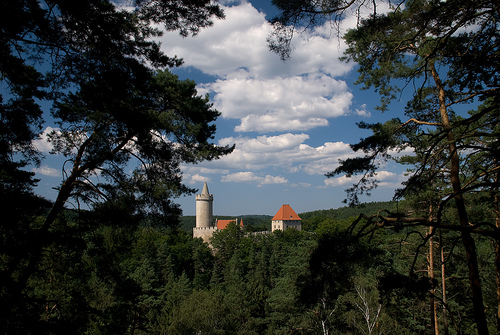
Location: 10 km (6 mi) Northeast of Mělník, Central Bohemian Region Map
Constructed: 14th century by Hynek Berka z Dubé
Tel. +420 315 695
064
Open:
May- Sept 9am- 12pm, 1pm- 4pm Tue- Sun
Apr, Oct 9am-
12pm, 1pm- 3pm Sun, public holidays
Nov- Mar: by appointment
Kokořín Castle (Hrad Kokořín) stands as one of the most picturesque and romantically reconstructed medieval sites in the Czech Republic. Located in the Kokořínsko Protected Landscape Area in the Central Bohemian Region (about 40–50 km northeast of Prague, near Mělník), it perches dramatically on a narrow, jagged sandstone promontory high above the forested Pšovka River valley. The castle integrates seamlessly with the surrounding bizarre sandstone rock formations and cliffs, using the natural terrain for defense while offering sweeping panoramic views of the wooded hills and valleys. Its remote, serpentine ridge location made it more of a secluded noble residence than a frontline fortress.
Origins and Early Medieval Period (14th Century)
The castle
was constructed around 1320 (or in the first half/mid-14th century)
by order of Hynek Berka of Dubá (also spelled Dubé), a powerful
Bohemian noble from one of the region's influential families. It
began as a fortified Gothic palace with a prominent tower and
defensive walls, strategically positioned for defense and oversight
of the surrounding lands. The first recorded mention of the Kokořín
manor dates to 1320, when Hynek granted it to Sir Jindřich of
Osměchov. Some accounts suggest earlier fortifications in the area
(late 13th century), but the standing castle structure originates
from this period.
Hussite Wars and Late Medieval Ownership
(15th–16th Centuries)
During the Hussite Wars, Hussite troops
captured and heavily damaged the castle in 1426, leaving it in poor
condition. It subsequently passed through multiple owners in the
15th century, including Řitka of Bezdědice and the Lords of
Klinštejn. In the late 15th century, the Klinštejn family renovated
it in late Gothic style, adding fortifications and decorative
elements. Ownership continued to shift in the 16th century to
families such as the Beřkovs of Šebířov and the Kaplířová. By this
time, the structure no longer met contemporary living standards and
fell into disrepair. It was officially listed as deserted by 1544.
Abandonment, "Cursed" Status, and Decline (17th–18th Centuries)
After the Thirty Years' War (1618–1648), the castle deteriorated
further into ruins. Emperor Ferdinand III (r. 1637–1657; some
sources cite Ferdinand II or simply "Ferdinand") included it among
the so-called "cursed castles" (prokleté hrady). These sites were
forbidden from repair or maintenance because their defensible
locations could potentially serve as rebel strongholds against
Habsburg authority. The desolate ruins became a refuge for marauding
knights and bandits. According to local legend, brigand knights led
by Petrovský of Petrovice used it as a base to terrorize the
countryside; this tale gained credence when workers discovered 22
human remains during 20th-century restoration.
Romantic
Rediscovery (19th Century)
By the 19th century, the overgrown
ruins had become a symbol of romantic decay. They inspired Czech
patriots, writers, and artists during the National Revival,
including poet Karel Hynek Mácha, and painters Antonín Mánes and
Josef Navrátil. In 1895, the Club of Czech Tourists raised awareness
by displaying a model at Prague’s Ethnographic Exhibition, making
the site partially accessible and sparking public interest.
Purchase and Romantic Reconstruction (Late 19th–Early 20th
Centuries)
In 1894 (or 1896 per some accounts), Prague
businessman Václav Špaček (of Starburg) purchased the estate and
ruins. His family—particularly son Jan—oversaw a major
reconstruction from 1911 to 1918, one of the earliest and most
comprehensive restorations of a medieval ruin in Bohemia. Leading
historians and experts supervised the work: August Sedláček, Čeněk
Zíbrt, Zikmund Winter, and architect Eduard Sochor. The project
blended preserved original Gothic elements with neo-Gothic/Romantic
additions, creating the castle’s present appearance (including the
distinctive round tower and red-tiled roofs). Critics noted some
stylistic liberties, but it transformed the site into a family
memorial and public attraction. The Špačeks added recreational
facilities below the castle (swimming pool, tennis courts), boosting
tourism in the Kokořín area.
20th Century to Present:
Nationalization, Restitution, and Preservation
After World War II
and the 1948 communist takeover, the castle was nationalized (around
1950–1951) under land reform laws and opened as a state monument. It
was declared a national cultural monument in 2001. Following the
Velvet Revolution and restitution processes, a 2006 court decision
returned it to the Špaček family heirs. Today it remains privately
owned by the family, who maintain it as a popular tourist site while
preserving its historical character. It is open to visitors
(typically April–October for guided tours), with exhibits on its
history inside.
Significance and Legends
Kokořín Castle
embodies Czech romantic nationalism and resilience. Additional
folklore includes tales of hidden treasure buried by feuding lords
and the ghost of a tragic maiden haunting the grounds at dusk—though
these are more atmospheric than historically documented. The castle
and surrounding protected landscape attract thousands of hikers and
history enthusiasts annually.
The castle was built before 1320 (first documented mention around
that year) by order of the powerful Bohemian noble Hynek Berka of Dubá,
a Prague castellan. It began as a compact Gothic fortified palace
complex typical of small Bohemian noble seats: a main residential palace
(palác) block combined with a defensive tower (likely an early version
of the current keep) and an enclosing curtain wall.
The design relied
heavily on natural defenses—the steep rocky outcrop and a deep chasm at
the entrance—supplemented by man-made fortifications including a main
gate protected by a tall, machicolated curtain wall (with openings for
dropping projectiles or boiling substances) and battlements. A narrow
passage beside the original (Old) Palace led to a lower courtyard, while
curtain-wall walkways allowed defenders to move between sections. Late
Gothic renovations occurred in the late 15th century under the lords of
Klinštejn, adding refinements to the walls and structures. Materials
were primarily local sandstone blocks quarried from the surrounding
cliffs, giving the castle its sturdy, earth-toned appearance. Interiors
were functional rather than lavish, likely including basic living
quarters, a possible chapel, and defensive elements like narrow windows
and spiral access routes.
Decline into Ruins
The castle
suffered heavy damage in 1426 during the Hussite Wars (captured and
ravaged by Hussite troops). It changed hands repeatedly but fell into
disuse by the mid-16th century and was listed as deserted by 1544.
Emperor Ferdinand II later classified it among the “cursed castles”
(prokleté hrady), banning repairs because of its strategic ridge
position. By the 17th–19th centuries, it was a romantic ruin that
inspired Czech artists and writers (including Karel Hynek Mácha). It
became a refuge for bandits in local legends.
Romantic Neo-Gothic
Reconstruction (1911–1918)
In 1894, Prague businessman Václav Špaček
purchased the ruins. His son Jan initiated a major reconstruction
between 1911 and 1918 (completed around the end of World War I),
transforming it into its present form. Architect Eduard Sochor led the
project under the guidance of prominent historians August Sedláček and
Čeněk Zíbrt. This was one of the last major Romantic restorations of a
medieval ruin in Bohemia, blending historical fidelity with 20th-century
comfort and national-patriotic symbolism.
Key changes included:
Raising the main residential palace by one full floor and adding a roof.
Building or significantly modifying the dominant cylindrical lookout
tower (38 meters / ~125 feet high, with a conical roof and battlements).
Adding or enhancing neo-Gothic decorative elements such as stepped
gables, pointed-arch windows, crenellated parapets, and sculptural
details.
Creating a family memorial aspect (including a statue of
Václav Špaček’s wife on the palace facade, sculpted by Josef Kalvoda
after a design by Jarmila Špačková).
The result is a harmonious
neo-Gothic (Gothic Revival) ensemble that feels authentically medieval
while being habitable and visitor-friendly.
Current Layout and
Architectural Features
The compact castle follows a linear ridge
layout adapted to the narrow promontory:
Entrance and outer
defenses: The main gate is approached via a chasm and guarded by a tall
machicolated curtain wall with battlements. A south curtain wall
includes a postern (secondary) gate for discreet access or escape.
Lower courtyard: Accessed via a narrow passage beside the Old Palace;
offers dramatic views of the New Palace and the massive tower.
Middle
courtyard: A small central space with entrances to the New Palace and a
stair turret.
Upper courtyard: The highest terrace area.
Old
Palace and New Palace: The residential core (now a multi-story block)
features neo-Gothic windows, a prominent statue, and a deck-like
projection for views. The palace connects via curtain-wall walkways. It
rises to roughly three stories in its current form.
Stair turret and
Tower: The cylindrical 38-meter tower (serving as both keep and
observation point) is accessed only via an external or dedicated stair
turret (its sole door). It includes machicolations and battlements at
the top for defense and vistas.
Curtain walls and walkways:
Crenellated paths encircle the complex, linking the palaces and allowing
circulation along the ridge.
Additional elements: Gargoyles,
decorative stonework, and integration with the living rock below.
Red-tiled roofs (including on the palace and smaller turrets) contrast
with the pale sandstone walls.
Interiors and Decorative Details
The interiors reflect the Romantic neo-Gothic vision—atmospheric but not
overly ornate. The main hall (or knights’ hall) features exposed wooden
beam ceilings, dark wood paneling, a large ornate fireplace with Gothic
detailing, heavy wooden furniture, and wall frescoes or paintings
depicting romantic and historical scenes (some by Julius Fischer).
Spiral staircases and wall-walk access points add to the medieval feel.
Additional spaces include exhibition areas showcasing 19th-century Czech
romantic art and a monument to Karel Hynek Mácha. The overall effect is
intimate and evocative rather than opulent.
Significance and
Visitor Experience
Kokořín Castle exemplifies Czech national revival
through its sensitive 20th-century reconstruction. Designated a national
cultural monument in 2001 and returned to the Špaček family in 2006, it
remains open to the public with guided tours that highlight both its
medieval roots and Romantic transformation. The 38-meter tower provides
one of the best viewpoints in the region. Surrounded by hiking trails
through sandstone “rock cities,” it perfectly embodies the fairy-tale
quality of Bohemian castle architecture.
Nestled dramatically on a sandstone promontory above the picturesque
Kokořín Valley in Central Bohemia, Czech Republic, the historic Kokorin
Castle has long served as a captivating backdrop for filmmakers. Its
romantic neo-Gothic silhouette, surrounded by dense forests, unique rock
formations (such as the famous "pokličky" hoodoos), and medieval charm,
makes it an ideal stand-in for fairy-tale fortresses and dramatic
historical settings.
The castle, originally constructed in the first
half of the 14th century by the powerful Bohemian noble Hynek Berka of
Dubá, has endured a turbulent history—including destruction during the
Hussite Wars, abandonment as a so-called "cursed castle" under Emperor
Ferdinand III, and a beautiful early 20th-century restoration in
neo-Gothic style. This rich heritage and atmospheric location have drawn
numerous productions over the decades.
Notable Film and
Television Appearances:
The Princess with a Golden Star (Princezna se
zlatou hvězdou, 1959), directed by Martin Frič.
This beloved Czech
fairy-tale fantasy stars Marie Kyselková as the bold Princess Lada, who
flees an unwanted marriage in a clever mouse-fur disguise. Kokorin
Castle provided enchanting exteriors and interiors that perfectly
captured the storybook medieval atmosphere. The film remains a classic
of Czech cinema, seen by millions.
The Sinner (Die Wanderhure / The
Whore, 2010), directed by Hansjörg Thurn.
A German historical
television drama set in the early 15th century around the Council of
Constance. The castle's rugged medieval features were used for key
exterior and fortress scenes in this epic tale of love, betrayal, and
adventure.
The Sinner's Legacy (Das Vermächtnis der Wanderhure / The
Revenge of the Whore, 2012), directed by Thomas Nennstiel.
The sequel
to The Whore, continuing the saga with more intense historical drama.
Kokorin Castle once again served as a primary filming location alongside
other Czech castles like Křivoklát and Točník, enhancing the authentic
medieval feel.
Crown Prince (Korunní princ, 2015), directed by Karel
Janák.
This Czech production utilized the castle's scenic and
architectural beauty for its royal and period storytelling.
Hospital
on the Outskirts of the City, Part 18 (Nemocnice na kraji města – nové
osudy, 2008–2009 series).
The long-running and popular Czech hospital
drama series featured the castle in one of its later installments,
showcasing its versatility beyond pure historical or fairy-tale genres.
Kokorin Castle’s filmography highlights its enduring appeal as a
versatile location that transports viewers to different eras. Visitors
to the castle today can explore its restored interiors, enjoy panoramic
views of the protected Kokořínsko landscape, and imagine the scenes from
these beloved productions unfolding around them. It’s a must-see for
film enthusiasts and history buffs exploring the Czech Republic’s
"film-friendly" castles!
Kokořín Castle (Hrad Kokořín) is a charming, romantic medieval castle
in the Kokořínsko Protected Landscape Area of Central Bohemia, Czech
Republic, about 40 km (25 miles) north of Prague and 10 km northeast of
Mělník. It's a hidden gem—less crowded than Karlštejn or Prague
Castle—offering a picturesque setting amid sandstone rock formations,
forests, and valleys. The castle's conical tower, turrets, and red roofs
rise dramatically above the trees, making it ideal for history buffs,
hikers, photographers, and day-trippers seeking a peaceful escape.
Brief History
Built in the early 14th century by Hynek Berka of
Dubé, the castle had a relatively short operational life. It was damaged
during the Hussite Wars, fell into ruin, and was later labeled one of
the "cursed castles" after the Thirty Years' War, forbidden from repair.
It became a hideout for bandits and inspired Romantic-era artists like
Karel Hynek Mácha and painters such as Antonín Mánes. In the late 19th
century, the Špaček family (Prague businessmen) acquired it, and it
underwent a full Romanticist reconstruction (completed around 1918),
becoming one of the first such restored castles in Bohemia. It remains
privately owned by the family today and is open to the public.
How to Get There
By Car (Recommended for Flexibility): Drive from
Prague (about 45–60 minutes). Park at the official lot at the base of
the hill (around 60–100 CZK for all day; pay at a machine). From there,
it's a steep 10–15 minute uphill walk (follow pink arrows). The path
includes stairs but is short. Note: No parking right at the castle.
By Public Transport: From Prague's Ládví metro station (Red Line C),
take bus 369 to Mělník, then transfer to bus 695 (or sometimes 474)
toward Kokořín. Get off at Kokořínský Důl – Podhradí (valley stop). Walk
10–15 minutes uphill. Buses run on weekends too, roughly every 2 hours.
Total time: ~1.5–2.5 hours one way. Check idos.cz for schedules.
Tours/Organized: Some full-day options from Prague combine it with
hiking, local food, or nearby sites like Houska Castle.
Opening
Hours and Tickets (as of 2026)
The castle is typically open
April–October (closed Mondays in some months; check the official site).
Example for June: 9:00–16:45. It may have limited weekend hours in
shoulder seasons.
Two main circuits:
Circuit I (Guided): Old
palace, ramparts/battlements, tower. Adults ~140 CZK; reduced (students
15–26, seniors) 100 CZK; children 6–15 ~80 CZK; under 6 free. Family
ticket (2 adults + 2 kids) ~340 CZK.
Circuit II (Tower only,
self-guided): ~70 CZK adults, 50 CZK reduced.
Dogs allowed for
~30 CZK. Off-hours private tours possible for groups (min. 10). Tickets
bought on-site; cash/ card likely accepted.
Pro Tip: Arrive early
(opens ~9 AM) for fewer crowds and better light. The visit itself (tour
+ tower + views) takes 1–2 hours.
What to Expect and See
Exterior and Approach: Dramatic rock-moat setting with a wooden bridge.
The castle blends into the forest but reveals itself beautifully up
close or from viewpoints.
Interiors: Compact but atmospheric—restored
rooms with murals (e.g., jousting knights, hunting scenes), historical
furnishings. Guided tour covers the old palace.
Battlements and
Tower: Highlights include walking the walls and climbing the tower for
panoramic views over the Kokořín Valley, forests, and sandstone cliffs.
Other: Small gallery in the cellar with old photos/prints of the area.
Occasional events like falconry displays.
The site feels authentic
and romantic rather than overly touristy.
Visiting Tips
Best
Time: Spring (April–June) or early autumn (September–October) for mild
weather, wildflowers/foliage, and fewer people. Avoid peak summer
weekends if possible. Early morning or late afternoon for golden light
and tranquility.
What to Wear/Bring: Comfortable hiking shoes (steep,
uneven paths/stairs). Weather-appropriate layers—forested area can be
cooler/shaded. Bring water, snacks (picnic spots nearby), and cash for
parking/tickets if needed. Binoculars or a good camera for views.
Accessibility: Steep uphill access; not ideal for mobility issues
(limited info on wheelchair access—contact ahead). Tower involves
stairs.
Photography: Great from the main viewpoint (short walk beyond
the entrance), ramparts, and surrounding trails. The "mushroom" Pokličky
rock formations (nearby) are photogenic.
Crowds and Etiquette:
Relatively quiet compared to major sites. Respect private ownership—stay
on paths, no littering.
Weather/Seasonal: Muddy/slippery after rain.
Winter visits limited (exterior views possible but interiors closed).
Duration: Half-day for castle + short hike; full day with surrounding
trails.
Nearby Attractions and Hiking
The Kokořínsko area is a
hiker's paradise with sandstone "rock cities," gorges, caves, and trails
(marked paths like blue trail to Kokořín village). Key spots:
Pokličky Rock Formations ("Lids" – mushroom-shaped): Short steep hike,
~2 km away. Stunning views but watch edges (no fences).
Other Trails:
Circular routes around the plateau (e.g., 11 km including castle),
Cinibulk’s Trail, or valley paths. Combine with Mšeno town or a swim at
local pools.
Mělník: Wine town ~10 km away—visit the chateau,
confluence viewpoint, cellars.
Houska Castle: Nearby, with its own
legends (sometimes combined in tours).
Food, Stay, and
Practicalities
On-Site/Nearby: Bistro or restaurant (e.g., Pobuda)
opposite the castle with tourist menus. Hotel Kokořín in the valley
below (restaurant, wellness, bike rental).
Accommodation: Stay
overnight for hiking immersion—options in Kokořín valley/village or
Mělník. Great for a relaxing base.
Pets: Allowed on tours for a fee.
Official Site: hrad-kokorin.cz for latest hours/prices (Czech/possibly
English). Contact: +420 315 695 064.