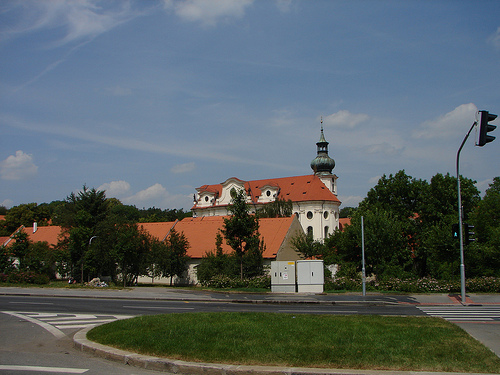
Location: Marketska 28, Brevnovsky Klaster
Established: 993 AD
Tel. 220 406 111
Trolley: 8, 15, 22, 25
www.brevnov.cz
Brevnov Monastery is a Roman Catholic complex in the Prague
outskirts. It was originally found in the ninth century. Brevnov
Monastery was founded in 993 AD by Vojtech who was the second bishop
of Prague and was later canonized by the Roman Catholic Church. Due
to political rivalry inside the big city, he was forced to resign
from his position. He briefly went to Rome and then he came back to
Central Bohemia he established a monastery with help of Benedictine
monks.
The legend claims that residents around Brevnov
Monastery found timber that was floating on the surface of a well.
Locals used it to construct the new monastery. In Czech, the name of
Brevnov Monastery is translated as a "Timber" Monastery. The name is
unofficial, but it stuck with Brevnov Monastery for ease of
pronunciation since its official name of Benedictine Archabbey of
Saint Vojtech (Adalbert) and Saint Margaret is pretty long.
Brevnov Monastery was constructed and destroyed repeatedly.
Unfortunately, we don't know how did it look. Brevnov Monastery
along with Bohemia was swept by religious conflicts of the Hussite
and Thirty Years' Wars. Its current Baroque facade was acquired in
the eighteen century by architect Dientzenhofers and his son. The
interior of the Church of Saint Margaret is covered by frescoes of
Brandl. It carries the noble title of Basilica Minor, given to it by
the pope. Locals claim that it is the first church in the vicinity
of Prague to receive such an award. It is interesting to note that
in times of the Communist regime between 1948-1989, it was used as
one of the headquarters of the Secret Police.
Today Brevnov
Monastery is open to the public. The best time to visit is the warm
months of the year on weekends then the garden and the main church
are open to the public. After the collapse of the atheistic
Communist government about a dozen monks got a chance to return to
the monastery. Besides the main buildings, you can inquire about the
old Romanesque crypt that was found here during archaeological digs
in 1969. It is one of the few surviving structures from the Medieval
period of monastery history.
Founding and Early History (10th–11th Centuries)
The monastery was
founded on January 14, 993, by Bohemian Duke (Prince) Boleslaus II
(Boleslav II, called "the Pious," d. 999) and Saint Adalbert of Prague
(Vojtěch, 956–997), the second Bishop of Prague. Adalbert, from the
Slavník family, had encountered Benedictine monasticism during studies
in Magdeburg, Germany. After serving as bishop amid tensions with
Bohemian nobility, he spent time in Rome at the Santi Bonifacio ed
Alessio monastery on the Aventine Hill. He returned in 992 with 12 monks
from there.
The foundation was dedicated to the Virgin Mary, St.
Benedict, St. Boniface, and St. Alexius. Pope John XV approved it via a
document dated May 31, 993—one of the oldest surviving records of the
monastery. The first abbot was Anastasius (another Aventine monk).
Adalbert left Bohemia again in 994 and was martyred in Prussia in 997.
Legend of the Name and Founding: According to tradition, both Boleslaus
II and Adalbert had the same dream instructing them to found a monastery
beyond Prague at the Brusnice stream. They met at a spring where a deer
was trying to drink but was blocked by a wooden beam (břevno in Czech).
Adalbert reportedly struck the ground, causing a spring to flow. The
name "Břevnov" derives from this beam (or from a village named Břevnová
granted to the monks). The monastery's coat of arms includes a log or
beam as a reference. The site was in a then-rural area west of Prague,
aiding Christianization in a region where paganism persisted.
Early
structures were wooden and temporary. Significant rebuilding occurred
under Duke Bretislav I (Břetislav I) around 1040, with stone
construction. Abbot Meginhardus (1035–1089) oversaw a Romanesque
three-nave church with a crypt (eastern part completed by ~1045). In
1045, the remains of the hermit-monk Gunther of Bohemia (Vintíř, c.
955–1045, originally from a noble Thuringian family and affiliated with
Niederaltaich Abbey) were buried there. Archaeological finds confirm
pre-Romanesque elements. Filial monasteries were established, such as at
Broumov and Police nad Metují.
Medieval Prosperity and Gothic
Period (12th–14th Centuries)
By the mid-11th century, the monastery
featured a Romanesque church, enclosure (to the north), abbot's
residence (south), and farm buildings. It became a major ecclesiastical
and economic center in medieval Bohemia, serving as a mother house. It
remained largely Romanesque until the mid-13th century.
Gothic
reconstruction began in the mid-to-late 13th century under abbots like
Martin and Křišťan (Christianus), continuing under the influential Abbot
Bavor of Nečtiny (1290–1332), during whose tenure the monastery reached
its medieval peak of prosperity. However, the Gothic works were likely
incomplete; a 1357 visitation by Archbishop Ernest of Pardubice noted
some buildings in poor condition.
Hussite Wars and Decline
(15th–16th Centuries)
The Hussite Wars (early 15th century) brought
devastation. The monastery, seen as hostile to the reform movement and
strategically located on the western approach to Prague, was attacked on
May 22, 1420, by Taborites. Much of the complex, including the brewery,
was nearly destroyed. The abbot and most of the community fled to
Broumov (a provostship/filial that became central for the order).
Post-Hussite recovery was slow, with a small community and partial
repairs. Larger Late Gothic renovations occurred under Abbot Matěj of
Tachov (1537–1553), reopening the church in 1545.
Baroque
Rebuilding and 17th–18th Centuries
A new era of prosperity began
under Abbot Thomas Sartorius (1663–1700), who built a new convent
(1668–1672, by Martin Reiner; known as Sartorius’ Convent). A 1676 fire
damaged it, leading to further work.
The grandest transformation came
under Abbot Othmar Daniel Zinke (1700–1738). From 1708–1745 (or ~1740),
the complex was rebuilt in High Baroque style by architects Christoph
Dientzenhofer (who started the church) and his son Kilián Ignác
Dientzenhofer. Key artists included painter Petr Brandl, frescoist
Cosmas Damian Asam, stuccoist Egid Quirin Asam, and others like Matěj
Václav Jäckl (sculptures) and Jan Sichmüller (choir stalls). The
Basilica of St. Margaret is a standout hall church with rich interiors
(altars, frescoes, etc.). A pre-Romanesque crypt (~1040) was later
discovered archaeologically.
The brewery, documented from the 13th
century (one of the oldest in Czech lands), was active again; annual
production reached ~5,000 hl in the 18th century. Other features include
the prelature (with Theresian Hall, visited by Maria Theresa in 1753),
gardens, and the Vojtěška pavilion (summer house/chapel by Kilián Ignác
Dientzenhofer, 1722–1725, over the founding spring).
The monastery
suffered during wars (e.g., Thirty Years' War, Prussian sieges in 1757
converting parts to stables/hospital, Napoleonic Wars) but avoided full
closure under Joseph II's reforms (1780s) due to its utility. Broumov
often served as the de facto center, with a "double-abbey" arrangement
until separation in 1939.
19th–20th Centuries: Challenges and
Revival
The 19th century saw relative decline compared to Broumov. In
the 20th century: occupied by Nazis in WWII; suppressed by Communists in
1950 (abbot Anastáz Opasek imprisoned in a show trial; monks dispersed
or fled). The complex was used by secret police (StB) until 1990.
After the Velvet Revolution, restoration began. It celebrated its
millennium in 1993. Pope John Paul II visited in 1997, and it was
elevated to archabbey status. It was declared a National Cultural
Monument in 1991. A small Benedictine community remains active today.
Significance and Modern Role
Břevnov symbolizes Bohemian
Christianization, Benedictine tradition, and Czech cultural resilience.
The Baroque complex, gardens, brewery (revived as Břevnovský klášterní
pivovar producing Břevnovský Benedict beer), and basilica (first in
Prague named basilica minor in 1948) make it a key landmark. It features
in literature, art, and even anime (Monster). Guided tours highlight the
crypt, basilica, prelature, and history.
Břevnov Monastery (Břevnovský klášter), located in the Břevnov
district of Prague, Czech Republic, is the oldest male Benedictine
monastery in Bohemia, founded in 993 by Saint Adalbert (Vojtěch) of
Prague and Duke Boleslaus II.
Its architecture reflects over a
millennium of evolution—from early Romanesque roots through Gothic
influences to a magnificent High Baroque reconstruction in the early
18th century. Today, it stands as a prime example of Bohemian Baroque
architecture, primarily designed by the renowned Dientzenhofer family.
Historical Architectural Layers
Early Romanesque Period
(10th–11th centuries): The original monastery featured simple wooden
structures initially, replaced by stone buildings under Duke Bretislav I
around 1040. Key surviving element: the Romanesque crypt beneath the
current church choir, dating to around 1040. It is a
pre-Romanesque/early Romanesque space with simple, robust forms typical
of the era—thick walls, basic vaulting, and functional design tied to
the earliest stone church.
Gothic Phase (13th–14th centuries):
Reconstructions under abbots like Martin, Křišťan, and especially Bavor
of Nečtiny (around 1300) introduced Gothic elements, though these were
never fully completed and much was later damaged or overlaid. The
monastery suffered significant destruction during the Hussite Wars
(e.g., 1420) and the Thirty Years' War.
Baroque Reconstruction
(1708–1745): This defines the current appearance. Commissioned under
Abbot Othmar Daniel Zinke, the complex was rebuilt according to plans by
Christoph Dientzenhofer (initial phases), with interiors and refinements
by his son Kilián Ignác Dientzenhofer. It exemplifies Bohemian High
Baroque: dynamic forms, dramatic spatial effects, rich ornamentation,
and integration of architecture with sculpture, painting, and stucco.
Construction of the main church ran from 1708–1735, with the full
complex completed around 1745. The monastery was elevated to an
archabbey in 1997.
Main Church: Basilica of St. Margaret (of
Antioch)
The focal point is this Baroque hall basilica (or church),
one of the finest examples of Bohemian High Baroque ecclesiastical
architecture.
Exterior: It features a striking facade with a
prominent white tower topped by an onion dome (a hallmark of Central
European Baroque). The design emphasizes verticality, curves, and
theatrical presence. You enter the complex via a Baroque portal/gate
(1740, by Kilián Ignác Dientzenhofer) adorned with statues of St.
Benedict and angels by Karel Josef Hiernle. The church facade closes the
main courtyard, flanked by convent and prelature buildings.
Interior:
A single-nave (hall) layout with side chapels/altars creates an open,
unified space typical of Baroque churches for immersive worship. High
vaults (dramatic height) are covered in trompe-l'œil frescoes by Jan
Jakub Steinfels (1719–1721), creating illusions of depth and heavenly
scenes.
Main Altar (1718): Designed by Christoph Dientzenhofer,
carved by Josef Dobner, with sculptures by Matouš Václav Jäckel and
paintings by Petr Brandl. Side altars feature statues of Benedictine
saints by Jäckel.
Rich stucco work (by Egid Quirin Asam), altarpieces
by Petr Brandl, and a ceiling fresco by Cosmas Damian Asam contribute to
the opulent, light-filled interior.
Inlaid 18th-century choir pews by
Jan Sichmüller with statues by Richard Prachner; a 1725 organ by Tobiáš
Meysner.
Southern part: Tombstone of St. Vintíř (Gunther of Bohemia).
It received the title of Basilica minor in 1948 from Pope Pius XII, the
first in Prague.
Convent, Prelature, and Other Buildings
Convent (Enclosure): Built 1709–1720 (Christoph Dientzenhofer). Includes
functional and ceremonial spaces:
Winter and summer refectories (the
latter with a 1739 fresco of the Miraculous Multiplication of Loaves).
Chapter hall (capitulary) with a 1745 fresco of Christ Washing the
Apostles’ Feet.
Sacristy, billiard room.
Prelature (Abbot’s
Residence): Annexed after 1720 (Kilián Ignác Dientzenhofer). Highlights
include:
Theresian Hall (Terezian Hall): One of the most splendidly
decorated rooms, named after Empress Maria Theresa’s 1753 visit.
Features exquisite frescoes, Baroque/Rococo detailing—ideal for events.
Library (first floor): Painted ceiling and richly carved Baroque/Rococo
bookcases.
Other rooms: Classicist chamber, Chinese Lounge (exotic
landscapes by Antonín Tuvora), Blue Lounge, Pompeian Hall (ornamental
wall paintings).
Supporting structures: Granary, farmhouse
(possibly former hospital), stables (now part of hotel/restaurant), and
brewery buildings. The layout forms a cohesive courtyard complex with
the church as the visual anchor.
Gardens and Pavilions
Extensive gardens adjoin the monastery, historically including
greenhouses (early 18th century remains).
Vojtěška Pavilion (summer
house/chapel, 1722–1725 by Kilián Ignác Dientzenhofer): Baroque
structure protecting the foundational spring of the Brusnice Stream
(legendary meeting site of the founders). It adds a picturesque,
contemplative element to the grounds.
Overall Layout and Features
The complex is organized around courtyards and gardens, with the church
facade dominating the main yard. It integrates monastic functionality
(cloister-like enclosure) with representative Baroque grandeur.
Materials include stone, stucco, frescoes, and wood carvings. The style
emphasizes movement, light-shadow play, illusionistic painting, and
ornate decoration to evoke spiritual awe—typical of Bohemian Baroque
under Habsburg influence.
Today, parts serve as a hotel (Adalbert),
restaurant/tavern, brewery (revived tradition of Břevnovský Benedict
beer), and event spaces, while remaining an active Benedictine
archabbey. Guided tours typically cover the basilica, Romanesque crypt,
prelature (including Theresian Hall), and Vojtěška.
Břevnov Monastery (Břevnovský klášter) is Prague’s oldest monastery
and the first Benedictine male monastery in Bohemia, founded in 993 AD
by Prince Boleslav II and Bishop (Saint) Adalbert (Vojtěch). It remains
an active Benedictine archabbey with a rich history, stunning High
Baroque architecture, tranquil gardens, and a historic brewery
tradition. It serves as a peaceful hidden gem on Prague’s outskirts,
away from the Old Town crowds.
History in Brief
According to
legend, the monastery’s name derives from a wooden beam (břevno) in a
spring where Boleslav II and St. Adalbert met; the saint removed it so a
deer could drink. The site has endured destruction (Hussite Wars in
1420, Thirty Years’ War), Baroque rebuilding (1708–1745 by Christoph and
Kilian Ignaz Dientzenhofer), wartime seizures, and Communist
suppression. It was returned to the Benedictines after 1989, renovated,
visited by Pope John Paul II in 1997, and elevated to archabbey status.
Key highlights include the Baroque Basilica of St. Margaret (with
frescoes, Petr Brandl paintings, ornate altars, and a Romanesque crypt
from ~1040), the prelature with the Theresian Hall (frescoes, named
after Maria Theresa’s era), the Garden Pavilion Vojtěška (over the
founding spring), and extensive gardens with water features.
Visiting Tips: Practical Information
Location: Markétská 28/1, 169 00
Praha 6 - Břevnov (western Prague, near Hradčany/Prague Castle area).
Getting There:
Tram: The easiest and most scenic option. Take tram 22
(or sometimes 23/25) from central spots like Malostranská (near Prague
Castle), Národní třída, or other points. Ride ~15–30 minutes to the
Břevnovský Klášter stop. The monastery gate is a short 2–3 minute walk
away. The route passes near Strahov Monastery and offers nice views.
Other: Bus options exist (e.g., line 180), or combine with a walk from
Strahov Monastery (~2–2.5 km). Taxis/Uber or driving are
straightforward; free parking is available on-site.
Tip: It pairs
well with a half-day trip including Prague Castle, Strahov Monastery, or
the White Mountain (Bílá Hora) pilgrimage site, which the monastery
oversees.
Opening Hours:
Grounds and Gardens: Open daily,
roughly dawn to dusk (e.g., lower garden 6:45–20:00). Free entry.
Information Center/Shop: Typically Mon–Fri 8:30–17:30, Sat–Sun
9:00–17:30.
Guided Tours (recommended for interiors): Primarily
weekends. Saturday 10:00 & 14:00; Sunday 11:00 & 14:00 (summer may add
16:00). ~90 minutes. Tours are usually in Czech with English text sheets
provided. English tours by prior arrangement.
Basilica masses are
held regularly (e.g., Sundays 7:30, 9:00, 18:00).
Tickets:
Grounds/gardens: Free.
Guided tour: Around 120–180 CZK adults
(basic), reduced 80–120 CZK for seniors/students; children 6+
discounted, under 6 free. Cash often preferred at the ticket office (in
the granary).
Brewery tours: Separate, pre-booked for groups.
What to See and Do
Explore Freely: Wander the large, peaceful
grounds, Baroque gardens, lake/pond areas, greenhouses, and cemetery
(notable grave: singer Karel Kryl). Climb for views of the complex and
Prague skyline.
Guided Tour Highlights: Basilica interior (trompe
l’oeil frescoes, organ, crypt), prelature (Theresian Hall frescoes,
Chinese Lounge, etc.), and Vojtěška Pavilion.
Brewery & Dining:
Sample Břevnovský Benedict beers at Klášterní Šenk (tavern) or the
granary taproom. Enjoy Czech monastic-inspired or home-cooked meals.
There’s also a shop for monastery-made biscuits, syrups (e.g., pine
herbal), chocolates, and beer.
Stay: Hotel Adalbert on-site for a
unique overnight experience.
Events: Concerts in Theresian Hall,
weddings, or cultural events. Check the official site.
In-Depth
Visiting Advice
Best Time: Weekends for tours, but weekdays are
quieter. Spring/fall for pleasant garden weather; avoid peak summer heat
if possible. Early arrival for popular tour slots.
Duration: 1–2
hours for grounds + beer; 2.5–3+ hours with tour and meal. Combine with
nearby sites for a full day.
What to Bring/Wear: Comfortable walking
shoes (grounds are extensive), modest clothing for the church
(shoulders/knees covered), cash for tickets/shop, and a camera (respect
photography rules inside buildings). English info sheets available.
Accessibility: Grounds are mostly flat/gravel; some buildings may have
steps. Inquire for specifics.
Etiquette: Respect the active monastic
community—keep noise low in sacred areas, no flash photography where
prohibited, and follow any visitor notices.
Family-Friendly: Yes for
gardens and brewery (non-alcoholic options); tours suit older kids
interested in history.
Pro Tips:
Download or pick up the monastery
map/plan.
Try the pine syrup in lemonade or over food—popular local
souvenir.
Visit the shop for unique Benedictine products from Czech
monasteries.
For deeper history, read up on the Dientzenhofers or St.
Adalbert beforehand.
It’s less crowded than central Prague
sights—perfect for a relaxed, authentic experience.
Official
Resources
Website: brevnov.cz/en (tours, contacts, plan).
Email:
klaster@brevnov.cz for inquiries/tour bookings.
The monastery originated on the site where Boleslaus II and St.
Adalbert reportedly met at a spring marked by a beam (břevno in Czech),
giving the place its name. It quickly became a center of Benedictine
life ("pray and work"). Over centuries, it suffered destruction during
the Hussite Wars (early 15th century), the Thirty Years' War, and other
conflicts, followed by major Baroque reconstructions in the early 18th
century under architects Kryštof and Kilián Ignác Dientzenhofer.
Key features include:
The Basilica of St. Margaret (1708–1735), a
prime example of Bohemian High Baroque with frescoes by Jan Jakub
Steinfels, altars and sculptures by artists like Petr Brandl and Matouš
Václav Jäckel, and a Romanesque crypt from around 1040.
The prelature
with ornate halls (e.g., Theresian Hall, named after Empress Maria
Theresa’s 1753 visit), libraries with Baroque/Rococo furnishings, and
painted ceilings.
Gardens with the Vojtěška pavilion (summer house
and chapel) over the founding spring.
It was returned to the
Benedictines after 1990 and declared a National Cultural Monument in
1991. Today, a small community of monks maintains parish duties,
publishes spiritual works (Pietas benedictina), and engages in
hospitality and cultural activities.
The Brewery: St. Adalbert
Břevnov Monastic Brewery (Břevnovský klášterní pivovar sv. Vojtěcha)
The brewery is inextricably linked to the monastery’s history and is
often cited as the site of the first written mention of beer brewing in
Czech territory (dating to the monastery’s founding era, with references
as early as 993). Brewing supported the monastery’s economy and followed
monastic traditions common across Europe.
Historical Brewing:
Early operations were part of the monastic estate.
Interrupted by
wars (e.g., near-total destruction in the Hussite period); a new brewery
was built around 1720 during Baroque rebuilding, with production
reaching up to 5,000 hl annually at times.
Operations continued
(often leased to tenants) until 1889, when cellar limitations forced
closure. The old building was later demolished in the 1950s for road
expansion.
Modern Revival (2011–present):
The current brewery
occupies restored Baroque stables on the monastery grounds. It revives
the tradition under monastic ownership with professional brewers.
Annual production: Up to ~3,000–4,000 hl. Beers are available in
bottles, kegs, and on draft (often requiring advance orders for draft at
certain venues). A small on-site hop field supplies some ingredients,
and some beers age in wooden barrels.
Beers (Břevnovský Benedict
brand):
Permanent offerings (around 6): Includes classic Czech styles
like Světlý ležák 12° (pale lager, ~5% ABV, balanced with Saaz hops,
noted for high "pitelnost" or drinkability), Tmavý ležák 11° (dark
lager), wheat beer, Klášterní IPA, Abbey dark ale, and stronger options
like Imperial Lager 20° (~8.5% ABV).
Seasonals and specialties: Up to
20 varieties per year, including Russian Imperial Stout, wheat bock,
barrel-aged beers, and more experimental styles blending Czech lager
traditions with international influences.
Emphasis on quality, aroma,
and sessionability for the pale lagers. Some beers are also produced
under license (e.g., Praha 993 variants in South Korea).
Visitors
enjoy the beers at the on-site Monastery Tavern (Klášterní šenk) with
its beer garden, the taproom in the former granary (Klášterní Sýpka),
and the hotel. A small brewery museum and permanent exhibition of beer
glasses add educational value. The brewery hosts tastings, tours, and
demonstrations (e.g., medieval brewing at festivals).
Cultural
Life and Visitor Experiences
Břevnov blends spiritual, historical,
and social functions into a lively cultural hub:
Tours and Heritage:
Guided tours (typically in Czech with English materials; English tours
by arrangement) cover the basilica, crypt, prelature halls, and gardens
(~90 minutes). The site offers a peaceful contrast to central Prague’s
bustle.
Events and Venues: The monastery hosts classical music
concerts (excellent acoustics in Theresian Hall), exhibitions, lectures,
workshops, weddings, corporate events, and private functions in historic
spaces. It participates in broader Prague events like the Night of
Churches and local festivals (e.g., Břevnov festivals with food, drinks,
music, and brewery activities).
Hospitality:
Hotel Adalbert (in
the former Sartorius Convent): 23 rooms for guests seeking a tranquil
stay.
Klášterní šenk restaurant: Traditional Czech cuisine paired
with monastery beers in a historic setting with a summer beer garden.
Granary: Info center, ticket office, beer shop, and taproom selling
bottled beers, souvenirs, and monastic products.
Community and
Spiritual Role: Active Benedictine community, parish services in the
basilica, gardens open daily, and publications promoting monastic
spirituality. It serves as a pilgrimage and reflection site while
engaging modern audiences through brewing and culture.
The
monastery and brewery attract history buffs, beer enthusiasts,
architecture lovers, and those seeking serene cultural experiences. It’s
easily reachable in Prague and often paired with nearby sites like
Strahov Monastery in walking or thematic tours.