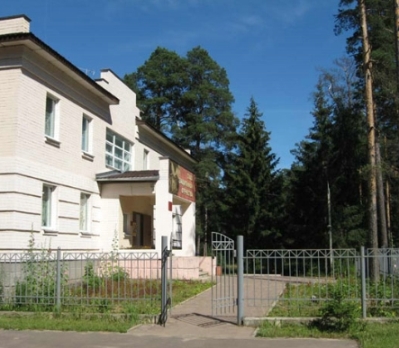
Museum of Kalinin Front is dedicated to a major battle that was fought here during World War II. Its location in a village of Emmaus is not coincidence. It was in 1941 Soviet soldiers of Kalinin Front broke through German lines on December 5th, 1941. It turned out to be a turning point in the history of Great Patriotic War as World War II is known in Russia. It broke the momentum of Blitzkrieg and saved Russian capital, Moscow from conquest. Museum of Kalinin Front was opened in 2002. It contains a exposition devoted to actions of various of divisions of the Kalinin Front from beginning of the war to the very end when it merged and became part of the Baltic Front.
Historical Context of the Kalinin Front
To understand the
museum, note its namesake: The Kalinin Front was a major Red Army
formation established on October 17, 1941, by Stavka (Soviet high
command) directive. Named after the city of Kalinin (Tver’s name
from 1931 to 1990), it initially comprised the 22nd, 29th, and 30th
Armies. It played a critical role in defending the northern
approaches to Moscow during the 1941 German offensive (Operation
Typhoon), holding the line amid fierce winter fighting. The front
conducted defensive actions, then spearheaded counterattacks,
including operations in the Rzhev-Vyazma salient. Between 1941 and
1943, it participated in eight major offensive operations (and one
defensive) independently or in coordination with other fronts,
contributing to the eventual liberation of the region before its
disbandment in October 1943 (with forces reassigned). The area saw
some of the war’s bloodiest attritional fighting, with heavy Soviet
casualties.
The museum’s location in Emmaus is no coincidence: It
marks the precise breakthrough point on December 5, 1941,
symbolizing the shift from desperate defense to offensive momentum.
The Museum of the Kalinin Front (Музей Калининского фронта) is a
specialized branch of the Tver State United Museum dedicated to the
military history of the Kalinin Front during the Great Patriotic War
(World War II). It focuses on the Soviet Red Army’s operations on
the northern flank of the Battle of Moscow and subsequent campaigns
in the Tver (then Kalinin) region. Located in the village of Emmaus
(Эммаусс), Kalininsky District, Tver Oblast—about 16 km northwest of
Tver city center—the museum sits on the exact historical site where,
on December 5, 1941, troops of the Kalinin Front achieved a
breakthrough in German defenses, launching the Red Army’s successful
counteroffensive in the Battle of Moscow.
Historical Context of
the Kalinin Front
To understand the museum, note its namesake:
The Kalinin Front was a major Red Army formation established on
October 17, 1941, by Stavka (Soviet high command) directive. Named
after the city of Kalinin (Tver’s name from 1931 to 1990), it
initially comprised the 22nd, 29th, and 30th Armies. It played a
critical role in defending the northern approaches to Moscow during
the 1941 German offensive (Operation Typhoon), holding the line amid
fierce winter fighting. The front conducted defensive actions, then
spearheaded counterattacks, including operations in the Rzhev-Vyazma
salient. Between 1941 and 1943, it participated in eight major
offensive operations (and one defensive) independently or in
coordination with other fronts, contributing to the eventual
liberation of the region before its disbandment in October 1943
(with forces reassigned). The area saw some of the war’s bloodiest
attritional fighting, with heavy Soviet casualties.
The museum’s
location in Emmaus is no coincidence: It marks the precise
breakthrough point on December 5, 1941, symbolizing the shift from
desperate defense to offensive momentum.
Founding and
Creation History
The museum’s origins stretch back to the late
Soviet era but faced significant hurdles, making its story “unusual
and long,” as described in official commemorative materials.
Early 1990s Initiative: The concept emerged around 1991, timed for
the 50th anniversary of the Kalinin Front’s creation. Yuri
Mikhailovich Boshnyak, then general director of the Tver State
United Museum, championed the idea. A dedicated sector was
established within the museum’s Department of the History of Soviet
Society. Retired colonels from the Kalinin Air Defense Academy
staffed it as scientific researchers. The Council of Veterans of the
Kalinin Front (active in the 1960s–1970s) had already amassed
materials. Staff issued public appeals via local radio and
newspapers for artifacts, documents, and photos from residents. A
detailed thematic-expositional plan was drafted and approved by the
museum’s methodological council, authored by scientific staff
Nikolai Alekseevich Yakimansky and Svetlana Alexandrovna Gerasimova.
Requests went to the Ministry of Defense for military equipment; a
few pieces (an anti-aircraft gun, howitzer, and cannon) were
allocated.
Delays and Setbacks: Economic turmoil and shifting
priorities in the post-Soviet 1990s derailed the project. An
allocated building proved unsuitable, and broader societal attitudes
toward military history were lukewarm. The museum was not ready for
the 1991 milestone. However, collected materials supported a
temporary exhibition titled “Kalinin Front 1941–1943” and the book
On the Right Flank of the Battle of Moscow. This exhibition traveled
internationally, including to Osnabrück, Germany.
Revival in the
Mid-1990s: Great Patriotic War veteran Captain First Rank Mikhail
Efremovich Ovchárov (a persistent advocate) revived the effort. He
lobbied authorities relentlessly, gaining Boshnyak’s support.
Regional veterans’ organizations, especially Chairman Viktor
Ivanovich Korolev of the Tver Regional Council of Veterans, helped
secure funding. Co-financing came from multiple sources: the Moscow
government contributed 2.3 million rubles, the Moscow Region
provided a 5-million-ruble promissory note, and the Tver Region
budget added 800,000 rubles (total project cost: approximately 8.66
million rubles).
Construction and Openings: Construction of a
two-story brick building began in 2000 in Emmaus. The first stage
opened on May 9, 2001. The official opening followed on May 8, 2002,
featuring the temporary exhibition “Kalinin Front. The Beginning,”
curated by senior scientific staff member Valentina Viktorovna
Glafirowa. Veterans from the 29th and 31st Armies attended, along
with regional officials like Governor Vladimir Ignatievich Platov.
The city administration gifted a painting titled Front Letters.
Permanent Exhibition (2005): A new, stationary exhibition opened in
May 2005, timed precisely for the 60th anniversary of Victory Day.
This remains the core display today. The museum has operated as a
full branch of the Tver State United Museum ever since.
Exhibitions and Collections
The museum is compact but richly
detailed, with two main exhibition halls, a lecture hall, and an
exhibition space. The artistic design—using wartime-inspired color
schemes and layouts—evokes the atmosphere of 1941–1943.
First
Hall (1941 Events): Covers the opening months of the war, fighting
in the Kalinin region, the German occupation of Kalinin (Tver) from
October to December 1941 (lasting 62 days), and its liberation on
December 16, 1941. It includes German command plans and battle
schematics, photographs and documents of Soviet defenders/liberators
(highlighting individual acts of heroism), and a dedicated section
on the Kalinin Front’s formation. Artifacts feature Wehrmacht
weapons and equipment in one case; unique items in another include
the authentic red flag hoisted over Kalinin’s river station on
liberation day and bloodstained Komsomol (Communist Youth League)
membership cards of fallen soldiers.
Second Hall (1942–1943
Operations): Focuses on the Kalinin Front’s later campaigns,
detailing eight offensive operations and one defensive action
(including the previously under-discussed July 1942 defensive battle
near Bely). Heavy emphasis falls on the Rzhev-Vyazma salient
fighting. The centerpiece is a large diorama, “Battle for the
Tveretsky Bridge,” recreating a real 1941 episode: artillerymen of
the 5th Battery, 531st Artillery Regiment (led by Lt. A.I.
Katsitadze) and infantrymen of the 4th Company, 937th Rifle Regiment
(led by Lt. N.M. Bukshenko) held the bridge for three days against
German forces near Fire Square in Kalinin, blocking advances toward
Zavolzhye. Additional displays cover Supreme Commander Joseph
Stalin’s visit to nearby Khoroshevo (August 4–5, 1943), photos of
the house where he stayed and met Front commander Gen. Col. A.I.
Yeryomenko, and the first artillery salute of the war (ordered
during this visit). A spatial artistic composition summarizes key
Front statistics.
Lecture Hall and Additional Exhibits: Features
wartime photographs by Kalinin Front correspondent B.E. Vdovenko and
captured German photographers. A separate exhibition hall hosts
“Childhood Scorched by War.” Outdoor elements include a mass grave
of soldiers killed in fighting for Emmaus, a display of artillery
pieces, and a camouflaged field kitchen with benches.
Collections draw from veteran donations, public appeals, and
archival sources, prioritizing authenticity (e.g., original
documents, newspapers, and personal items) over quantity.
Current Operations and Significance
The museum offers interactive
programs such as the role-playing event “Aty-baty, Went the
Soldiers!” (for groups up to 30, involving soldier simulations) and
the quest “From Kalinin to Königsberg” (using maps and Red Army
booklets). It hosts guided tours, temporary events, and educational
activities, often partnering with the Fund of Memory of the
Commanders of Victory. Admission is modest (around 300 rubles full
price as of recent data; free for children under 16), with audio
guides available. Seasonal hours apply (generally Tuesday–Sunday,
10:00–17:00).
Today, the museum serves as a site of national
memory, connecting generations to the “generation of victors.” It
preserves the heroic yet tragic legacy of the Kalinin Front’s
soldiers in one of WWII’s most grueling sectors, emphasizing themes
of resilience, liberation, and the human cost of war. Its creation
through grassroots veteran advocacy and regional cooperation
underscores post-Soviet efforts to honor WWII memory amid economic
challenges. For visitors, it provides a focused, emotionally
resonant experience at a pivotal battlefield site rather than a
large-scale complex.
The Museum of the Kalinin Front (Музей Калининского фронта) is a
specialized military-historical branch of the Tver State United Museum.
It is located in the village of Emmaus (Эммаус), Kalininsky District,
about 16 km northwest of Tver (formerly Kalinin), Russia. It opened in
May 2005 to mark the 60th anniversary of Victory in the Great Patriotic
War (WWII). The museum focuses on the history of the Kalinin Front, a
key Soviet formation on the northern flank of the Battle of Moscow and
in subsequent operations from late 1941 to 1943. Its collection
emphasizes authentic wartime artifacts, documents, photographs, and
reconstructions to convey the events, heroism, and human cost of the
fighting in the Tver region.
The museum is compact but densely
packed, with a deliberate artistic design—dark, somber color schemes,
trench-like display cases, and large two-color photo-collage backdrops
made from authentic period images, maps, and documents—to immerse
visitors in the wartime atmosphere. It comprises two main exhibition
halls, a separate exhibition hall, a lecture hall, and an outdoor
display area. The total collection includes hundreds of original items
(reviews and descriptions note well over a thousand artifacts when
counting all photos, documents, and small objects).
First
Exhibition Hall: The Early War Months and the Defense/Liberation of
Kalinin (1941)
This hall covers the first months of the Great
Patriotic War, the German advance into the Kalinin region, the fierce
defense and eventual liberation of the city of Kalinin (Tver) in
December 1941, and the formation of the Kalinin Front itself.
Key
elements of the collection:
Large-scale schematic maps and
diagrams showing German command plans for the Kalinin area and the
progression of battles around the city.
Photographs, personal
documents, and testimonials of Soviet defenders and liberators,
highlighting individual acts of heroism (names and stories are
prominently featured).
A dedicated section on the creation and early
organization of the Kalinin Front (formed October 17, 1941).
A
showcase of captured Wehrmacht weapons and soldier equipment (small
arms, gear, personal items).
Unique flagship artifacts:
The
authentic red flag raised over the Kalinin River Station (Речной вокзал)
on the day of liberation, December 16, 1941.
Bloodstained Komsomol
membership cards belonging to soldiers killed in the fighting for the
city.
Central highlight: A large, detailed diorama “Battle for
the Tveretsky Bridge” (Бой за Тверецкий мост). It reconstructs a real
three-day stand at the bridge on Posharnaya Square (now in Tver), where
the 5th Battery of the 531st Artillery Regiment under Lieutenant A. I.
Katsitadze, supported by the 4th Company of the 937th Rifle Regiment
under Lieutenant N. M. Bukshenko, held off German forces and prevented
them from crossing the Tvertsa River into Zavolzhye during the Soviet
counteroffensive.
Second Exhibition Hall: Combat Operations of
the Kalinin Front, 1942–1943
This hall focuses on the Front’s later
campaigns: eight major offensive operations and one defensive operation,
conducted both independently and in coordination with other fronts
(primarily the Western Front). It covers the intense fighting around the
Rzhev-Vyazma salient, including the Kalinin offensive,
Rzhev-Sychevskaya, Rzhev-Vyazemskaya (1942 and 1943),
Dukhoshchina-Demidov, and others. The hall also documents the previously
under-emphasized July 1942 defensive operation near Bely.
Key
collection elements:
Detailed operational maps, battle schemes,
drawings, and timelines for each major engagement.
Photographs of key
commanders, including General-Polkovnik (later Marshal) A. I. Yeremenko.
Materials on the elimination of the German Rzhev-Vyazma bridgehead and
the immediate aftermath.
Documentation of Supreme Commander I. V.
Stalin’s only front-line visit (August 4–5, 1943) to the village of
Khoroshevo near Rzhev: photos of the house where he stayed, the
commander’s residence where he met Yeremenko, and the decision for the
first artillery salute in the Great Patriotic War.
Personal items of
soldiers, awards (medals and orders), protective gear, mortars, rifles,
and other small arms.
Central feature: A large spatial artistic
composition that serves as an informational hub, integrating maps,
statistics, and visuals about the Kalinin Front’s overall role and
achievements.
Notable artifact: The genuine uniform tunic (kittel) of
Marshal of the Soviet Union Ivan Stepanovich Konev, who commanded the
Kalinin Front during its critical early phase.
Lecture Hall
This space functions as both a viewing and educational area. It
displays:
A collection of photographs by B. E. Vdovenko, official
correspondent of the Kalinin Front.
Works by German photographers
(captured or contemporary images providing a contrasting perspective on
the war).
Exhibition Hall (Temporary/Permanent Rotating Space)
This hall hosts the stationary thematic exhibition “Za Mir! Za Pravdu!
Za Pobedu!” (“For Peace! For Truth! For Victory!”). It has also featured
the highly emotional “Childhood Scorched by War” (Детство, опалённое
войной), which includes original letters, children’s drawings,
documents, and personal artifacts illustrating the impact of the war on
civilians, especially children in the occupied or frontline regions.
Outdoor Display Area
On the museum grounds (free to view):
Brotherly (mass) grave of Soviet soldiers killed in the battles for
Emmaus.
Open-air platform with samples of artillery pieces (Soviet,
German, and some American Lend-Lease examples).
A reconstructed field
kitchen under camouflage netting, complete with wooden tables and
benches for immersive educational programs.
Overall Character and
Additional Notes
The collection prioritizes authenticity and
storytelling over sheer size: original documents, personal effects,
captured enemy items, and large-scale visual reconstructions (maps,
dioramas, photo-collages) dominate. The design makes the showcases
resemble trench walls, enhancing the sense of being “in the war.” The
museum runs guided tours (highly recommended) and interactive
educational programs, especially for school groups, such as role-playing
exercises and quests that bring the artifacts to life.
Though modest
in scale compared to larger Moscow museums, the Museum of the Kalinin
Front is valued for its focused, emotionally resonant presentation of a
often-underappreciated sector of the Battle of Moscow and the grueling
Rzhev “meat grinder” operations. It preserves the memory of the Kalinin
Front’s soldiers through concrete artifacts and human stories rather
than abstract statistics.