Location: Kassel, Hesse Map
Constructed: 1793- 1800
Museum open: 10am- 5pm Tue- Sun (each hour)
Tel: +49 (0)561 3 16 80-244
Fax: +49 (0)561 3 16 80-222
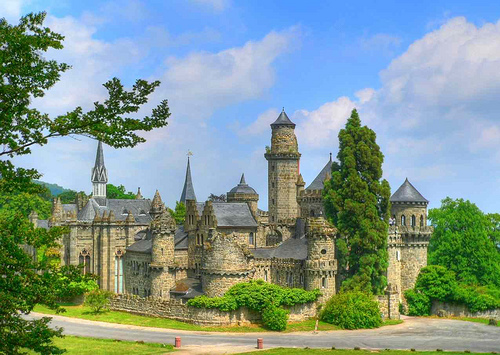
Löwenburg Castle is residence situated near town of Kassel in the region of Hesse in Germany. Löwenburg Castle was designed by Christoph Heinrich Jussow and constructed in 1793- 1800. The castle architecture was influenced by the medieval German castles. A collection of 16th and 17th century weapons inside further increased the similarities. Its first resident Wilhem IX lived here for 21 years and after his death was buried underneath the castle chapel. Much of the dungeon and parts of the castles was destroyed by the RAF (Royal Air Force- British) night raids during World War II. Neighboring town of Kassel suffered a worse bombings that wiped out 90% of the original city.
Construction and Purpose (Late 18th–Early 19th Century)
Landgrave
William IX of Hesse-Kassel (later Elector William I, 1743–1821)
commissioned the castle. Construction ran from 1793 to 1801 under court
architect Heinrich Christoph Jussow. It was intentionally built as a
picturesque, ruined hilltop knight's castle to evoke the Middle Ages and
underscore the ancient lineage and prestige of the House of Hesse, which
had ruled since the medieval period.
Design and Style: It is one
of the earliest significant neo-Gothic buildings in Germany, part of the
broader European Romantic fascination with chivalry, ruins, and medieval
aesthetics (following influences like Strawberry Hill in England and
earlier German examples). Initially planned as just a ruined tower with
outbuildings (similar to an earlier ruin Jussow built for William at
Wilhelmsbad), it expanded into a full courtyard-centered complex with
towers, battlements, a chapel, and defensive-looking features.
Materials: Builders used local Habichtswald tuff (a relatively soft
volcanic stone), which was easy to work but not very
weather-resistant—contributing to its intentional "ruined" appearance
over time.
Function: It served as a private retreat and pleasure
palace for William IX and his mistress, Karoline von Schlotheim, rather
than a defensive fortress. Interiors were lavishly appointed in a
princely Baroque style with historical furniture, paintings, tapestries,
glassware, bronzes, a large weapons collection (armory with 16th–17th
century armor and weapons), and medieval stained glass. Costumed
servants enhanced the immersive medieval staging to impress guests.
William reportedly never lived there full-time.
The castle sits
on a hill above Wilhelmshöhe Palace in the southern part of the vast
English-style landscape park, enhancing the Romantic scenery alongside
features like the Hercules monument, cascades, and aqueducts.
19th Century: Use and Legacy
After completion, it functioned as a
showpiece. In 1821, William I (elevated to Elector in 1803) was buried
in a crypt beneath the castle chapel—his sarcophagus remains there. The
structure symbolized dynastic continuity and the era's historicist
tastes.
20th Century: Destruction and Initial Reconstruction
During World War II, Kassel suffered heavy Allied bombing due to its
industry and half-timbered old town. The devastating raid on 22 October
1943 severely damaged the Löwenburg: the main bergfried (keep) was
largely destroyed (leaving only a stair tower and fragments), and other
sections like the kitchen and connecting buildings were heavily hit.
Post-war reconstruction in the late 1940s–1950s was pragmatic and
functional, prioritizing usability over full historical detail (e.g.,
1957 modifications to the ladies' building to house salvaged artifacts).
Many original furnishings had been evacuated and some remain in storage
or displayed elsewhere (e.g., at Schloss Friedrichstein).
Modern
Era: Major Restoration and Current Status
A comprehensive renovation
occurred from 2005 to 2022, including full reconstruction of the
bergfried (now accessible as a viewing tower). The castle reopened in
July 2022, restoring much of its Romantic appeal.
Today, it is
managed by Museumslandschaft Hessen Kassel (MHK). Visitors access
interiors via guided tours (often hourly; advance booking recommended),
seeing the armory, chapel, living quarters, and collections. The
exterior and grounds offer dramatic views of Kassel and the park. It
remains a highlight of the Bergpark, blending seamlessly with the
landscape.
Overall Concept and Style
Romantic Historicism: One of the
earliest and most significant neo-Gothic structures in Germany. It was
intentionally designed as an artificial ruin to look centuries old, with
deliberate "aging" effects like uneven masonry, crumbling sections,
bricked-up openings, and varied window styles suggesting multiple
building phases (all constructed simultaneously).
Materials: Built
primarily from local Habichtswald tuff (a relatively soft, workable
volcanic stone quarried nearby). The walls were left rough and irregular
to mimic weathered medieval construction. Slate roofs and other details
complete the picturesque effect.
Setting: Perched on a hill at about
350m elevation, overlooking the park and Kassel. It includes surrounding
staged elements like a castle garden, vineyard, tournament ground
(jousting area), and even a small zoo to enhance the medieval fantasy.
Exterior Architecture
The castle is a complex, irregular ensemble
grouped around an inner courtyard, evolving from an initial plan for
just a ruined keep with outbuildings into a full castle complex.
Key
features include:
Towers and Battlements: Multiple round and
polygonal towers with conical or crenellated tops, a prominent central
keep (bergfried), and extensive battlemented walls. Some towers have
spires or Gothic pinnacles.
Crenellations and Defensive Elements:
Machicolations, arrow slits, and fortified-looking walls, including a
drawbridge and gatehouse elements (though never functional for defense).
Varied Facades: Gothic arched windows (some pointed, some rounded),
blind arcades, and asymmetrical massing to create a "grown-over-time"
appearance. Ivy and moss were encouraged for added antiquity.
Main
Structures: The complex includes residential wings, a chapel with a
spire, an armory area, and service buildings. A carving above one gate
falsely dates it to 1495.
The design draws inspiration from real
medieval hilltop castles but prioritizes picturesque, theatrical effect
over military utility.
Interior Architecture and Layout
While
the exterior is medieval fantasy, the interiors were fitted as a
luxurious late-18th/early-19th century princely residence with Baroque
and Rococo influences blended with Gothic Revival elements. Wilhelm
never lived there full-time; it served as a retreat, entertaining space,
and showcase for his collections (especially weapons and medieval
artifacts).
Layout: Organized around a central courtyard with
interconnected buildings. Key accessible areas include princely
apartments, a grand hall, and specialized rooms. The keep contained more
private or display spaces.
Key Rooms and Features:
Armory: One
of the highlights, displaying 16th–17th century suits of armor
(including mounted figures), weapons, helmets, shields, and pikes
arranged dramatically on walls. Vaulted or high-ceilinged spaces enhance
the martial atmosphere.
Chapel: Gothic Revival with medieval
stained glass, religious artifacts, and a crypt below where Wilhelm I
was buried in 1821. Richly furnished.
Princely Apartments and
Reception Rooms: Ornate wood-paneled ceilings (coffered or painted),
large tapestries (including mythological or historical scenes),
chandeliers, marble fireplaces, gilded details, portrait paintings, and
period furniture. Windows often feature Gothic tracery with luxurious
drapery. One notable room has walls covered in small portrait panels.
Other Details: Inlaid floors, grand staircases, carved doorways, and
collections of bronzes, glass, and furniture. The interiors emphasize
comfort and opulence rather than austerity.
Historical
Modifications and Current State
WWII Damage: Heavily damaged in 1943
bombings (keep largely destroyed). Post-war reconstruction was
utilitarian at first. A major restoration from 2005–2022 restored many
original features, including reopening the keep.
Today: Open to
visitors (tours often required for interiors). It functions as a museum
highlighting its collections and the Romantic movement.
Location and Getting There
Address: Schloßpark 9, 34131 Kassel, in
Bergpark Wilhelmshöhe (above Wilhelmshöhe Palace).
By Car: Park at
the large free lot near the Hercules Statue (top of the hill). From
there, it's a pleasant 15–20 minute downhill walk through the park to
the castle.
Alternative: Park lower down and walk uphill (steeper but
scenic).
Tip: On weekends, public holidays, or when the famous water
features (cascades) run (Wednesdays, Sundays, holidays), the upper
parking lot fills quickly—arrive early or use public transport.
Public Transport: Kassel has good connections (train to
Kassel-Wilhelmshöhe station, then bus or tram + walk). Check local
transport apps for routes to Bergpark stops.
Shuttle: Limited service
(e.g., Wednesdays and Sundays) — confirm on-site or via Kassel tourism.
Pro Tip: Combine with the Hercules Monument (short walk uphill) and
the massive cascading fountains. Start at the top and walk downhill to
avoid steep climbs. Many visitors recommend a taxi drop-off near the top
for easier access.
Opening Hours (as of recent data)
April 1 –
October 31: Tuesday–Sunday + holidays, 10:00–17:00.
November 1 –
March 31: Friday–Sunday + holidays, 10:00–16:00.
Closed: Dec 24, 25,
31; limited hours Jan 1.
Guided tours only — interior access is
strictly on the hour (last tour starts 1 hour before closing). Tours
typically last 60–90 minutes.
Tickets and Booking
Wilhelmshöhe
Day Pass (recommended): Adults €8, reduced €5, under 18 free. Covers
Löwenburg (with tour), Wilhelmshöhe Palace, Hercules, etc.
Annual
pass available (~€60).
Book in advance — tours can sell out,
especially weekends/holidays. Use the official Hesse Kassel Heritage
site or ticket portal (gomus system). Some reviews note limited on-site
availability.
English materials are often provided even if tours are
in German.
Accessibility: Not fully accessible (steps, uneven
terrain). Service dogs welcome; dedicated parking and accessible toilets
available. Some areas (e.g., tower climb) have extra stairs.
Visiting Tips
Best Time to Visit:
Spring/summer for lush greenery
and longer hours.
Early morning or late afternoon to avoid crowds and
enjoy golden light on the stonework.
Wednesdays/Sundays for the
impressive water features in the park.
What to Bring/Wear:
Comfortable walking shoes — the park has steep paths and many stairs
(e.g., 144 steep steps mentioned in reviews).
Weather-appropriate
layers (hilltop can be windy/cooler).
Water, snacks (limited options
on-site; there's a café nearby with views).
Binoculars for park
views; camera/phone for photos.
Exploring the Site:
Exterior
Grounds: Free to wander — courtyard, towers (some climbable for extra
fee/views), gardens. Highly photogenic with dramatic "ruined"
architecture.
Interior Tour: Highlights include the armory, chapel
(with crypt), princely rooms, and collections. Expect medieval staging
mixed with Baroque luxury.
Allow 2–4+ hours total for castle + park.
With Kids/Families: Free for under 18. The fairy-tale look appeals
to children, but tours may be long; focus on exteriors and park walks.
Photography & Views: Stunning from multiple angles — approach paths,
lawns, and the keep. Golden hour or misty mornings are magical.
Additional Advice
Combine Attractions: Full day in Bergpark
Wilhelmshöhe (Hercules, fountains, Wilhelmshöhe Palace, hiking trails).
Food: Cafés/restaurants in the park or lower areas. Picnic options
available.
Crowds: Quieter on weekdays. Peak in summer.
Check
Updates: Verify hours/tickets on heritage-kassel.de or visit.kassel.de,
as they can change seasonally.
Nearby: Kassel has Documenta art,
Grimm brothers ties (fairy-tale route), and other palaces.