Location: Mespelbrunn, Bavaria Map
Constructed: 1427
Open: Apr- Oct
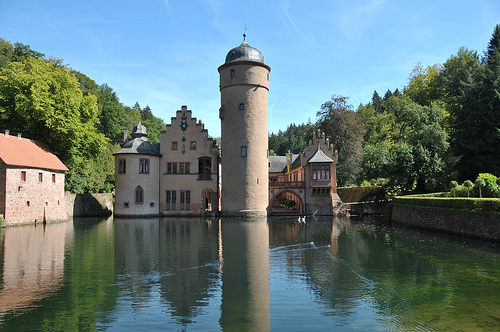
Mespelbrunn Castle (German: Schloss Mespelbrunn or Wasserschloss Mespelbrunn) is a picturesque late-medieval/early-Renaissance moated castle located in the small town of Mespelbrunn in Lower Franconia, Bavaria, Germany. It sits in a secluded tributary valley of the Elsava river within the dense Spessart forest, roughly midway between Frankfurt and Würzburg. Its romantic, fairy-tale appearance—surrounded by water, with half-timbered and stone elements, towers, and gables—has made it one of Germany's most photographed and visited water castles.
Origins (Early 15th Century)
The castle's history
begins on May 1, 1412, when Archbishop Johann von
Nassau-Wiesbaden-Idstein of Mainz granted a forest clearing next to a
pond ("Platz zum Espelborn") to the knight Hamann Echter (also spelled
Hermann Echter). Echter served as Vizedom (representative) of
Aschaffenburg and as an electoral forester. The grant rewarded his loyal
services, particularly in campaigns against the Czechs/Hussites.
The
Echter family originated from the Odenwald region; their name likely
derives from "der die Acht vollstreckt" (executor of the ban/ostracism).
At the time, the Spessart was a wild, undeveloped virgin forest teeming
with bandits and Hussite raiders who plundered nearby areas. Echter
initially built a simple, unfortified house on the site—essentially a
manor house beside the pond.
In 1427, his son (also named Hamann
Echter) fortified the structure due to ongoing threats. He added walls,
towers, and a moat fed by the nearby lake, transforming it into a
defensive water castle. Only the round Bergfried (keep) from this
medieval phase survives today.
Renaissance Transformation (16th
Century)
The castle evolved from a defensive fortress into an elegant
residence during more peaceful times. The most significant changes
occurred between 1551 and 1569 under Peter Echter von Mespelbrunn and
his wife Gertraud (or Gertrud) von Adelsheim. They oversaw an 18-year
reconstruction that gave the castle its present Renaissance character:
two- and three-story buildings around a courtyard, corner towers with
stepped gables, ornate portals, and a more residential layout while
retaining the moat.
An inscription above a side portal reflects their
vision:
"Marital love in God and faith so true, Brings happiness and
blessings anew. We trusted in God with diligence and might, To build
this house for our own delight."
This period marked the height of the
Echter family's prominence. The most famous member was Julius Echter von
Mespelbrunn (1545–1617), born at the castle. As Prince-Bishop of
Würzburg (from 1573) and a leading figure in the Counter-Reformation, he
founded the Juliusspital hospital (1576) and re-founded the University
of Würzburg (1583). He also significantly influenced Franconian
architecture and built the Marienberg Fortress.
Transition to the
Ingelheim Family and Later Centuries
The male Echter line ended in
1665 with the death of the last direct male heir, largely due to losses
in the Thirty Years' War (1618–1648). However, the family had prepared
for continuity: In 1648, Maria Ottilia Echter married Philipp Ludwig von
Ingelheim, from a baronial (later comital) family in the Rheingau. With
imperial permission, they merged the names and coats of arms, creating
the lineage Counts of Ingelheim called Echter von und zu Mespelbrunn.
This hybrid name persists today.
The castle's remote, forested
location helped it survive the Thirty Years' War and other conflicts
largely unscathed—one of the few Franconian castles to do so. In 1875,
the family added a Romanesque Revival chapel overlooking the Elsava
valley as a burial site.
20th Century to Present
Economic
pressures in the 1930s led the Ingelheim family to open parts of the
castle to the public as a museum, preserving it as a cultural monument.
The family still owns and resides in the southern wing, while the main
rooms (including the Knights' Hall, Ancestors' Hall, and others with
period furniture, portraits, weapons, and artifacts) are accessible via
guided tours.
The castle has appeared in popular culture, notably as
a filming location for the 1958 German comedy Das Wirtshaus im Spessart
(The Spessart Inn). It has hosted notable visitors over the centuries,
including Johann Wolfgang von Goethe and (possibly inspiring elements
for) the Brothers Grimm.
Architecture and Significance
Overall Layout and Setting
The castle sits on a
small island-like foundation in a pond/moat fed by a natural spring,
creating a romantic, reflective water setting surrounded by dense
forest. The main complex forms an irregular courtyard on an almost
square base on the eastern side of the lake.
Three-sided
enclosure: Two-story residential and service buildings surround the
northern, western, and southern sides of the courtyard.
Towers: Round
and polygonal towers rise at the northeastern and southwestern corners
(and a prominent central/main tower on the western side). The western
side features open framed passages to the water and a dominant central
tower that visually anchors the composition.
Access: The main
entrance is on the left side of the southern building. A bridge or
causeway leads visitors across the moat.
The only substantial
surviving medieval element is the round Bergfried (keep/tower) from the
15th century. Everything else reflects 16th-century rebuilding.
Architectural Style and Evolution
Origins (1412–1427): Started as a
simple, unfortified manor house by Hamann Echter. After attacks (e.g.,
by Hussites), it was fortified with walls, towers, and a moat—typical
late-medieval defensive design.
Renaissance Transformation
(1551–1569): Peter Echter von Mespelbrunn and his wife Gertrud von
Adelsheim rebuilt it into its current form over ~18 years. Defensive
features were softened into a comfortable manor house (Schloss) with
Renaissance proportions, symmetry, and decorative elements while
retaining some medieval massing.
Key stylistic features:
Renaissance elements: Stepped gables (especially on the western side),
multi-light windows with stone mullions and transoms, decorative
portals, and balanced facades.
Materials: Light-colored plaster or
rendered walls (often pale pinkish/ochre tones), red sandstone details
(columns, portals, trim), timber framing in some sections, and slate or
tiled roofs.
Towers: Cylindrical or polygonal with domed or conical
roofs (some with lanterns or finials), blending medieval robustness with
Renaissance refinement. One prominent tower has a large dome-like cap.
Gables and roofs: Ornate stepped gables and picturesque rooflines
contribute to the “fairytale” appearance.
Water integration: The moat
and pond are central to the design, not just defensive but
aesthetic—reflections enhance the romantic quality.
The style is
often described as a harmonious blend of late Gothic remnants and early
Renaissance, resulting in a charming, non-intimidating noble residence
rather than a stern fortress.
Exterior Highlights
Western
facade (most photographed): Features the main tower, arched water
passages, stepped gables, and oriel windows/balconies overlooking the
moat.
Courtyard: Intimate and enclosed, with arcades or covered
walkways in places.
Ancillary buildings: A separate stone outbuilding
(possibly former stables or service wing) with a red-tiled roof stands
nearby.
Interior Architecture and Rooms
The interior is
accessible via guided tours (parts remain a private residence for the
Counts of Ingelheim). Rooms are relatively intimate and livable compared
to grander palaces, reflecting centuries of family use with original or
period furnishings, portraits, weapons, and hunting trophies.
Notable spaces include:
Knights’ Hall (Rittersaal): Imposing yet
cozy, with red sandstone columns and large windows—used for gatherings.
Ancestors’ Hall: Displays family portraits and a notable stained-glass
window with coats of arms showing the family tree.
Banquet Hall:
Features an impressive weapon collection, including a large ceremonial
sword of the Echter family.
Chapel: Late Gothic design with
hand-painted stained-glass windows and an alabaster altar. A separate
Romanesque Revival burial chapel was added in 1875 overlooking the
valley.
Echter Room: Dedicated to Julius Echter (famous
Counter-Reformation bishop born here), with related memorabilia.
Chinese Room: Reflects 18th-century Chinoiserie fashion with East Asian
porcelain and decor.
Bedroom: Contains a historic family bed
associated with multiple generations, including Julius Echter.
Other
features: Vaulted rooms, ornate sandstone portals (some with carved
pediments), wood-paneled walls, hunting trophies (antlers, boar heads,
weapons), period furniture (16th–19th centuries), and decorative
elements like carved doors and beamed ceilings.
Why Visit?
It's still privately owned by the same
family for centuries (the Echter family), which gives it an intimate,
lived-in feel.
The exterior and grounds are stunning, especially for
photos. The interior offers a personal guided tour of well-preserved
rooms with historical artifacts, furniture, and stories.
It's compact
and manageable (unlike massive palaces), making it ideal for a relaxing
half-day visit.
Best Time to Visit
Season: Open from late
March to early November (specifically March 28 to November 9 in 2026).
It closes for winter after that.
Day of the week: Weekdays are
strongly recommended for fewer crowds. Weekends (especially Saturdays in
spring/summer) get busy quickly.
Time of day: Arrive early (opening
around 9:30am) for calmer conditions and better light for photos. The
castle looks magical in soft morning light or golden hour.
Weather:
Spring (blooming) and autumn (fall colors in the forest) are ideal.
Avoid heavy rain if possible, as paths can get muddy.
Getting
There
By Car (Recommended): Easiest option. It's just off the A3
motorway (Frankfurt-Würzburg route), about 45-60 minutes from Frankfurt
and similar from Würzburg. Take exit 63 (Weibersbrunn), follow signs to
Hessenthal, then Mespelbrunn. GPS: Schloßallee 25, 63875 Mespelbrunn.
Public Transport: Train to Aschaffenburg, then bus 40 to "Abzw. Schloss
– Mespelbrunn" stop, followed by a short walk. Taxi from Aschaffenburg
is more convenient but pricier. Not ideal without a car.
Parking
& Arrival
There's a dedicated parking lot right before the castle
grounds. It costs around €3 (cash, barrier system). Some visitors note
the toilets there are basic/not always pristine.
Short, mostly flat
walk (gravel then paved path) to the ticket area—relatively accessible
for those with mobility needs or strollers compared to hilltop castles.
Tickets & Guided Tours
Price (2026): €7 for adults (includes
guided tour). Reduced rates: €6.50 for groups of 20+, €3.50 for
students/seniors/disabled, free for children under 6. Cash only—no
cards.
Access: You pay for grounds + tour. Exterior views from
outside the gate are free but limited. No wandering the grounds
independently outside of tour times/café access.
Tours: Mandatory for
the interior. Last ~35-40 minutes. They run frequently (every 30-40
minutes; more on weekends). Last entry ~4:30pm. Tours are in German; ask
for an English pamphlet/script at the ticket booth.
No need to book
in advance like bigger castles (e.g., Neuschwanstein)—just show up, but
arrive early on busy days.
Tip: Dogs are not allowed on tours but
can be leashed at a "DOG station" near the ticket area with water
provided.
What to Expect During the Visit
Exterior/Grounds:
Moat with swans and fish (you can buy fish food for €0.50). Beautiful
Renaissance architecture from 1569. Great photo spots, especially the
bridge and courtyard views.
Interior: Compact but richly decorated
with family history, portraits, armor, and period furnishings. Guides
are often described as friendly and knowledgeable.
After the Tour:
You can visit the Pferdestall Café (in the old stables) for coffee,
homemade cakes, apple strudel, or beer garden refreshments. It's a
lovely spot to linger.
Practical Tips
Duration: 1.5–3 hours
total (tour + photos + café).
What to Bring: Comfortable shoes (some
uneven surfaces), cash (small bills), camera/phone for photos. Light
jacket for the forest setting.
Accessibility: Relatively good for a
castle, but water surroundings mean watching kids closely. Not fully
wheelchair-friendly inside.
Nearby: Combine with a drive through the
Spessart Forest or stops in Aschaffenburg or Würzburg. There are hiking
trails nearby (e.g., panorama walks).
Overnight: Schlosshotel
Mespelbrunn is nearby for a charming stay.
Potential Drawbacks
Some visitors find the multiple small fees (parking + entry) annoying if
expecting free grounds access.
Very touristy on peak weekends; it can
feel crowded in the small space.
Limited facilities (basic toilets).