Location: 80 km (50 mi) East of Frankfurt Map
Constructed: 1151 by Ludwig I, Count of Loon and Rieneck
Open: 7:30am- 1pm Mon- Fri
8am- 12pm Sat, Sun
Tel. 09354 902317
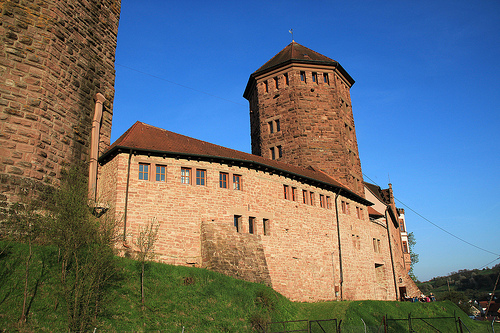
Rieneck Castle is located 80 km (50 mi) East of Frankfurt in Bavaria region of Germany. Rieneck Castle was found in 1151 by Ludwig I, Count of Loon and Rieneck. This stronghold was mostly occupied by a small garrison of soldiers. Most of the residents didn't live here due to its cramped conditions. However in a time of war all the residents in the surrounding lands would flee here. Today the stronghold is managed by German Christian Guide and Scout Association as a scouting facility. There is a small campground available just next to Rieneck Castle.
The castle was constructed by Ludwig I, Count of Loon and Rieneck, as
a defensive stronghold overlooking the Sinn River valley. Its design
features a prominent "Thick Tower" (Dicker Turm), a 19-meter-high keep
with thick walls. Over centuries, it evolved from a noble fortress to
its current role as a scout and education center.
Visitors often
describe it as a "real" medieval castle with thick walls, winding
staircases, themed rooms, a courtyard, and panoramic views — evoking a
genuine fortress feel rather than a polished tourist site. It offers an
authentic, lived-in medieval experience, especially appealing for those
interested in history, scouting, or immersive stays.
How to
Visit: Practical Tips
Not a Casual Day-Trip Drop-In: Access for
non-group visitors is limited. It primarily hosts booked groups
(schools, scouts, families, seminars). Casual tourists may walk around
the exterior or grounds, but interior access (tours, tower) usually
requires prior arrangement or participation in a program.
Best Way to
Experience It: Book an overnight stay or group program. This unlocks
full access, meals, activities, and the castle's atmosphere. Many
reviewers (scouts and families) rave about stays here.
Contact &
Booking: Reach out via the official website (burg-rieneck.de) or email
(info@burg-rieneck.de, phone +49 9354 902317). English availability may
be limited; basic German or translation tools help.
Opening/Access Hours (as listed on Tripadvisor): Generally 9:00 AM –
8:00 PM, but this reflects operational times for guests rather than
public museum hours. Always confirm directly.
Accommodation and
Facilities
The castle offers ~140 beds across the main building,
annex, hall building, and residential tower. Rooms range from 2-8 beds
(dorm-style, often grouped by floors for groups). There is also a
campsite with good facilities.
Food: Reviewers praise the regional,
seasonal, and plentiful meals (full board often around €39/night in
older reviews, with discounts for longer stays). It exceeds typical
youth hostel standards.
Amenities: Clean sanitary facilities,
approachable staff (including FSJ volunteers). Suitable for families,
youth groups, and relaxed adult getaways.
Vibe: Adventurous and
communal. Expect medieval-themed activities if you opt in.
Activities and Programs
This is where Burg Rieneck shines. Programs
emphasize hands-on, educational, and fun experiences:
Medieval &
Adventure: Abseiling from the Thick Tower, building catapults/wooden
swords, archery, knight tournaments, shield & coat-of-arms making,
medieval cooking, and tower tours (sometimes with candlelight legends).
Nature & Outdoor: Hiking in the Spessart forests, orienteering, canoeing
on the Fränkische Saale, bee-keeping visits, night hikes, land art, and
forest exploration.
Creative & Team-Building: Batik, paper-making,
games, team challenges, and more.
Packages: You can mix-and-match or
choose pre-set programs for school trips, scout camps, family vacations,
or seminars.
The surrounding Spessart region is excellent for
hiking and cycling. Nearby trails offer great views of the castle.
Getting There
By Car: Easy access via A3 or local roads. Parking
is available.
By Public Transport: Train to nearby stations (e.g.,
Lohr am Main or Gemünden am Main), then bus/taxi. It's rural, so a car
is most convenient.
Location Perks: Quiet Spessart setting, ideal for
nature escapes. Day trips possible to Würzburg (historic city, ~45-60
min), Lohr am Main, or other Franconian spots.
Visiting Tips
Best For: Scout/youth groups, families seeking active historical
immersion, history buffs wanting more than just looking at walls, or
anyone craving a unique castle stay. Less ideal for luxury seekers or
those wanting polished museum experiences.
When to Go: Spring-fall
for outdoor activities. Check for open fire restrictions (occasional due
to forest risks). Weekends or school holidays may be busier with groups.
What to Bring: Comfortable walking shoes (cobblestones, stairs, trails),
weather-appropriate layers (Spessart can be rainy), flashlight for
evening exploration, and enthusiasm for group activities.
With Kids:
Highly recommended — children love the towers, activities, and "castle
life."
Budget: Affordable for what you get (group-style pricing).
Confirm current rates directly.
Language: German primary; staff may
speak English, especially with international scout groups.
Etiquette/Considerations: Respect its role as an active scout center.
Book ahead, especially for activities or stays. Be mindful of
sustainability efforts (they emphasize eco-friendly operations).
Nearby Attractions
Spessart forests and hiking trails.
Lohr am
Main (Spessartmuseum, charming town).
Würzburg (Residenz palace, wine
region).
Other Franconian castles and villages.
Origins and Construction (Mid-12th Century)
The castle's roots
trace back to the Counts of Rieneck, a noble family with connections to
the Counts of Loon (Loon). The family name derives from an earlier
Middle Rhenish line that had died out; Gerhard I of Rieneck was
mentioned as early as 1071.
Around 1150, Ludwig I (Louis I), Count of
Loon and Rieneck, ordered the construction of the castrum Rinecke on a
small hill at the northeastern boundary of his territory. The primary
purpose was to secure his lands against the competing interests of
powerful neighboring ecclesiastical territories: the Archbishopric of
Mainz (Kurmainz), the Bishopric of Würzburg (Hochstift Würzburg), and
Fulda Abbey.
The location was strategically chosen: natural defenses
on most sides meant only one vulnerable direction required extra
fortification (a defensive ditch and minimized attack front). The
initial structure included:
A courtyard enclosed by defensive
walls.
The prominent "Dicker Turm" (Thick Tower or Keep) — a
19-meter-high, irregular seven-sided (heptagonal) bergfried with walls
up to 4–8 meters thick. Its shape points a "spike" toward the nearby
hill for defense.
Half-timbered buildings inside the walls for living
quarters, storage, and stables (only the arched cellar largely survives
from this period).
A standout feature is the unique Romanesque
tower chapel (Turmkapelle) built entirely into the thick walls of the
Dicker Turm — a rarity on the European mainland. It features three
conches (niches) with a half-dome, a square crossing, and an apse
oriented east, resembling a miniature cathedral.
The castle was first
documented as "castrum Rienecke" in 1179, and mentioned again in 1188 in
a treaty between Emperor Frederick Barbarossa and King Alfonso VIII of
Castile (as part of a proposed marriage dowry, though the marriage never
occurred).
Expansion and Peak as a Noble Seat (Late 12th–13th
Centuries)
Around 1200, as the county was divided, the castle was
strengthened into a more robust knightly fortress:
Addition of the
"Dünner Turm" (Thin Tower), an octagonal structure originally with small
arrow slits.
Romanesque courtyard chapel.
Strengthened outer
walls, zwinger (outer ward), gatehouse, and drawbridge over a moat.
It served as the political and military center for the Counts of Rieneck
in the Spessart region, helping them manage fiefs, develop their county,
and protect allodial lands amid rivalries with Mainz, Würzburg, and
Fulda. The counts' main seat was often at Lohr am Main.
Later
Medieval Period and Decline
The castle faced conflicts typical of the
era. It was reportedly destroyed by siege in 1282 (first documented
mention around 1271) but reconstructed by 1346.
The direct male line
of the Counts of Rieneck ended with Count Philipp III in 1559. After
this, the castle was only sporadically occupied, leading to gradual
decay. Parts of the inheritance passed through marriage to families like
the Counts of Hanau.
19th Century: Romantic Restoration
In the
19th century, the castle was in private hands. Legends circulated
locally that the towers dated to Roman times or were built by
Charlemagne. It underwent significant Neo-Gothic restoration under
owners like Franz von Rinecker, giving it much of its current
picturesque appearance while preserving core medieval elements like the
Thick Tower and outer walls.
20th Century to Present: Scout
Castle
In the 20th century, further modifications occurred (e.g.,
windows added to the Thin Tower in 1929). After periods of varied use
(including as a hospital or other purposes), it became the property of
the Verband Christlicher Pfadfinderinnen und Pfadfinder (VCP) — the
German Christian Guide and Scout Association — and serves as their
national youth center (Jugendburg).
Construction began around 1150 under Ludwig I, Count of Loon and
Rieneck, as the castrum Rinecke. Its primary purpose was to secure the
northeastern border of the counts' territory against the powerful
neighboring ecclesiastical principalities of Mainz, Würzburg, and Fulda.
The site was strategically chosen: the hill provided natural defenses on
most sides, requiring only one additional defensive ditch on the
vulnerable northwestern approach. This influenced the castle's
irregular, defensive layout.
Core Architectural Features
The
"Dicker Turm" (Thick Tower / Bergfried)
The most distinctive and
iconic element is the Dicker Turm, a massive 19-meter-high keep
(bergfried) serving as the primary defensive stronghold.
Shape
and Design: Its exterior ground plan forms an irregular seven-sided
polygon, with the sharpest point oriented toward the vulnerable hill
direction to minimize the attack front and deflect projectiles. This
rare polygonal form is a key defensive innovation.
Wall Thickness:
Varies from 4 to 8 meters thick, making it extremely resistant to siege
weapons.
Access: No ground-level entrance; entry was only possible
via higher levels (typical for medieval keeps to enhance security).
Access required climbing or ladders, exposing attackers.
Interior
Features: Equipped with practical amenities for the era, including a
kitchen/hearth, washbasin, and a latrine ("heimlicher Ort"). The third
floor housed a Kemenate (heated living chamber with a fireplace).
Unique Highlight: The Dreikonchenkapelle (Triconch Chapel or St.
Mariae Chapel)
Built into the thick walls of the Dicker Turm is a
small Romanesque cloverleaf-shaped (triconch) chapel. This is a unique
feature on the European mainland — similar defensive tower chapels are
found mainly in the British Isles. The chapel is integrated directly
into the massive masonry, combining spiritual and military functions in
one structure.
The "Dünner Turm" (Thin Tower)
An octagonal
tower added around 1200 during later fortifications. Originally, it had
only small high-level slits (luken) for defense. In the 20th century
(notably 1929 renovations), it received larger windows, altering its
purely military character.
Curtain Walls and Defenses
The
initial complex featured a courtyard (Burghof) enclosed by defensive
walls.
The walls were reinforced on the exposed side by the Thick
Tower.
A defensive ditch protected the vulnerable approach.
Later
expansions (13th century) strengthened the overall fortifications.
Residential and Ancillary Buildings
Early Period (12th century):
Half-timbered (Fachwerk) buildings inside the walls served as living
quarters, storerooms, and stables. Only the "arched cellar" survives
from this phase.
13th Century Expansions: More representative stone
residential buildings were added, along with a Romanesque courtyard
chapel (Hofkapelle).
Over time, the castle evolved from a purely
military outpost into a more residential aristocratic center.
Architectural Styles and Evolution
Romanesque Core (12th–13th
centuries): Dominant in the keep, polygonal tower design, thick masonry,
and the unique chapel. Heavy, functional, and defensive.
Later
Medieval: Fortification upgrades and stone residential structures.
19th Century: Private ownership led to extensive Neo-Gothic restoration,
adding romantic, picturesque elements (e.g., battlements, oriel windows,
and decorative features visible in some structures).
20th Century:
Major renovations in 1929 adapted it for modern use while preserving
medieval character. It became a youth and scouting center in 1959.
The overall appearance today is a layered mix of medieval fortress
architecture with romantic 19th-century restorations, typical of many
German castles adapted for tourism/education.
Current Use and
Layout
Since 1959, Burg Rieneck has served as the federal center
(Bundeszentrum) of the German Christian Guide and Scout Association
(VCP). It functions as a youth hostel, educational facility, and event
venue, with accommodations, a campsite, and programs focused on scouting
skills, history, and outdoor activities.
The castle includes:
The
historic keep and towers (accessible for tours, including abseiling from
the Thick Tower).
Courtyard areas.
Modernized residential wings
for guests.
The chapel, which remains a focal point for visitors.