Location: Zwickau Map
Constructed: first castle build in the 13th century
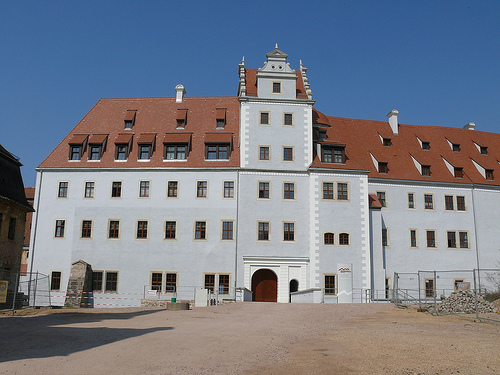
Osterstein Castle or Schloss Osterstein is a medieval mansion that stands in Zwickau in German state of Saxony. The name of Osterstein Castle or Schloss Osterstein is translated as a Castle of an Easter Stone. The first castle on this place was constructed in the 13th century. However it was demolished in 1407 by troops of William I, Margrave of Meissen. The ruins of the stronghold were later incorporated into a new Renaissance Mansion that was constructed in 1587- 90 by Christian I, Elector of Saxony. The castle was turned into a Nazi Concentration Camp during World War II. In the end of the 20th century abandoned and dilapidated building was reconstructed and open as a retirement house.
Early Origins (12th–14th Centuries)
A smaller fortified
structure likely dates to the late 12th or early 13th century on the
site near the Zwickauer Mulde River in northeastern Zwickau's old
town. It functioned as a lowland castle (Niederungsburg), possibly a
water castle with moats and high walls.
The first documentary
mentions are debated. Some sources cite 1292 as Castrum Czwickaw,
but historians like Norbert Oelsner and Daniel Jakob view this
skeptically based on source criticism. It was more reliably
mentioned as a "hus" (house/castle) in 1331. During the 13th and
14th centuries, it expanded into a significant margravial castle
(markgräfliche Burg) for the Margraviate of Meissen under the Wettin
family.
In 1403, a devastating fire in Zwickau severely damaged
the castle. Between 1404 and 1407, Margrave William I of Meissen
ordered its demolition and reconstruction as a more strongly
fortified complex.
Renaissance Era and Peak as a Residence
(15th–16th Centuries)
In the early 16th century, the castle
temporarily housed the Zwickau mint (previously inactive since
1493), operating from around 1530–1533. Elector John the Steadfast
(Johann der Beständige) used it as a ducal retreat residence from
1517–1518 during a plague outbreak in Weimar.
Zwickau was an
early Reformation center. Martin Luther reportedly preached in the
castle's chapel in 1522. Until the late 16th century, it was known
as Schloss Weißenstein.
The major transformation occurred under
Elector Christian I of Saxony (reigned 1586–1591). From 1587 to
1590, master builder Hans Irmisch redesigned it into a magnificent
Renaissance palace. This rebuild introduced the name Osterstein and
gave it its characteristic appearance, including features like the
preserved "Große Hofstube" (Great Court Room)—a large two-aisled,
three-bay vaulted hall with Tuscan sandstone columns, one of
Saxony's best-preserved Renaissance dining halls (about 175 m², once
seating 20 tables).
Decline and Conversion to a Prison
(17th–19th Centuries)
The Thirty Years' War (1618–1648) brought
devastation. In 1632, the castle was heavily plundered and left
uninhabited for about 30 years.
In the late 18th century (around
1770–1775), it was converted into a Zuchthaus (workhouse/prison),
known as Zwickau Prison. This marked the start of nearly two
centuries as a penal institution. A cross-shaped cell block was
added between 1860 and 1864.
Notable prisoners included:
Writer Karl May
Social democrat August Bebel
Communist
revolutionary Rosa Luxemburg
Others like Martin Hoop
20th
Century: Dark Chapters and Decay
In the Nazi era, it briefly
served as a Schutzhaftlager (protective custody camp/concentration
camp) starting in March 1933, then reverted to a penitentiary until
1945.
During the GDR (East Germany) period, it continued as a
prison, including for political dissidents. The prison function
ended on December 31, 1962, after 187 years. Post-prison, parts
housed a public bathhouse, coal industry archives, and storage. Some
sections were demolished, and the site deteriorated significantly
from the 1980s onward, becoming an eyesore. Emergency stabilizations
were needed in the early 2000s.
Modern Restoration and
Current Use (21st Century)
A Förderverein Schloss Osterstein
(support association) formed around 2000 to save it. Major
restoration began with a foundation stone laying on November 3,
2006. Work included roof repairs, structural reinforcements, and
conversion into a senior living and nursing home complex (Senioren-
und Seniorenpflegeheim). The topping-out ceremony was in September
2007, and the first residents moved in November 2008.
Today, it
offers assisted living apartments. Public elements include the
restored Renaissance features, the "Mauritius Schloss Schenke"
restaurant in the cross-vaulted cellar (opened 2016), and some
museum-like access. The site is a protected monument, blending
historical preservation with modern social use.
Origins (Medieval Period): First mentioned in 1292 as Castrum
Czwickaw, it began as a fortified structure (likely a moated castle) on
a rocky outcrop near the Zwickauer Mulde River in the northeastern part
of Zwickau's old town. A major fire in 1403 severely damaged it, leading
to its demolition between 1404 and 1407 under William I, Margrave of
Meissen.
Renaissance Rebuild (1587–1590): Under Elector Christian I
of Saxony, it was transformed into a magnificent Renaissance palace (or
Residenzschloss) by master builder Hans Irmisch. This conversion
elevated it from a defensive structure to a stately princely residence,
reflecting the architectural trends of Saxon Renaissance style prevalent
in the late 16th century.
Later Uses: In the 18th century, it became
the Zwickau Prison (Zuchthaus Zwickau), serving that role (with
interruptions) until 1962. It briefly functioned as a concentration camp
in the Nazi era. Post-WWII decay led to major restoration starting in
2006; it was converted into a modern nursing home/senior residence while
preserving key historical elements. Parts now include gastronomic and
potential museum spaces.
Overall Architectural Layout and Style
The castle exemplifies Saxon Renaissance architecture, characterized by:
Symmetrical facades with stepped gables (typical Zwerchgiebel or dwarf
gables).
Red-tiled roofs with dormer windows.
Light-colored
plastered walls with stone accents and decorative elements.
A
courtyard-centered design, common in German Renaissance palaces,
blending defensive remnants with residential elegance.
The
structure features multiple wings arranged around an inner courtyard.
The exterior is imposing yet refined, with a prominent main facade
including arched entrances, evenly spaced windows, and ornamental
detailing. A moat and high walls ( remnants or historical features) once
emphasized its fortified character.
Key exterior features include:
Stepped gables and dormers that create a rhythmic, vertical emphasis.
Corner towers or pavilions (some with domes or spires).
Stone window
frames and portals.
Integration with the urban landscape, visible
near churches with spires.
Interior Highlights (Renaissance Core)
The most architecturally significant interior space is the Große
Hofstube (Great Hall or Court Room):
One of the best-preserved
Renaissance great halls in Saxony.
Approximately 175 m², making it
the largest surviving 16th-century room in the complex.
Two-aisled,
three-bay vaulted structure supported by robust Tuscan columns made of
Cainsdorfer sandstone. These columns dominate the space and provide
structural and aesthetic strength.
Originally used for dining and
courtly functions (up to 20 tables could be set simultaneously).
Restored according to monument preservation principles, retaining its
vaulting and historical character despite earlier modifications.
Other notable interiors (accessible via guided tours by appointment):
Silberkammer (Silver Chamber).
Wendelstein (spiral staircase or
winding stair tower, a common Renaissance feature for elegant vertical
circulation).
Chapel where Martin Luther is said to have preached.
Materials and Construction Techniques
Stone: Local sandstones
(e.g., Cainsdorfer) for columns, portals, and detailing — durable and
characteristic of Saxon building traditions.
Roofing: Traditional red
clay tiles.
Vaulting: Ribbed or groin vaults in key halls, showcasing
Renaissance engineering adapted from Gothic precedents but with lighter,
more decorative forms.
The 2006–2008 restoration combined historical
reconstruction with modern adaptations (e.g., glass elements for light
and functionality in some areas).
Visiting Tips for Zwickau's Schloss Osterstein
Accessibility and
What You Can See:
The courtyard (Schlosshof) is generally open to the
public for free and worth a quick visit for its architecture and
atmosphere.
Limited interior access: Rooms like the Große Hofstube
(large court room, one of the best-preserved Renaissance halls in Saxony
with impressive vaults and columns), Silberkammer (silver chamber), and
Wendelstein (spiral staircase) are viewable only by guided tour with
advance reservation.
Contact the Tourist Information Zwickau
(Hauptstraße 6, Tel: +49 375 2713247, tourist@kultour-z.de) to arrange a
tour. These are not daily and depend on availability.
There may be
occasional cultural events, exhibitions, or a Christmas market
(Schlossweihnacht) in the area.
Best Time to Visit:
Spring
through fall for pleasant weather and greener surroundings. Weekdays are
quieter.
Avoid expecting a full "open castle museum" experience —
respect residents' privacy as it's a working care facility.
How
to Get There:
Address: Schlossgrabenweg 1 (or Dr.-Friedrichs-Ring
area), 08056 Zwickau.
By car: Easy parking nearby. Zwickau is
reachable via A4/A72 autobahns.
Public transport: From Zwickau
Hauptbahnhof, take tram or bus to "Neumarkt" then a short walk (~10
minutes). Follow signs.
Combine with Zwickau's old town, the August
Horch Museum (automotive history), or other Saxon sites.
Practical Tips:
No standard opening hours/tickets for full access
like typical tourist castles (e.g., Neuschwanstein). The courtyard is
informal; interiors require booking.
Wear comfortable shoes — some
areas involve cobblestones or stairs.
Photography: Allowed in
public/courtyard areas; be discreet around residential zones.
Facilities: Limited on-site (respect the nursing home setting). Use
nearby city amenities.
Duration: 30–60 minutes for courtyard + views;
longer if a guided tour is arranged.
Nearby: Mulde river promenade
for walks, historic Zwickau center.
Who It's For: History
enthusiasts, architecture fans (Renaissance details), or those combining
with Zwickau sightseeing. Not ideal for families seeking interactive
castle experiences or people expecting lavish furnished rooms.