Location: Kohren- Sahlis, Saxony Map
Constructed: 13th century
Tel. +49 34344 61309
Email: gnandstein@schloesserland-sachsen.de
Entrance Fee: 4 Euro
2 adults + 4 children 9 Euro
1 adult
+ 2 children 5 Euro
Free Admission for visitors on their
birthday
Open: Mar- Oct 10am- 6pm daily
Nov- Feb
10am- 5pm daily
Closed: Nov- Jan & Ascension day
Nov- Feb 10am- 5pm daily
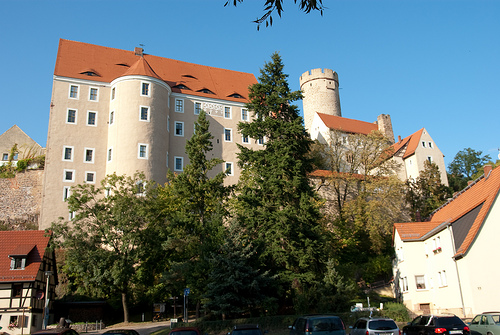
Gnandstein Castle is a medieval citadel situated in Kohren- Sahlis, Saxony region in Germany. Gnandstein Castle was constructed in the 12th century to guard the valley of the river Wyhra. In the 14th century Gnadstein Castle was bought by a noble family of von Einsiedel. This family continued to live here until the end of World War II. During Thirty Years' War in the 17th century, Swedish troops captured the castle and inflicted great degree of destruction. To make things worse shortly before the war's end South wing was struck by a lighting and burned down. Over centuries the castle had several additions and reconstruction that gave it a Romanesque appearance. The tallest tower of the castle is the Well House. Standing at a height of 33 meters it offers a great view of the citadel and the surrounding lands.
Early Foundation and Romanesque Construction (c.
1200–Mid-13th Century)
The castle was founded around 1200 by members
of the von Schladebach family (sometimes linked to the Marschall von
Bieberstein line), who served as ministerial retainers (Dienstleute) to
Margrave Theodoric the Oppressed of the Wettin dynasty. They built it as
a forward outpost to protect a ford across the Wyhra and as a defensive
position on the border with the imperial territory of Altenburg.
The
initial layout was a nearly rectangular ring wall enclosing a
residential tower (the precursor to today’s keep) and a representative
four-story Palas (palace building), constructed between 1220 and 1230.
This Palas remains one of Saxony’s finest surviving examples of
Romanesque secular architecture, featuring a hall on the second upper
floor with distinctive triplet windows and carved Romanesque capitals. A
bower (residential wing) with a Romanesque chapel was likely built at
the same time.
By the mid-13th century, defensive upgrades included
an outer ward wall (Zwingermauer) attached to the curtain wall and the
construction of a round keep (Bergfried) in the upper inner courtyard.
This 33-meter-high tower had its only entrance 8 meters above ground
level, accessible only by ladders, serving as both a lookout and a final
refuge. A 25-meter-deep castle well was also dug inside the complex.
The castle was first documented in 1228, when brothers Heinrich and
another von Schladebach were recorded as its lords.
Ownership
Transitions and Late Medieval Expansions (Late 13th–15th Centuries)
Tensions with the Wettin margraves escalated, and the von Schladebachs
vacated the castle by 1317 at the latest. It passed briefly to the
burgraves of Leisnig before the von Einsiedel family acquired it in
1409. Hildebrand I von Einsiedel was among the first documented owners.
The von Einsiedels would hold Gnandstein continuously for more than 500
years—until the end of World War II—making it one of Saxony’s longest
family-owned castles.
Under the von Einsiedels, the castle underwent
significant Gothic-era development in the 15th century. They added a
gatehouse (Torhaus) and a three-story Gothic south wing for residential
use; its ground-floor loopholes (Schießscharten) and late-Gothic plaster
frieze show it was designed for defense as well as living quarters. In
the north wing, Heinrich von Einsiedel inserted a late-Gothic chapel
around 1500 between older walls. This irregularly shaped room features a
Zellengewölbe (cell vault), three carved winged altars from the workshop
of Peter Breuer, and oak choir stalls. Late-Gothic defensive cellars
(Wehrkeller) with sunken loopholes for firearms were also created—one
with an integrated well system has been restored for visitors.
At the
end of the 14th century, the Palas’s top (originally half-timbered)
floor was rebuilt in solid stone. Around 1410, the keep was heightened
and topped with a tower warden’s room.
Reformation, Wars, and
Early Modern Changes (16th–18th Centuries)
The von Einsiedels were
early supporters of the Reformation. Heinrich Hildebrand von Einsiedel
(1497–1557) corresponded directly with Martin Luther and other
reformers. Although the family embraced Protestantism, the late-Gothic
chapel was left structurally unchanged and continued to serve
evangelical services.
During the Thirty Years’ War (1618–1648),
Swedish troops raided and partially destroyed the castle. Near the war’s
end, lightning struck the south wing, causing a fire that burned it
down; repairs followed soon after.
In the early 18th century, the
interior was completely redesigned, and a stone arcade (Arkadengang) was
added to the inner courtyard. Minor works continued into the 19th
century, including the replacement of dilapidated Romanesque window
columns in the Palas with copies and the installation of the first
window glazing. In 1812, wooden galleries on the north wing’s courtyard
side were removed, and an interior stairwell was built in the west gable
for chapel access. A new staircase on the south side (still in use
today) was added in 1840.
19th–20th Century: Private Ownership,
Museum Beginnings, and Expropriation
At the turn of the 20th century,
owner Hanns von Einsiedel (1878–1958) opened the chapel and Knights’
Hall to the public, installed a local museum, and gave the keep a new
entrance with a wooden spiral staircase. He repaired the battlement
platform and began using the castle for tourism.
After World War II,
the von Einsiedels were expropriated as part of the 1945–1946 land
reform in the Soviet occupation zone. The castle became nationally owned
property. In the early 1950s, storm damage to the roofs was repaired.
The west-side building (used as a restaurant since 1932) was fully
reconstructed in 1964–1965. For a time in the 1950s, rooms housed
children’s holiday camps organized by Chemnitz’s Wanderer-Werke.
Modern Restoration and Museum Era (1990s–Present)
Since German
reunification, Gnandstein has been administered by the State Palaces,
Castles and Gardens of Saxony. Extensive archaeological excavations
began in the 1990s, enabling historically accurate restorations. Between
1994 and 2004, the south wing, keep, Palas, bower, extension, and chapel
wing were structurally secured and made accessible to the public.
In
2004, the castle received the Groß Collection as a donation—338
high-quality items including Meissen porcelain, 17th-century Dutch
paintings, sacred sculptures, furniture, and more—now displayed in a
permanent exhibition that blends historical furnishings with a “display
depot” style.
Today, Gnandstein Castle operates as a museum
showcasing its 800-year history, medieval architecture, and the Groß
Collection. It remains a premier example of Saxon Romanesque military
and residential design, with its well-preserved keep, Palas, chapel, and
defensive features intact. Minor 18th- and 19th-century alterations
blend seamlessly with the original medieval fabric, making it a living
testament to centuries of noble life, warfare, and cultural patronage.
Overall Layout and Setting
The castle occupies a
roughly rectangular ground plan on an elevated, unpopulated rocky spur.
It divides into an upper eastern core (Oberburg or Kernburg)—the
original fortified heart—and a lower western section (Unterburg) that
developed later for residential use. Key defensive features include:
A high, thick ring wall (Ringmauer) enclosing the main courtyard.
An outer Zwinger (ward or bailey wall), added eastward as a protruding
defensive barrier with a rock-cut neck ditch (Halsgraben) on the
vulnerable side.
A gatehouse (Torhaus) from the 15th century.
Battlements, loopholes, and three late-Gothic defensive cellars
(Wehrkeller) with sunken gun slits (Senkscharten) for firearms.
The site’s natural porphyrite rock foundation provided both elevation
for defense and building material. The layout centers on an inner
courtyard with the prominent round keep, creating a compact, functional
fortress that feels remarkably complete today despite repairs.
Construction Phases and Architectural Evolution
Early 13th Century
(Late Romanesque Core, ca. 1200–1230):
The castle originated under
the von Schladebach family (ministeriales of the Wettin margraves).
Builders first raised an almost rectangular ring wall and a residential
tower (predecessor to the keep). Between roughly 1220 and 1230, they
constructed the representative Palas (palace or hall building)—a three-
(later four-) story structure regarded as one of Saxony’s best-preserved
examples of its type. A 25-meter-deep castle well was also sunk at this
stage. Romanesque hallmarks dominate: rounded arches, robust masonry,
and simple yet elegant detailing. Outer walls were extended multiple
times for added defense, including an early Zwinger wall.
Mid-13th
Century:
A round Bergfried (keep) rose in the upper inner courtyard
as a dedicated watchtower and refuge. It originally stood about 33
meters tall with entrance access only at 8 meters (via removable
ladders), typical of pure defensive design. A ward wall further
strengthened the perimeter.
14th–15th Century (Gothic
Expansions):
Under the von Einsiedel family (owners from around 1409
for over 500 years), the castle grew residentially. The Palas’s fourth
floor—previously half-timbered—was rebuilt in solid stone. The well
gained a protective Brunnenhaus (well house). North and south wings were
added, enclosing the lower courtyard: the south wing became a
three-story Gothic residential block with a defensive basement full of
loopholes and a reconstructed late-Gothic plaster frieze beneath the
eaves. Around 1500, Heinrich von Einsiedel inserted a late-Gothic chapel
into the north wing between existing walls. This jewel features a
winding layout, intricate cell vaulting (Zellengewölbe in star form),
three magnificent carved winged altars from the workshop of Peter Breuer
(a pupil of Tilman Riemenschneider), and an original oak choir stall.
Remarkably, the chapel survived unaltered into the Protestant era and
remains one of the castle’s highlights.
17th–19th Centuries and
Later Modifications:
Damage occurred during the Thirty Years’ War
(Swedish attacks and a lightning-induced fire in the south wing).
Baroque-era repairs introduced larger rectangular windows, updated
facades, and a stone arcade (Arkadengang) in the inner courtyard.
19th-century work included new staircases and window restorations.
20th-century renovations (especially under Hanns von Einsiedel) added
public access, a spiral staircase in the keep, and museum installations.
Post-1945 archaeological work and structural securing (1990s–2000s)
preserved and reconstructed key elements while integrating the castle as
a public museum.
Key Architectural Components in Detail
Palas
(Palace Building): The Romanesque heart of the complex. Its upper-floor
hall features dramatic triple windows (Drillingsfenster) with original
(or faithfully copied) Romanesque columns and capitals, plus window
sills and a rounded portal. The arcaded openings frame sweeping valley
views, creating a light-filled, representative space—one of the finest
surviving examples of early medieval secular architecture in the region.
It houses part of the museum’s historical interiors.
Bergfried
(Keep): A towering round stone structure (33 m high) that dominates the
upper courtyard. Climbable today via a modern wooden spiral staircase,
it offers panoramic views over the Kohrener Land. Originally a pure
watchtower and refuge, it later gained a tower warden’s room
(Türmerstube) around 1410. Its massive masonry and battlemented platform
exemplify Romanesque military engineering.
Chapel (North Wing): A
late-Gothic masterpiece inserted circa 1500. Its star-cell vaulting,
pointed-arch windows with gable tracery, and lavish carved altars
(depicting Marian scenes, saints, and biblical figures) create an
intimate, jewel-like interior. The original furnishings and lack of
post-Reformation alterations make it exceptionally rare.
Defensive
and Ancillary Features: Thick curtain walls with battlements, the
integrated well system, defensive cellars with firearm slits, and the
gatehouse complete the fortified ensemble. Preserved Romanesque window
elements, plaster friezes, and internal shutters add authenticity.
Interiors and Current Character
The castle’s rooms—including the
Knights’ Hall (one of Germany’s oldest and best-preserved), historical
living quarters, and gallery spaces—showcase period furnishings, art,
and artifacts from the 14th to 20th centuries. The overall impression
remains authentically medieval: massive stone walls, functional yet
elegant Romanesque forms, and targeted Gothic flourishes that never
overwhelmed the original defensive character. Minor 18th–19th-century
updates blend seamlessly, preserving the “spirit of ancient times.”