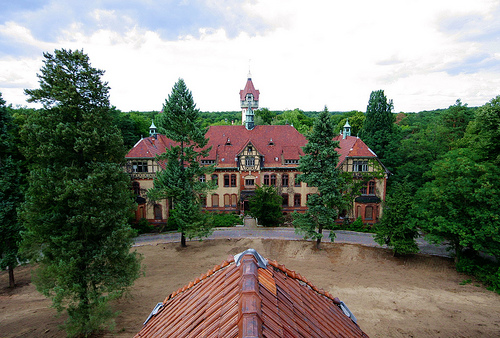
Location: Brandenburg Map
Constructed: 1898
Architect: Heino Schmieden
The Beelitz Heilstätten Military Hospital, often simply referred to as Beelitz-Heilstätten, is a sprawling abandoned complex of approximately 60 buildings spread across nearly 200 hectares in the forested district of Beelitz-Heilstätten, near the town of Beelitz in Brandenburg, Germany. Originally constructed as a sanatorium for treating lung diseases like tuberculosis at the turn of the 20th century, it evolved into a major military hospital during both World Wars, notably treating Adolf Hitler in 1916 after he was wounded in the Battle of the Somme. Post-World War II, it served as a Soviet military facility until its abandonment in 1994, leading to decades of decay that have transformed it into one of Europe's most iconic "lost places" or urban exploration sites. Today, the site blends haunting ruins with partial redevelopment, attracting history buffs, photographers, and tourists interested in dark tourism. Parts of the complex are accessible via guided tours and a modern treetop walkway, offering safe vantage points over the overgrown, graffiti-covered structures that evoke a mix of historical significance and eerie abandonment. Visitor ratings average around 4.5 out of 5 on platforms like Tripadvisor, praising its atmospheric allure, though some note the physical demands and safety restrictions.
Early Years: Tuberculosis Sanatorium (1898–1914)
Berlin's
health insurance authority (for workers) purchased the land in 1898
to combat the "White Plague" — tuberculosis, rampant due to
industrialization and urbanization. The complex opened in early 1902
with about 600 beds, featuring separate facilities for men and
women, pavilions, a cogeneration plant, and extensive supporting
infrastructure. It functioned as a self-contained "city" with its
own post office, bakery, butcher, laundry, kitchens, and more.
By
the late 1920s, after expansions (including another 200 hectares in
1928 and a modern surgical hospital completed around 1930), it could
accommodate over 1,300 patients, with two-thirds focused on lung
treatments. It was a pioneering center for TB research and therapy
at the time, emphasizing fresh air, rest, and isolation in a serene
forest setting.
World War I: Military Hospital and Hitler's
Stay (1914–1918)
Shortly after the outbreak of WWI in August
1914, civilian patients were removed, and the facility was taken
over by the Red Cross as a military hospital with 1,525 beds. It
treated thousands of wounded German soldiers, including early
victims of machine guns, artillery, and mustard gas.
One notable
patient was a young lance corporal named Adolf Hitler. In
October–November 1916, he recuperated here after being wounded in
the thigh by shrapnel during the Battle of the Somme. (Some accounts
also mention temporary blindness from a gas attack.) He spent
roughly two months recovering. This stay later became a point of
dark historical irony, as the site that helped save the future
dictator would later treat his soldiers' victims and then fall under
Soviet control.
The hospital returned to civilian use around 1920
and continued expanding.
Interwar Period and World War II
(1920s–1945)
Further expansions occurred in the 1920s–1930s,
including a surgical ward designed by architect Egon Eiermann during
WWII. The complex again served as a military hospital for wounded
soldiers. It was heavily damaged during the war, particularly in the
final stages.
In April 1945, elements of the German 12th Army
operated in the area during the Battle of Berlin.
Soviet Era:
Largest Military Hospital Outside the USSR (1945–1994/95)
In
1945, the Red Army occupied the site. It became the Soviet Union's
largest military hospital outside the Soviet Union itself, serving
troops stationed in East Germany (GDR). It employed up to 1,000
staff at its peak and was highly advanced, though largely off-limits
to most Germans (some locals worked in support roles like the power
station).
The Soviets maintained control long after German
reunification in 1990, not fully withdrawing until 1994–1995. In
December 1990, shortly after his ouster, Erich Honecker (longtime
leader of East Germany) and his wife Margot were given shelter here
by the Soviets as he faced health issues (liver cancer) and
potential prosecution. He stayed briefly before fleeing to Moscow.
Post-Soviet Abandonment and Partial Revival (1995–Present)
After the Soviets left, the complex lost its primary purpose.
Privatization attempts in the 1990s–2000s largely failed or went
bankrupt. Much of the site was abandoned and fell into decay,
becoming one of Germany's most famous "lost places" (urban
exploration sites). It attracted photographers, filmmakers, vandals,
and thrill-seekers, with some incidents of crime and tragedy
reported in the surrounding area.
Parts of the complex have
been restored or repurposed:
A neurological rehabilitation clinic
operates in some sections.
It serves as a center for Parkinson's
disease research and care.
Other buildings remain derelict,
though large-scale restoration efforts began in the mid-2010s. A
popular treetop walkway (Baumkronenpfad) now allows visitors to
explore the ruins safely from above.
The site has been used in
films like The Pianist (2002), Valkyrie (2008), A Cure for Wellness
(2016), and others, as well as music videos.
Beelitz Heilstätten (also known as Beelitz-Heilstätten) is a
sprawling historic sanatorium and hospital complex in Beelitz,
Brandenburg, Germany, about 30–45 km southwest of Berlin. Built
primarily between 1898 and 1930, it originally served as one of the
world's largest and most advanced tuberculosis treatment centers. It
later functioned as a military hospital in both World Wars (notably
treating Adolf Hitler in 1916) and as the Soviet Army's largest military
hospital outside the USSR until 1994–1995.
The complex comprises
roughly 60 buildings spread across about 140–200 hectares of forested
parkland, designed as a self-sufficient "health city" with its own power
plant, kitchens, laundry, farms, and staff housing.
Overall
Layout and Planning
The site is divided into four main quadrants by a
railway line (east-west) and a road (north-south):
Northern sections:
Primarily for lung/TB patients (infectious cases).
Southern sections:
For other patients.
Western sections: Women's facilities.
Eastern
sections: Men's facilities.
This segregated pavilion system
reflected contemporary medical thinking on infection control, fresh air,
and patient rest. Patient buildings were decentralized and mostly
south-facing to maximize sunlight and ventilation. The grounds featured
parks, paths, pergolas, and landscaped areas (including an "Alpine"
valley feature) to promote outdoor therapy.
Architectural Style
The complex exemplifies Wilhelminian eclectic architecture (late
19th/early 20th-century German historicism under Kaiser Wilhelm II).
Architects Heino Schmieden and Julius Boethke (initial phases) blended:
Historicist ornamentation inspired by Prussian villas and English
country manors.
Functionalist and industrial elements from Berlin's
contemporary architecture.
Key exterior features:
Yellow brick
façades with red brick accents around windows, corners, and openings.
Sloping/falling tile roofs (often red-tiled) with picturesque attics,
dormers, turrets, domes, or prominent central sections.
False
half-timbering in attics.
Gothic-style mullioned windows and
compartmentalized openings.
Generous, rhythmic rows of windows for
light and air.
U-shaped or elongated pavilion layouts with covered
terraces/verandas running along one side for open-air "air-bath"
treatments.
Buildings often featured three stories (sometimes
four plus attics/basements), long corridors, and grand proportions. Some
resemble English country homes from the outside.
Patient
Pavilions and Wards
Typical design (e.g., women's pavilion):
Longitudinal main body with a central corridor serving rooms on north
and south sides, crossed by three protruding transverse sections
(central and at ends). This created a functional, efficient layout.
Patient rooms: Spacious, high-ceilinged, south-facing with large windows
for maximum light and airflow. A complex ventilation system was
integrated.
Verandas and balconies: Essential for the "fresh air
cure" — patients spent hours outdoors even in winter.
Interiors:
Light and airy despite the era's limitations; vaulted halls, tiled
surfaces (especially in baths/pools), stained glass in some windows, and
ornate details like decorative staircases.
Alpenhaus (built ~1905
by Fritz Schulz): The largest in its quadrant (151m long, four floors +
basement, for 273 patients). Featured a clock tower, large water
reservoir on the roof, hydrotherapy rooms, dining halls, and an electric
lift. Its south side overlooked a landscaped "alpine" valley (Schlucht)
with paths for lung exercise. The roof is now gone (WWII damage),
creating a dramatic "rooftop forest" ruin.
Technical and
Supporting Buildings
Cutting-edge infrastructure: Steel-frame
construction enabled large, column-free spaces like dining halls. Roof
water tanks and advanced sanitation were included.
Power/Heating
Plant: Featured a prominent water tower (octagonal shaft with white
glazed bricks and red clinker accents, ~44m high) and cogeneration
capabilities — one of Germany's earliest and largest.
Other
facilities: Kitchens, bakery, butcher, laundry, church, administration,
staff apartments, and even a small shopping arcade (added later).
Later Additions and Military Adaptations
Expansions continued
into the 1920s–1930s, including a modern surgical pavilion (1930).
WWII-era buildings by Egon Eiermann (more modernist) added to the
southern complex.
Soviet period: Minimal major architectural changes,
but interiors adapted (e.g., gyms in former halls); Cyrillic graffiti
remains visible.
Current State and Atmosphere
Many buildings
are in varying states of decay — peeling paint, long eerie corridors,
broken windows, and nature reclaiming spaces — making it a prime site
for urban exploration and photography. Some sections have been restored
for clinics (e.g., neurology/Parkinson's), hotels/studios, or public use
(treetop trail over the Alpenhaus ruin). The contrast between grand
historicist exteriors, functional modern interiors, and romantic decay
defines its appeal.
How to Get There
By Public Transport (Recommended from
Berlin): Take a regional train (RE7 toward Dessau or similar) from
stations like Berlin Hauptbahnhof, Alexanderplatz, Friedrichstraße,
or Ostbahnhof. The journey takes about 45-60 minutes. Get off at
Beelitz-Heilstätten Bahnhof. From there, it's a short 10-minute walk
north along Straße nach Fichtenwalde to the entrance.
By Car:
About 45-60 minutes from central Berlin via A115 and A10. Exit at
Beelitz-Heilstätten. There is visitor parking on site.
Tip: Use
the DB Navigator or BVG app for schedules. An ABC ticket (or
extension) is usually needed.
Opening Hours and Tickets (as
of 2026)
The Baum & Zeit area (treetop path, park grounds, and
access to tours) operates with seasonal hours:
April–September:
Typically 10:00 AM – 7:00 PM daily.
October/March: 10:00 AM –
6:00 PM.
Winter: Shorter hours, often weekends only — check the
official site.
Last admission is usually 1 hour before
closing.
Ticket Prices (approximate; confirm on baumundzeit.de):
Adult park/treetop access: Around €9.50–17 (varies with concessions
and evening rates).
Family/group discounts available.
Guided
tours: Additional €10–17+ per person (e.g., Alpenhaus ~€12.50,
Chirurgie Total ~€17).
Tickets can be bought online or at the
on-site ticket office. Buy in advance for popular tours, especially
weekends.
What to Expect and Key Attractions
Treetop
Walkway (Baumkronenpfad): A highlight — 300–700m long, up to 23m
high, with a 36m observation tower. It offers unique aerial views of
the decaying buildings and forest. Barrier-free with elevator access
in parts.
Guided Tours: The only legal way to enter key buildings
(e.g., Alte Chirurgie/surgery ward, Alpenhaus). Tours cover history
from TB sanatorium days, WWII, Soviet era (Cyrillic graffiti), to
modern decay. Expect helmets (provided), no seating, and durations
of 60–120 minutes. Some are family-friendly; others have age limits
(usually 12+). English tours available on request for private
groups.
Grounds and Ruins: Explore the park-like setting with
overgrown buildings, Soviet remnants, and film-set vibes (used in
The Pianist, Valkyrie, etc.). Many areas are fenced for safety.
In-Depth Visiting Tips
Best Time to Visit:
Weekdays early
morning or late afternoon to avoid crowds and tour groups.
Golden
hour (sunrise/sunset) for photography — dramatic light on ruins and
trees.
Autumn for misty, eerie atmosphere and foliage;
spring/summer for longer days and greenery.
Avoid peak summer
weekends if you dislike crowds.
What to Bring:
Sturdy,
closed shoes and clothes you don't mind getting dirty (dust, debris,
uneven terrain).
Flashlight/headlamp for darker interiors on
tours or shaded areas.
Camera with wide-angle lens for
architecture and details. Tripod if allowed (check rules).
Water,
snacks (limited/no facilities inside), rain jacket (outdoor
elements), and sunscreen/hat.
Binoculars for tower views.
Photography Tips:
The site is a photographer's dream with peeling
paint, light beams, nature intrusion, and vast halls.
Respect
rules: Private photos usually OK on tours, but no professional
shoots without permission; no videos without approval.
Use the
treetop path for overview shots; get low angles inside for drama.
Safety and Rules:
Stay on designated paths and in permitted
areas. Many buildings are unstable — risk of collapse, falling
debris, hidden hazards.
No trespassing outside Baum & Zeit —
security, guards, and potential fines/police involvement. The site
has been increasingly secured.
Helmets mandatory on building
tours.
No dogs, smoking/vaping restrictions likely, no climbing
or removing items.
Watch for uneven floors, stairs, and wildlife.
Go with others if possible.
Health and Accessibility:
Some
tours are not barrier-free (stairs, rough terrain).
The treetop
path has elevator access but involves heights.
Not ideal for
those with mobility issues or claustrophobia in tunnels/buildings.
Combine with Nearby:
Pair with Potsdam (Sanssouci Palace) or
other Brandenburg sites for a full day trip.
Bring cash for small
extras; limited food options on site.
Final Advice
Beelitz
offers a haunting mix of history, architecture, and nature. Plan
around the official Baum & Zeit experience for a safe, enriching
visit — wandering freely like in the old urbex days is no longer
feasible or legal in most areas. Check baumundzeit.de for the latest
hours, prices, tour calendar, and bookings before going, as they can
change seasonally.
Historical Layers Fueling the Hauntings
Early Years & WWI: Opened
in 1902 for TB patients with open-air therapies on balconies. Converted
to a military hospital in 1914, it treated over 12,000 soldiers,
including a young Adolf Hitler recovering from a thigh wound after the
Battle of the Somme in 1916.
WWII and Soviet Era: Used again for
wounded soldiers. Post-1945, the Soviets took it over as their largest
military hospital outside the USSR until 1994. Erich Honecker (last
leader of East Germany) was treated here briefly in 1990–91 for liver
cancer.
Abandonment: Most of the complex was left to ruin after the
Soviets departed. Parts have been restored (e.g., a treetop walkway for
tourists), but many pavilions, surgical blocks (Chirurgie), psychiatric
wards, and corridors remain derelict, overgrown by forest, with peeling
paint, collapsing floors, and nature reclaiming the structures.
Specific Legends and Paranormal Reports
The site's reputation as
"Germany's most haunted hospital" is amplified by urban explorers, ghost
hunters, horror films (like the 2018 found-footage Heilstätten), and
local lore. Common reports include:
EVP and Auditory Phenomena: Ghost
hunters claim to capture faint screams, whispers, or moans in the old
surgery building (Chirurgie) on recordings, often amid
static—interpreted as echoes of TB patients or wounded soldiers.
Shadow Figures and Apparitions: Fleeting shadows in peripheral vision,
especially in long corridors or wards. Cold spots and a pervasive "sense
of being watched" are frequently mentioned.
The Schleicher von
Beelitz ("The Creeper/Stalker of Beelitz"): One of the most enduring
local legends. This phantom is described as a near-invisible or shadowy
figure that lurks in corridors, sometimes emitting child-like wails or
suddenly materializing to scare people. It appears primarily at night.
Some interpret it as a genuine ghost (perhaps a former patient or
victim), while others suggest it originated from a real person (a
prankster or someone deterring trespassers) whose stories grew into
myth. It has become a focal point for "ghost tours" and thrill-seekers.
Physical Sensations: Reports of being touched by unseen hands, hearing
footsteps in empty areas, or feeling overwhelming dread in certain
buildings.
These stories thrive in the eerie environment: vast,
silent halls with rusted beds, decaying operating theaters,
graffiti-covered walls, and trees growing through roofs and floors.
Real-World Darkness Amplifying the Lore
The supernatural tales
are intertwined with grim realities that make the place feel cursed:
The "Beast of Beelitz" (Wolfgang Schmidt, aka "Rosa Riese" or Pink
Giant): A serial killer active 1989–1991 who murdered at least five
women (including the wife of a Soviet doctor at the hospital and their
infant) and attacked others in the surrounding forests. His crimes,
involving sexual violence, added a layer of modern horror.
A 2008
murder of a young model in one of the buildings during a fetish
photoshoot gone wrong.
General dangers of the ruins: Collapsing
structures, squatters, and criminal activity over the years.
These
events blend with the historical suffering to create a feedback loop
where "hauntings" feel plausible.
Visiting and Modern Context
Parts of the site are now safer for tourism with guided tours and the
treetop path offering views over the ruins. However, many areas remain
restricted or hazardous due to decay. Unauthorized urban exploration was
once very popular (and risky) but has become more controlled.
Skeptics note that experiences are likely explained by psychology
(expectation, pareidolia in low light), wind through broken windows,
structural creaks, animals, and the site's overwhelming atmosphere.
Believers see it as a classic residual haunting location where trauma
lingers.