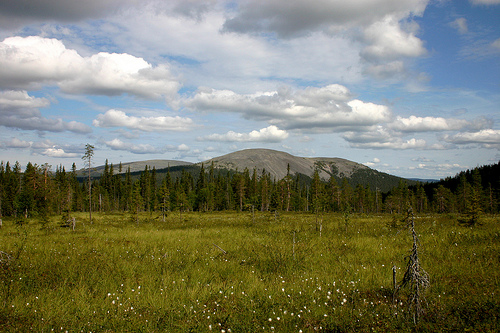
Location: Lapland Map
Area: 1,020 km²
Official site

Pallas-Yllästunturi National Park (Pallas-Yllästunturin
kansallispuisto) is Finland’s third-largest national park, covering
about 1,020 km² in Finnish Lapland (municipalities of Enontekiö,
Muonio, Kittilä, and Kolari). It protects a long chain of fells,
pristine boreal forests (taiga), old-growth woodlands, mires (aapa
bogs), and herb-rich groves. This creates a rich transition zone
where northern Arctic and southern boreal species meet.
The
park’s varied topography—rounded fells (highest point Taivaskero at
809 m), valleys, streams, and lakes (notably Pallasjärvi)—supports
high biodiversity for its latitude, including many rare and
old-growth-dependent species.
Prehistoric and Early Human History
Human presence in the area
dates back over 7,000 years to the Stone Age. Archaeological
evidence includes settlement traces around Ounasselkä, Sonkamuotka,
Muonio church village, Jerisjärvi, Pallasjärvi (near the Pyhäjoki
river mouth), and sites like Hangasojankuru, Kesänkijärvi, and
Aakenusjoki.
During the Bronze Age, western Lapland saw increased
trade, particularly in furs, leading to seasonal camps and fishing
bases (e.g., Keimiöniemi fish camp on Jerisjärvi). Reindeer use as
transport animals and for luring wild reindeer began early, with
ancient pitfall traps for hunting visible until at least the 19th
century.
The region lies in a cultural border zone between Sámi
(indigenous) and Finnish influences. Sámi ancestors likely engaged
in hunting, fishing, and gathering, with later shifts toward
reindeer herding. Permanent Finnish peasant settlement in river
valleys emerged in the second millennium AD, using meadows for
livestock and surrounding wilderness for resources. Reindeer herding
culture spread from Norway and Swedish Lapland in the 1500s–1600s,
becoming prominent along forest-tundra edges. Nomadic herding
largely ended in the early 20th century.
Small-scale selective
logging occurred in the late 19th–early 20th centuries near rivers
and lakes, tied to tar and charcoal production (popular since the
1700s) in nearby Muonio and Kolari.
Path to Protection (Early
20th Century)
The idea of national parks in Finland emerged
around 1910. A committee on protected forests proposed parks at the
Pallastunturi Fells and Pyhätunturi. Finnish botanist Kaarlo Linkola
played a key role in advocating for Pallastunturi protection due to
its botanical value.
Finland’s Nature Conservation Act passed in
1923. A proposal for Pallas-Ounastunturi as a protected area was
approved in the 1928 Parliamentary session. After further studies,
Finland established its first national parks in 1938, including
Pallas-Ounastunturi National Park alongside Pyhätunturi. This made
it one of the country’s oldest parks.
Tourism Beginnings and
WWII
Tourism in the area began in the 1930s. Fell skiing courses
were organized at Pyhäkero (Ounastunturi) and Pallastunturi, with
visitors also heading to Äkäslompolo. The Hetta–Pallas hiking trail,
Finland’s oldest marked fell trail, dates to this era (marked in
1956, though used earlier).
The original Hotel Pallas, a
functionalist stone building with 150 beds completed in 1938, was a
landmark. It was destroyed in 1944 during the Lapland War when
retreating German forces blew it up. A new wooden hotel was built
lower on the slope by 1948.
Post-War Developments and
Expansion
In the 1950s, the Ylläs-Aakenustunturi area was
protected from logging, and Metsähallitus established a special
forest area. Traditional meadow-based agriculture declined in the
1960s. Various protections followed: wetland areas in the 1980s,
Varkaankuru herb-rich forest in 1992, and inclusion in old-growth
forest programs in 1996.
The park joined the EU Natura 2000
network in stages (alpine areas in 2003, boreal in 2005). In 2005,
Pallas-Ounastunturi National Park merged with the Ylläs-Aakenus
Nature Reserve and other protected areas (old-growth forests,
wetlands) to form the current Pallas-Yllästunturi National Park.
This significantly expanded its size and scope.
Cultural and
Historical Significance Today
The park preserves a mosaic of
natural and cultural heritage. Key features include:
Traces of
ancient reindeer hunting pits.
Old settlements and cultural
border influences.
Historic trails, wilderness huts (autiotuvat),
and ruins of early tourism infrastructure.
The Pallastunturi
landscape is one of Finland’s national landscapes. Taivaskero (809
m), the park’s highest point, hosted the lighting of the second
symbolic Olympic flame for the 1952 Helsinki Olympics.
Visitor
centers (e.g., Pallastunturi, one of Finland’s oldest) and
exhibitions highlight the area’s nature and culture. The park
remains a prime destination for hiking, skiing, and experiencing
Lapland’s wilderness while balancing conservation with sustainable
tourism.
Overall Landscape and Topography
The park’s defining feature
is a nearly 100 km (about 60 miles) north-south chain of fells
(tunturi in Finnish)—gently rounded, treeless or sparsely vegetated
hills that are the eroded remnants of an ancient mountain range from
around 3 billion years ago (part of the Svecokarelian orogeny).
Glacial action during multiple ice ages has worn them down into
smooth, accessible domes with rocky scree slopes and broad plateaus.
Highest point: Taivaskero (809 m / 2,654 ft) in the
Pallastunturi area.
Other notable summits include Pyhäkero,
Lumikero, Laukukero, Palkaskero, and various "kero" (rounded,
treeless tops).
Elevations generally range from 500–800 m, with
local relief of over 500 m in places—significant for flat Finland.
The park divides roughly into northern (Pallas-Ounastunturi) and
southern (Yllästunturi) sections, separated by a road/highway, with
the northern part slightly larger.
The fells rise above the
surrounding boreal landscape, offering expansive 360° views across
vast wilderness, forests, and mires. The Pallastunturi fells have
been designated one of Finland’s official national landscapes due to
their iconic beauty.
Geology and Soils
The fells consist
of ancient Precambrian bedrock, including quartzite and mafic
volcanic rocks (e.g., on Keimiötunturi, Sammaltunturi). This creates
varied soil conditions: nutrient-richer slopes on mafic rocks
support more diverse vegetation, while felsic areas (e.g.,
Ounastunturi) are poorer, influencing tree lines. Glacial deposits,
moraines, and till cover much of the area.
Vegetation and
Ecosystems
The park sits at the transition between Forest Lapland
(taiga/boreal forest) and Fell Lapland, with the northern limit of
spruce passing through it. This creates high biodiversity for the
latitude.
Open fells and heaths (above treeline): Dwarf
birch, Alpine bearberry, crowberry, lichens, mosses, and low shrubs.
Treeless tundra-like conditions on summits.
Boreal taiga forests:
Dominated by Scots pine (on poorer soils), Norway spruce (on richer
slopes), and downy birch. Old-growth forests with ancient, gnarled
pines are common.
Aapa mires (bogs/wetlands): Extensive, with
tussock cottongrass, cloudberry, Labrador tea, bog bilberry. These
are characteristic of northern peatlands.
Lush streamside groves
and herb-rich forests: Ferns, angelica, orchids (in calcareous
spots), wood cranesbill, etc.
Treeline varies: Spruce up to
~450–550 m on richer sites; pine lower (~360 m) on poorer fells.
Climate warming has caused measurable upward shifts (e.g., +55 m for
spruce in decades).
Forests and mires dominate the lower and
valley areas, while fells provide open vistas.
Waterways
The park features numerous lakes, ponds, streams, and rivers. The
largest is Pallasjärvi (17.3 km², max depth 36 m), which drains via
the Ounasjoki River system into the Baltic Sea. Clear, pristine
waters support aquatic life and scenic views from fell slopes.
Climate and Seasons
Subarctic/northern boreal climate
(Köppen), with cold, snowy winters and short, cool summers. Annual
mean temperature around -1°C at lower stations. Winters see polar
night (Dec–Jan), temperatures down to -30°C or lower, and deep snow
(peak >1 m in March–April). Summers bring midnight sun (June–July).
Autumn features vibrant "ruska" colors in September. The area is
known for some of the world’s cleanest air (measured at
Sammaltunturi station).
Human Context and Accessibility
The park is highly accessible with extensive trail networks
(hundreds of km for hiking/skiing), visitor centers (e.g.,
Pallastunturi, Yllästunturi Kellokas, Fell Lapland in Hetta), and
services. It borders areas important for reindeer herding and Sámi
culture in the north. Its popularity stems from varied terrain
suitable for all levels, pristine nature, and clean air.
Flora (Vegetation)
The park features distinct vegetation zones
influenced by altitude, soil (moraine, quartzite vs. more base-rich
bedrock), snow cover, wind, and moisture.
Heath forests
(kangasmetsät): Dominated by Scots pine (Pinus sylvestris) and Norway
spruce (Picea abies). Understory includes dwarf shrubs like blueberry
(Vaccinium myrtillus) and lingonberry (Vaccinium vitis-idaea).
Old-growth spruce and pine forests often host abundant dark hair lichens
(e.g., Bryoria species), mosses, and fungi.
Fell birch and treeline
zones: Mountain birch (Betula pubescens subsp. czerepanovii,
tunturikoivu) forms a zone above conifers in northern parts. Dwarf birch
(Betula nana, vaivaiskoivu) is common. The treeline varies (350–550 m)
depending on slope, exposure, and snow load.
Open fells (paljakka)
and alpine tundra: Treeless summits and slopes feature low-growing,
mat-forming plants adapted to harsh conditions: dwarf birch, crowberry
(Empetrum nigrum ssp. hermaphroditum, variksenmarja), Alpine bearberry
(Arctostaphylos alpinus, riekonmarja), pincushion plants, and lichens.
Higher areas include Alpine bistort (Bistorta vivipara), Sudeten
wood-rush (Luzula sudetica), and mountain avens (Dryas octopetala).
Snowbed vegetation (lumenviipymäkasvillisuus) occurs in sheltered
gullies.
Mires and wetlands: Extensive aapa bogs and fens support
cloudberry (Rubus chamaemorus, hilla), Labrador tea (Rhododendron
tomentosum, suopursu), tussock cottongrass (Eriophorum vaginatum,
tupasvilla), and bog bilberry. Calcareous areas host rare orchids (e.g.,
Dactylorhiza species). Southernmost palsas (permafrost mounds) exist in
the park.
Herb-rich groves and creekside forests: Lush riparian areas
and gorges (e.g., Varkaankuru, Pyhäjoki) feature species rare at this
latitude: downy currant (Ribes spicatum, lapinpunaherukka), ostrich fern
(Matteuccia struthiopteris, kotkansiipi), garden angelica (Angelica
archangelica, väinönputki), mezereon (Daphne mezereum, näsiä), wood
cranesbill (Geranium sylvaticum, metsäkurjenpolvi), and dwarf cornel
(Cornus suecica, ruohokanukka). These areas also support diverse mosses
and fungi.
The park is botanically rich due to its position at
the transition between forest Lapland and Peräpohjola zones, with many
species at their northern or southern limits.
Fauna (Animals)
Fauna (Animals)
Approximately 30 mammal species, ~180 bird species,
and smaller numbers of amphibians/reptiles inhabit the park. Habitats
range from dense old-growth forests to open fells and wetlands.
Mammals
Large herbivores: Reindeer (Rangifer tarandus, poro) are
iconic and common, especially on fells and mires in summer. Elk/moose
(Alces alces, hirvi) inhabit forests and bogs.
Predators: Brown bear
(Ursus arctos, karhu) and Eurasian lynx (Lynx lynx, ilves) are permanent
residents but shy and rarely seen. Wolverines and wolves occur
occasionally in the broader region.
Smaller mammals: Arctic fox (less
common), red fox, pine marten, stoat/weasel, least weasel, otter, mink,
mountain hare, red squirrel, Norwegian lemming, various voles (e.g.,
bank vole, field vole, Lapland vole), and shrews.
Birds
The
park is a meeting point for northern and southern species, with many at
range edges. It supports ~150–180 species, including ~48 threatened or
near-threatened.
Fell and tundra species (northern): Snow bunting
(pulmunen, the park’s emblem), rock ptarmigan (kiiruna), willow grouse
(riekko), Eurasian dotterel (keräkurmitsa), red-necked phalarope,
rough-legged buzzard.
Forest species: Siberian jay (kuukkeli), pine
grosbeak (taviokuurna), various tits, three-toed woodpecker, common
blackbird, wood warbler.
Wetland and stream species: White-throated
dipper (koskikara), wood sandpiper (liro), ruff (suokukko), spotted
redshank (mustaviklo), western yellow wagtail, bluethroat (sinirinta).
Raptors and others: Owls and hawks (increase with vole peaks), golden
eagle, gyrfalcon, whooper swan, and others. EU Birds Directive species
include capercaillie (metso), black-throated diver, etc.
Other
vertebrates
Reptiles and amphibians: Viviparous lizard, common frog,
and adder (Vipera berus) occur.