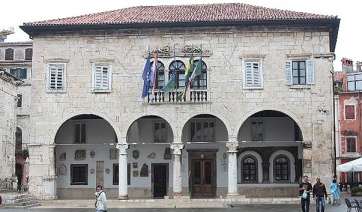
The Pula Communal Palace, commonly known as the Pula Town Hall or Gradska vijećnica, is a striking medieval administrative building at the heart of Pula's historic Forum Square (Trg Foruma) in Croatia's Istrian Peninsula. Constructed primarily in the late 13th century on the ruins of the ancient Roman Temple of Diana, it has served continuously as the seat of local governance for over seven centuries, evolving from a modest Gothic structure into a eclectic monument blending multiple architectural epochs. Today, it functions as the official residence of the city's mayor, a venue for municipal deliberations, and a cultural hub hosting exhibitions, ceremonies, and public events. Its central position amid Pula's Roman antiquities—flanked by the Temple of Augustus and Roma—underscores the city's layered heritage, from imperial Rome to Venetian dominance and beyond. Measuring roughly 40 meters in length with a two-story facade, the palace symbolizes civic pride and resilience, having withstood wars, fires, and neglect through repeated restorations.
The Pula Communal Palace (Croatian: Komunalna palača u Puli; Italian:
Palazzo Comunale), also known as the Town Hall or City Hall, stands at
the northern end of Forum Square (Trg Forum) in the historic heart of
Pula, Croatia. It has served as the continuous seat of local municipal
government for over 1,000 years—one of the longest such traditions in
Europe—and remains the home of the City Council and mayor today. Its
architecture and location form a living palimpsest (layered historical
record) of Pula’s entire past, from Roman antiquity through medieval
autonomy, Venetian rule, and into the modern era.
Roman Origins and
Early Medieval Use (1st Century AD – 13th Century)
The palace
occupies a site of profound ancient significance. During the Roman era
(when Pula was the colony of Pola), the Forum was the civic and
religious center of the city, framed by a triad of temples dedicated to
the imperial cult and local deities. Only the Temple of Augustus (built
around 2 BC–14 AD) survives largely intact on the western side of the
square; the eastern temple was the Temple of Diana, with a third temple
(likely dedicated to Juno or another deity) completing the group.
After the fall of the Western Roman Empire, the Forum retained its
importance as a public space. By at least the 9th century, the partially
ruined Temple of Diana was adapted into a rudimentary city hall to house
early medieval institutions of town government. This marked the
beginning of a continuous civic function on the site. Remnants of the
Roman temple—particularly the northern/back walls—are still visible
today embedded in the palace’s rear facade, along with reused Roman
stone blocks (spolia) incorporated into later construction.
Construction as a Free Commune (Late 13th Century)
By the late 13th
century, Pula had become a prosperous free municipality (komuna) with
growing self-governance. The need for a dedicated, purpose-built city
hall led to the construction of the Communal Palace directly on the
foundations and remains of the Temple of Diana. Work began in the 1290s
and was completed in 1296 under the podestà (chief magistrate)
Bartholomeus de Vitrei (or Vitreo), a noble from Padua who oversaw the
project during a period of relative independence.
The original
structure was built primarily in Gothic style, though earlier Romanesque
elements are evident, especially on the eastern wall where the two
styles intertwine. A prominent Latin inscription on the main (northern)
facade—restored in the 16th century but dating to the original
construction—records the 1296 completion. It describes the building as
the “honourable seat of the two councils and the court” and includes a
call for wise leadership, civic unity, and the preservation of peace.
Adjacent to it is a stone relief of a mounted horseman depicting
Bartholomeus himself as patriae praeses (president of the fatherland).
Other early sculptural features include a grotesque telamon (a muscular
supporting male figure, or atlantes) above the equestrian relief and a
Romanesque siren (mermaid) on the north-eastern corner, holding her
stone fins in a distinctive pose. These details reflect the transition
from Romanesque to full Gothic forms.
Venetian Era and Stylistic
Evolutions (14th–17th Centuries)
Pula came increasingly under the
influence of the Republic of Venice from the 12th century onward, with
full control solidified around 1331. The palace transitioned from a
symbol of communal autonomy to the official residence of the Venetian
duke (or count, knez) and provveditore (governor). It continued to
function as the administrative heart of the city throughout Venetian
rule.
Major reconstructions reflected shifting artistic tastes:
Late 15th century: Renaissance-style overhaul, adding elegant
columns and refining the facade.
17th century: Baroque modifications,
most visible today in the enlarged windows and decorative elements.
Additions and alterations occurred gradually from the 10th through
16th centuries, resulting in a harmonious (yet layered) blend of
Romanesque, Gothic, Renaissance, and Baroque features. The building’s
colonnaded ground-floor arcade and upper-story windows exemplify this
evolution.
Modern Reconstructions and Restoration (18th–20th
Centuries)
The palace saw further modifications in the 19th and 20th
centuries amid changing political control (Austrian, Italian, Yugoslav,
and finally independent Croatian rule). Periods of neglect left visible
traces of weathering and damage, but a comprehensive restoration was
completed in 1988. This final project carefully preserved the building’s
historical “stratigraphy”—the visible layering of architectural
periods—while ensuring it remained functional as a modern civic
building.
The palace occupies the exact site of the eastern temple in the Roman
Capitoline triad on the Forum (1st century AD), traditionally identified
as the Temple of Diana. From the 9th century onward, the ruined temple
was repurposed as a rudimentary seat of local administration. As Pula
prospered as a free municipality in the late 13th century, the existing
structures were extensively remodeled into a dedicated Gothic city hall,
completed in 1296.
Builders incorporated Roman spolia (reused stone
blocks, columns, and walls) wherever possible; the northern wall and
parts of the Temple of Diana’s gable, fluted columns, and entablature
remain clearly visible on the rear (northern) facade today, literally
forming the palace’s structural backbone.
Construction Phases and
Stylistic Evolution
The building is not the product of a single
architect or era but the result of centuries of adaptive additions,
partitions, and stylistic updates:
13th-century Gothic core (c.
1291–1296): The primary medieval phase. The palace was built in a mature
Adriatic Gothic style using local limestone. It featured pointed arches,
lancet windows, and ribbed vaulting (notably in the ground-floor atrium
or loggia areas) to create open, light-filled civic spaces.
10th–16th
centuries (major additions): Romanesque and early Gothic elements appear
intertwined, especially on the eastern wall—the oldest visible
construction layers.
Late 15th century: Renaissance reconstruction.
Classical proportions, pilasters, and framing elements were introduced.
17th century: Baroque phase under Venetian rule. Windows were enlarged
or replaced in the ornate Baroque style typical of Venetian civic
architecture.
19th–20th centuries: Multiple restorations and
refinements for functionality and preservation. The most recent
comprehensive restoration (completed 1988) stabilized the structure
while preserving all historic layers.
The result is an
“exceptional medley” of Roman, Romanesque, Gothic, Renaissance, and
Baroque features in a single harmonious yet eclectic facade.
Exterior Architecture and Key Features
The palace is a two- to
three-story rectangular stone building with a formal, symmetrical main
(southern) facade facing the Forum and more functional side/rear
elevations.
Main (southern) facade (Forum-facing): A rhythmic
arcade of rounded arches supported by robust columns at ground level
creates a shaded loggia. Above, the piano nobile features rectangular
windows with stone surrounds, a central balcony, and a prominent Latin
inscription (restored in the 16th century) recording the 1296 completion
under podestà Bartolomeus de’ Vitrei (from the Paduan Vitrei family).
The inscription emphasizes civic duty, wise governance, and the
“venerable seat of the two chambers and the court.”
Sculptural
highlights:
Telamon (Atlante): A grotesque, muscular male supporting
figure at a corner, depicted as strained and crooked under the weight of
the roof and cornice—a dramatic, almost caricatured Gothic/Renaissance
element.
Siren (Mermaid): A Romanesque-style female figure on the
north-eastern corner, holding her fins, adding a whimsical mythological
touch.
Both sculptures are framed/enclosed by elegant Renaissance
columns, creating a striking contrast between medieval expressiveness
and classical restraint.
Equestrian relief: A medieval stone
horseman (likely depicting the podestà) appears on the facade as a
symbol of civic authority.
Eastern wall: Best place to see the
earliest layers—intertwined Romanesque rounded forms and Gothic pointed
arches and moldings.
Baroque windows: The uppermost and most recent
exterior additions—tall, arched or rectangular openings with decorative
surrounds and shutters—give the upper stories a lighter, more ornate
Venetian appearance.
Rear (northern) facade: Dominated by the
protruding Roman Temple of Diana remains, offering a direct
architectural dialogue between antiquity and the Middle Ages.
The
entire structure is built of pale Istrian limestone, with visible
variations in stonework (rough Roman blocks vs. finely dressed medieval
and Renaissance ashlar) that reveal the building’s layered history.
Interior and Structural Notes
Although primarily a working civic
building (not a museum), the interior preserves Gothic structural
elements such as cross-ribbed vaults in the ground-floor atrium/loggia
and some upper chambers, which efficiently distribute weight and allow
taller, brighter spaces. Later partitions and Baroque/Neoclassical
updates adapted rooms for administrative use while retaining the
medieval footprint. The overall interior continues the exterior’s theme
of historical layering.
As Pula's enduring emblem of self-rule, the Communal Palace holds
immense cultural and symbolic value, anchoring the UNESCO-nominated
Historic Complex of Pula (via its Roman ties) and illustrating how
medieval communes adapted imperial legacies. It stands as a counterpoint
to Pula's gladiatorial Arena, representing intellectual rather than
martial Romanitas, and hosts annual events like the Istrian Spring
Festival or civic holidays, fostering community identity in a
tourist-driven economy. Architecturally, it offers scholars a case study
in adaptive reuse, with its temple integration highlighting sustainable
building practices avant la lettre.
For visitors, the palace is
accessible daily: weekdays 9:00 AM–5:00 PM for self-guided exploration
of public areas (mayor's antechamber, atrium), with guided tours
(Croatian/English, ~€5, discounts for students/seniors/groups) available
upon request. Weekends and holidays feature shorter hours (10:00 AM–2:00
PM), and closures may occur during official events—check ahead. Entry to
the exterior and square is free, but interiors require a nominal fee;
photography is permitted without flash. Located at Forum 1 (Trg Foruma
1, 52100 Pula), it's a 10-minute walk from the bus/train station or
Arena, with ample nearby parking (consult visitpula.hr for options).
Contact the City Office at +385 52 371 714 or info@pula.hr; the official
site (pula.hr) lists events. Spring/autumn visits avoid summer crowds,
allowing serene appreciation of its Forum setting—pair with a coffee at
adjacent cafes for an authentic Istrian interlude. As of 2025, no
disruptions are noted, though ongoing minor conservation ensures its
vitality.