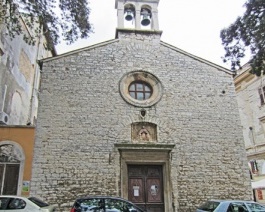
The Church of Our Lady of Mercy (Croatian: Crkva Gospe od Milosti; Italian: Chiesa della Misericordia or Madonna della Misericordia) stands in the historic heart of Pula (ancient Pola), Croatia, on Dante Alighieri Square (Danteov trg). It is a modest yet significant late-medieval votive church dedicated to the Virgin Mary under her title of Mercy. Located near the iconic Arch of the Sergii (Arco dei Sergii) and integrated into Pula’s ancient Roman urban grid—its side wall follows the Cardo Maximus (north-south axis) and its rear abuts the Decumanus Maximus (now Ulica Sergijevaca)—it embodies layers of Istrian history from Roman foundations through Venetian rule to modern Croatia.
Origins and the Marian Apparition Legend (Late 14th Century)
The
church’s story is rooted in a local tradition of a Marian apparition.
According to accounts preserved in Pula Cathedral parish archives (and
echoed in local tourism sources), the Blessed Virgin Mary appeared at
the site on October 10, 1383 (some records cite 1389). This miraculous
event, occurring amid the spiritual and material hardships of
late-medieval Istria—including plagues, wars, and Venetian
influence—prompted the immediate construction of a small votive chapel
as an act of thanksgiving and plea for divine protection.
Historical
records first mention the structure around this period. While the
precise date of the initial building is uncertain, it is widely regarded
as a late-14th- or early-15th-century foundation. Some sources note
foundational or expansion work as early as 1447–1453. The church was
formally consecrated in 1487, possibly under the commission or
involvement of Prefect Scipione Benzone.
Augustinian Era and
Institutional Growth (15th–18th Centuries)
In 1453 the church and an
adjoining (now-lost) monastery were entrusted to the Augustinian order,
which managed it until 1780. The Augustinians expanded its pastoral,
educational, and charitable roles. From 1600 to 1814 an associated
hospice operated nearby, offering shelter and aid during times of
crisis, including the Napoleonic era and Austro-Hungarian
administration.
A major reconstruction occurred in 1584, during which
an elegant loggia was likely added to the facade. This phase is
commemorated by an inscription on the lintel reading “SCIP BENZ
P.M.D.84” (referring to Scipione Benzone, prefect of the municipality).
The church received further renovation in 1750, with details recorded on
the entrance transom.
19th-Century Challenges and Restorations
The 19th century brought both damage and renewal. A fire in 1858
severely affected the interior; restoration followed, with contributions
from local industrialist Pietro Ciscutti (some accounts place related
work around 1854). In 1898, Trieste architect Tomasi proposed a grand
expansion to serve a growing congregation, but only a new presbytery and
sacristy were ultimately added, preserving much of the original medieval
fabric while introducing neoclassical elements.
These modifications
reflect Pula’s shifting political fortunes: from Venetian control to
Austrian, then Italian, and finally Yugoslav/Croatian sovereignty. The
church remained one of the few active Catholic sites in 1828 when the
Pula bishopric was merged with that of Parenzo (Poreč).
Modern
Era and Contemporary Significance (20th–21st Centuries)
Further
restorations occurred in 1980 and 2015, focusing on structural stability
and aesthetics (including seismic reinforcements suited to the region).
The church abuts Pula’s oldest school (OŠ Centar, built 1867 originally
for Austro-Hungarian naval families), and joint Masses still mark the
start of the school year.
Today it functions as an active parish
church under the Pula Cathedral parish (Diocese of Poreč-Pula). It hosts
daily Masses (in Croatian), processions, and cultural events. The annual
feast day on October 10 commemorates the apparition with solemn
liturgies and processions, maintaining its role as a local pilgrimage
site. Entry is free; donations support upkeep. It is easily reached on
foot from Pula’s Arena, bus station, or main sights and contributes to
the city’s UNESCO-nominated historic core.
Note on a similar-named
site: Pula also has a separate Sanctuary of Our Lady of Mercy (Svetište
Gospe od Milosti) in Šijana (a suburban neighborhood), a single-nave
church built in 1885–1887 on Byzantine-era foundations (8th century)
with a medieval predecessor mentioned from 1470. That structure is
distinct and lies outside the old town; the Danteov trg church is the
primary one referred to in English-language tourism and historical
sources as the Church of Our Lady of Mercy.
The church was constructed in the late 14th century (around 1389,
following a reported Marian apparition on 10 October 1383) as a
thanksgiving chapel and pilgrimage site. It reflects medieval Istrian
piety during a period of plagues, wars, and Venetian rule. For centuries
(1453–1780), it was linked to an adjacent Augustinian monastery and
hospice, which influenced its modest scale and communal function. A
devastating fire in 1858 damaged the interior, prompting restorations.
In 1898, architect Tomasi added a new presbytery and sacristy (only
partial implementation of a larger unbuilt expansion plan). Further
renovations occurred in 1980 and 2015, focusing on structural
reinforcement while preserving the medieval core. These layers of
modification illustrate how the building evolved without losing its core
Gothic character.
Overall Plan and Scale
The church follows a
simple rectangular single-nave plan, typical of 14th-century Istrian
chapels and votive shrines. It measures roughly 20–25 meters in length
(exact dimensions vary slightly due to later additions). There is no
transept or complex side chapels in the original fabric; the layout
prioritizes intimacy and functionality over grandeur. Its orientation
aligns deliberately with Pula’s Roman street grid: the lateral wall
follows the ancient Cardo Maximus (north–south axis, now part of
pedestrian routes), while the rear abuts the Decumanus Maximus
(east–west, today Ulica Sergijevaca). This integration into the urban
fabric is a hallmark of vernacular sacred architecture in Istria, where
churches often “grow” from the existing Roman and medieval street
pattern rather than dominating it.
Exterior Architecture
The
façade facing Danteov Trg is unadorned yet dignified, embodying the
restrained elegance of late Gothic Istrian stonework. The primary
decorative element is the portal sculpture or relief of the Madonna
della Misericordia (Our Lady of Mercy) above the entrance. This iconic
image shows the Virgin sheltering the faithful under her outstretched
mantle—a powerful symbol of protection and intercession tied directly to
the church’s founding apparition legend. The statue/relief crowns the
portal and serves as the visual focal point.
The walls are
constructed of local Istrian limestone (a durable, pale stone quarried
nearby), laid in regular courses with minimal ornamentation. Narrow
lancet windows along the nave provide controlled natural light while
maintaining the building’s solid, protective appearance. There is no
prominent bell tower attached directly to the church itself (any bell
elements are understated and blend into the urban skyline), reinforcing
its role as a neighborhood chapel rather than a monumental landmark. The
overall aesthetic is humble and functional, contrasting sharply with
Pula’s grand Roman Arena or the more elaborate Pula Cathedral nearby.
Interior Architecture and Features
Inside, the space feels
intimate and contemplative. The single nave is covered by pointed Gothic
arches and ribbed vaults (original late Gothic elements), which create a
sense of vertical lift and rhythmic flow despite the modest height.
Whitewashed walls highlight the wooden furnishings and stone structural
members, keeping the focus on light, acoustics, and devotion rather than
lavish decoration. Narrow windows filter Adriatic sunlight, producing an
ethereal quality especially during evening masses.
The main altar
holds a revered statue of the Virgin Mary (transferred or preserved from
earlier iterations). The 1898 additions at the east end introduced a
slightly enlarged presbytery and sacristy with arched doorways and
vaulted ceilings that incorporate subtle neoclassical
influences—providing a gentle stylistic bridge between the medieval core
and later practical needs. No extensive fresco cycles or ornate
altarpieces survive (or were ever prominent), emphasizing the church’s
votive humility. Any votive offerings or side elements remain simple, in
keeping with its origins as a pilgrimage site of thanksgiving.
Materials throughout are local Istrian stone for load-bearing walls and
foundations, chosen for its resistance to the humid coastal climate and
seismic activity common in the region. Modern interventions (post-1980
and 2015) have added discreet seismic retrofitting without altering the
visible historic fabric.
Architectural Significance in Istrian
Context
The Church of Our Lady of Mercy exemplifies late Gothic
vernacular architecture in Istria: small-scale, stone-built,
community-oriented shrines that blend seamlessly with Roman-era urban
layouts. Unlike the grand basilicas or Renaissance palaces of coastal
cities, it prioritizes functionality, symbolic devotion (the Mercy
motif), and adaptation to local stone-working traditions. Its survival
amid Pula’s layered history—from Roman colony (Pietas Iulia) to
Byzantine, Venetian, Austro-Hungarian, and modern Croatian periods—makes
it a living palimpsest of the city’s spiritual and architectural
continuity. Today it remains an active parish church, hosting masses,
processions (especially the annual October 10 commemoration), and
serving the local community alongside the adjacent historic school
building.
As a testament to Marian devotion and communal resilience, the Church
of Our Lady of Mercy holds profound cultural and spiritual significance
in Pula, a city famed for its Roman heritage yet vibrant in Christian
continuity. It represents the "small-scale sacred" amid grand
antiquities, offering a quiet counterpoint to tourist throngs at the
Arena. Its apparition legend fosters a sense of ongoing miracle,
attracting locals for feast days and visitors seeking authentic Istrian
piety. Architecturally, it contributes to Pula's UNESCO-nominated
historic ensemble, illustrating how medieval faith overlaid Roman
infrastructure.
The church is open daily for prayer, with masses in
Croatian (check local schedules via the Pula Cathedral parish at +385 52
222 538 or biskupija-porecko-pulska.hr). Entry is free, though donations
support maintenance. Located at Danteov Trg 1, it's a 5-minute walk from
the main bus station or Arena, ideal for self-guided old-town tours.
Nearby, explore the adjacent school, Sergijevaca's shops, or the Temple
of Augustus. For deeper insights, join October 10 celebrations or guided
walks via the Tourist Office Pula (pulainfo.hr). As of 2025, no major
disruptions are reported, but verify for events. This unassuming gem
invites reflection on mercy in a historic crossroads, much like the
apparition that birthed it.