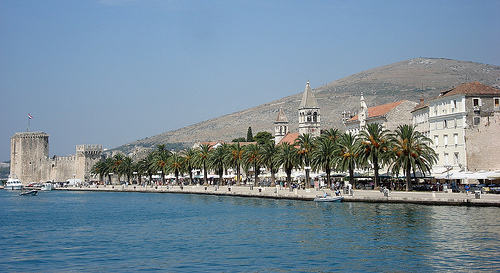
Kamerlengo Castle (Gradina Kamerlengo), also known as Kamerlengo Fortress, is a prominent 15th-century Venetian stronghold located in the historic town of Trogir, Croatia. Situated at the southwest corner of Trogir's UNESCO-listed Old Town island, it overlooks the Adriatic Sea and the channel separating Trogir from Čiovo Island. The name "Kamerlengo" derives from the Venetian term for a chamberlain or administrator, reflecting its historical role in managing the city's defenses and finances. Today, it serves as a popular tourist attraction, offering panoramic views, cultural events, and a glimpse into medieval military architecture. While primarily a defensive structure, it has been repurposed for open-air concerts, film screenings, and festivals, blending history with modern entertainment.
Early Site and Pre-Venetian Defenses (Late 14th
Century)
The castle did not arise in isolation. Trogir itself has
deep roots—settled by Illyrians around 2000 BC, colonized by Greeks as
Tragurion, and later a Roman municipium known for its stone quarries. By
the late 14th century, amid regional conflicts, the site already
featured significant fortifications. Around 1380 (during the lead-up to
or early stages of the War of Chioggia, 1378–1381), Trogir
residents—then allied against Venice with Genoa—built the massive Kula
Veriga (Veriga Tower or Tower of Chains), a large polygonal (roughly
octagonal) corner tower at the southwest edge of the island.
This
tower guarded the harbor: heavy iron chains stretched from it to the
opposite shore on Čiovo to block enemy ships. In 1378, a naval battle
between Venice and Genoa unfolded right in front of it, with sunken
galleys later repurposed by locals as artificial reefs ("porporele") for
extra harbor protection. The Veriga Tower became the oldest and largest
element of the future castle—the keep or donjon—and part of the broader
city walls built around that time.
Venetian Conquest and
Construction (1420–1437)
The pivotal moment came in 1420. After
decades of intermittent Venetian or Hungarian influence, Trogir enjoyed
a degree of autonomy until the Venetian Republic laid siege to the city
for nearly two months. The Venetians captured it, but the prolonged
fighting badly damaged existing defenses, and the local population
remained openly hostile to the new rulers.
To assert permanent
control, quell potential unrest, and create a secure base amid growing
regional threats (including later Ottoman incursions along the Dalmatian
coast), Venice ordered the construction of a dedicated city-castle
(citadel). Work began immediately in 1420 and continued until 1437. The
project expanded and incorporated the existing Veriga Tower rather than
starting from scratch.
Local stonemason Marin Radoj (or Radojev), a
prominent Trogir craftsman who also worked on the harbor and cathedral
vaults, oversaw the masonry and stonework. He quarried and shaped
limestone locally (with a team of masons), while the city provided ships
for transport. The Venetian state engineer and consultant Lorenzo Picino
provided the overall design and technical oversight. The Trogir prince
signed the contract; funding came largely from salt revenues, and some
private properties and houses were confiscated to clear space.
The
resulting fortress took the form of an irregular trapezoid with four
corner towers (the Veriga Tower as the dominant keep) and high polygonal
walls. It was deliberately placed outside the main town core but
adjacent to the sea for quick naval access and defense. An outer
crenellated wall stood about 5 meters beyond the main structure for
extra protection against artillery, and a wet moat (with a bridge)
separated the castle from the city proper—symbolizing ongoing distrust
of the locals. Inside were living quarters for the garrison and
officials, storage for supplies and treasure (to withstand sieges), a
well, and a small chapel dedicated to St. Mark, Venice’s patron saint.
Architectural details include machicolated parapets, wall walks, a
prow-shaped northeast tower, and symbolic reliefs: a monumental Venetian
lion (symbol of the Republic), the coat of arms of the Tron family
(honoring Luka Tron, sopracomite during the 1420 conquest events and
prince of Trogir 1421–1424), and a Gothic lion relief linked to the
Contarini family (referencing earlier Venetian victories like the
conquest of Zadar).
Name, Function, and Venetian Era (Mid-15th to
Late 18th Century)
At first, it was simply known as the “castle of
Trogir” or city fortress. By the mid-16th century, it acquired the name
Kamerlengo (from the Italian camerlengo, meaning chamberlain or
treasurer—an important Venetian administrative and financial official
responsible for managing communal revenues, expenses, and governance).
The kamerlengo and castellan resided here with Venetian mercenaries,
turning the castle into a combined military, naval, and administrative
hub.
During nearly 400 years of Venetian rule (1420–1797), it
functioned as a key stronghold in their Dalmatian network—defending
against pirates, sea attacks, and Ottoman threats—while also serving as
a naval base, barracks, and storage facility. It symbolized Venetian
dominance over a sometimes reluctant subject city.
Post-Venetian
History, Decline, and Revival (1797 Onward)
After the fall of the
Venetian Republic in 1797, Trogir passed to Napoleonic France, then
Austria, and later other powers. Most of the old city walls were
demolished in the mid-19th century, the moat was filled in, and the
castle gradually fell into disrepair. Plans to demolish the dilapidated
structure were considered but ultimately abandoned.
It saw varied
later uses, including as barracks and possibly storage or even an olive
refinery in some periods. Significant deterioration occurred toward the
end of the 19th century, but major renovations after World War II
restored it. Today, it remains owned by the City of Trogir and is a
popular tourist attraction offering panoramic views from the main tower
over the old town, Čiovo, and the Adriatic. In summer, the courtyard and
walls host concerts, plays, festivals, and cultural events.
Legend of the Kamerlengo
Local folklore adds a romantic (and tragic)
layer. One version tells of a Venetian camerlengo (sometimes named
Diego) who fell in love with a Trogir girl named Zora. Forced by his
family to marry a Venetian noblewoman, Orsola Gatti (or Orsola), he
complied. Heartbroken Zora reportedly died of poison or grief during the
wedding. The camerlengo and Orsola had a daughter who resembled Zora but
later fell ill and died; Orsola eventually left him. The camerlengo was
left alone, legend says he became mute and never spoke again. The story
symbolizes the fortress as a reminder “to fight for what we love.”
The fortress was built between 1420 and 1437, shortly
after the Republic of Venice conquered Trogir in 1420 following a nearly
two-month siege. Venetian authorities needed a secure stronghold because
local resistance persisted and earlier defenses had been damaged. Local
stonemason Marin Radoj oversaw construction, while engineer Lorenzo
Picino acted as architectural consultant. The new fortress expanded and
incorporated an earlier defensive tower—the late 14th-century Veriga
Tower (Kula Veriga or Tower of Chains, built ca. 1380)—which became the
central keep. The name “Kamerlengo” derives from the Venetian title for
the chamberlain/governor who resided here with a garrison of
mercenaries. Originally, the fortress was isolated from the rest of the
city by a wet moat and an outer crenellated wall for added security.
Overall Plan and Layout
The castle follows an irregular
trapezoidal plan (roughly 60 m × 40 m in overall footprint, though exact
dimensions vary slightly by source), created by closing off the
southwestern promontory of the city using existing walls and towers.
This functional military design prioritizes defense over symmetry,
typical of late medieval Venetian coastal fortifications with some early
Renaissance influences.
The structure encloses a central open
courtyard that originally contained residential and service ranges
(barracks, storage for supplies and treasure), a well for water
self-sufficiency during sieges, and a small Chapel of St. Mark (Venice’s
patron saint). Most internal buildings were later removed or adapted,
leaving the courtyard largely open today (it now hosts summer concerts
and events).
North entrance: An arched gateway (with a lunette)
originally reached via a drawbridge over the moat. The moat was filled
in the 19th century, and the fortress is now directly accessible from
the city promenade.
Towers and Keep
Four corner towers anchor
the trapezoid, providing all-around surveillance and crossfire
capability:
Southwestern corner (seaward): The massive Veriga Tower
(the oldest and largest, ca. 30 m high), a robust polygonal/octagonal
keep (sometimes described as roughly cylindrical in appearance from
afar). It predates the main fortress by about 50 years and now serves as
the visual and structural centerpiece. It rises above the curtain walls,
features machicolated parapets, Italian-style merlons, a flat roof, and
battlements. Protected entrances connect it to the south wall walk and
(originally) a northern drawbridge access. Climbing it today offers
panoramic views over Trogir’s old town, the marina, Čiovo Island, and
the Adriatic.
Other three corners: Smaller but substantial
cylindrical or turret-like towers. The northeastern one is notably
prow-shaped (pointed for better deflection of projectiles or wave
action), with its northwestern counterpart as a near-mirror image. The
southeastern tower completes the defensive ring. All towers are
integrated into the curtain walls and equipped for observation and
artillery.
Walls, Defensive Features, and Materials
Thick
limestone curtain walls (local stone, highly durable against seawater
corrosion) form the enclosure. The walls include:
A wall walk
(ramparts) along the top for guards and artillery placement—still
walkable today (though the pavement is uneven in places).
Crenellations (merlons and embrasures) for defensive firing.
Machicolations (projecting openings) on the keep and select sections for
dropping projectiles or boiling liquids.
Originally an outer
crenelated wall and wet moat for layered defense.
The design
blends robust functionalism with subtle Venetian Gothic/Renaissance
details (e.g., proportional symmetry, arched openings). Eleven (or more)
coats of arms of Venetian governors and doges adorn the walls, serving
as both decoration and political statements.
Inside the courtyard,
the Chapel of St. Mark features a monumental relief of the winged Lion
of St. Mark (Venice’s symbol) and smaller heraldic elements, including
the Tron family coat of arms (linked to a key Venetian commander during
the conquest) and a Gothic relief referencing the Contarini family.
Materials and Construction Techniques
The entire structure uses
local limestone masonry, typical of Dalmatian Venetian
fortifications—massive, precisely cut blocks for strength and weather
resistance. Construction integrated pre-existing elements efficiently,
reflecting pragmatic Venetian military engineering adapted to the
Mediterranean coastal environment (resistance to siege, naval threats,
and Ottoman incursions).
Later History and Current State
In
the 19th century, most of Trogir’s broader city walls were demolished
and the moat filled; plans to raze the castle were abandoned. The
fortress later served as barracks, a warehouse, and even an olive
refinery. Today it is owned by the City of Trogir, open to the public
(with seasonal hours and modest entry fee), and functions as a cultural
venue for concerts, performances, and tourism. The ramparts and Veriga
Tower offer some of the best views in Trogir, especially at sunset.
One of the castle's highlights is the climbable ramparts and towers, providing 360-degree views of Trogir's red-tiled rooftops, the Cathedral of St. Lawrence, the Adriatic Sea, and distant islands—ideal for photography and sunset watching. The polygonal tower houses a small exhibition space with historical artifacts, such as Venetian coats of arms and cannon replicas, evoking its military past. The open courtyard often hosts events like the Trogir Summer Festival, with concerts, theater performances, and medieval reenactments under the stars. A unique feature is the preserved defensive slits and embrasures, demonstrating Venetian engineering for crossbow and early cannon use. The castle's integration with Trogir's fortifications, including the nearby Vitturi Tower, underscores its role in the town's medieval defense network.
Kamerlengo Castle is open daily from 9:00 AM to 8:00 PM in summer (June-September), with reduced hours in shoulder seasons (10:00 AM to 6:00 PM) and potential closures in winter—check locally for updates. Admission is approximately €5 for adults, €3 for children and students, with free entry for under-7s. Tickets are purchased at the entrance; no advance booking is needed, though guided tours (around €10-15) can be arranged through Trogir's tourist office for deeper historical insights. The site is accessible on foot from Trogir's center (5-minute walk from the main bridge), with nearby parking available. Accessibility is limited due to uneven stone paths and stairs—no elevators, making it challenging for those with mobility issues. Photography is encouraged, and the castle is family-friendly, though supervision is advised on the ramparts. Reviews highlight the stunning views and affordable entry, averaging 4.5/5, with some noting crowds in peak season. Combine visits with St. Mark's Tower or a Trogir walking tour for a full experience.