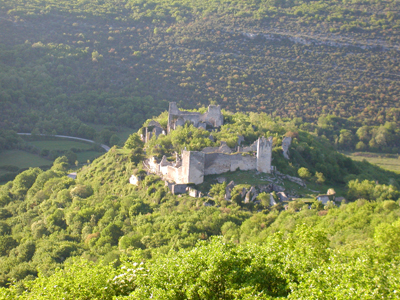
Location: Central Istria Map
Constructed: current walls erected in the 11th century
Dvigrad (also known as Due Castelli, Dvograd, or Docastei;
Croatian: Dvigrad, meaning “Twin Town” or “Two Castles”) is one
of Croatia’s most evocative abandoned medieval settlements. Its
stone ruins sit dramatically on a hill in the Limska Draga
(Draga Valley) in central Istria, about 18 km from Rovinj and
within the municipality of Kanfanar. The site is not a single
castle but the remains of a fortified medieval town that once
consisted of two separate but closely linked settlements: the
northern Moncastello (whose ruins visitors see today) and the
southern Castel Parentino (or Kaštel Parentino/Parentin), which
was abandoned much earlier.
The location was chosen for
strategic reasons: a defensible hill at 150–175 m elevation,
abundant fresh water, fertile land, and proximity to the ancient
Roman road Via Flavia, which linked the Adriatic coast with the
interior. These advantages made it a natural hub for trade and
defense for over a millennium.
Prehistoric, Roman, and Early Slavic Roots
Human presence in the
area dates back to prehistoric times, with evidence of an Illyrian
hillfort settlement. The Romans later incorporated the site into their
provincial network, using it as a way-station or fortified point along
the Via Flavia. By the end of the 6th century, Slavic communities had
settled in the region, though organized governance was limited at first.
Benedictine monks played a role in cultivating the surrounding Lim
Valley during the early medieval period.
Archaeological traces
confirm continuous habitation from antiquity onward, including early
Christian structures.
First Historical Mention and the Two-Town
Era (9th–10th Centuries)
Dvigrad enters written history in 879 AD,
when jurisdiction over its church was transferred from the Diocese of
Pula to the Patriarchate of Aquileia. At this time it already existed as
a developed settlement with two distinct fortified units—Moncastello and
Castel Parentino—hence the name “Dvigrad.” The southern town of
Parentino was abandoned by the 10th century (some sources link its final
decline to later conflicts, but most place its disappearance around this
earlier period). Only Moncastello continued to grow and became the core
of what we call Dvigrad today.
The Church of St. Sophia (Sv. Sofija),
the town’s spiritual and visual centerpiece, stands on the highest point
and has the deepest roots: its earliest phase dates to the 5th–6th
centuries as a single-nave Early Christian basilica with a semi-circular
apse. Over the centuries it was enlarged into a three-nave Romanesque
structure (13th century), with added chapels, a baptistery, bell tower,
and sacristy (9th–14th centuries). Frescoes and a unique 14th-century
hexagonal pulpit (now relocated to Kanfanar’s parish church) once
adorned it; the pulpit’s relief famously depicts St. Sophia holding a
model of each of the “two towns.”
Medieval Peak: Fortifications,
Trade, and Political Turmoil (11th–15th Centuries)
By the high Middle
Ages, Dvigrad had become a prosperous trade and defense center with a
population that peaked at several hundred to possibly around 2,000 at
its height (estimates vary, but it was one of Istria’s more significant
inland towns). The surviving ruins of Moncastello are encircled by two
rings of defensive walls connected by town gates (three gates and three
defensive towers in total). Inside were over 200 stone buildings:
residential houses (many with ground-floor animal stalls), military
quarters in the west, craftsmen’s workshops in the southwest, a main
town square, and a town palace.
Politically, Dvigrad remained under
the Patriarchs of Aquileia for centuries. In the late 13th century it
came under the influence of the Counts of Gorizia (Gorica), who were
allied with the patriarchs. This period saw ethnic shifts: Slavic
inhabitants increasingly dominated, even as some German immigration
occurred.
The 14th century brought devastating conflict during the
Venetian–Genoese wars. In 1345/1354, the Genoese admiral Paganino Doria
besieged and captured the town. In 1381 or 1383, the Venetians retook
it, burned much of the settlement, slaughtered or expelled many
residents, and looted relics from St. Sophia’s basilica. Despite these
blows, the town recovered. By 1413 (or 1420 in some accounts), Dvigrad
came fully under Venetian rule. The Venetians granted it a commune
statute and invested in its development, turning it into a stable
administrative and economic outpost.
Decline: Plague, Malaria,
Wars, and Abandonment (15th–18th Centuries)
From the late 15th
century onward, a series of disasters eroded Dvigrad’s viability. Plague
struck at the end of the 15th century and again in the early 17th. The
valley’s microclimate encouraged malaria, which became endemic. In 1616,
during the Uskok War between Venice and Austria, Uskok raiders
devastated the surrounding area and the town itself. The decisive blow
came around 1630–1631 with a major plague outbreak: most inhabitants
fled to the safer, higher-ground village of Kanfanar. By 1650, only
three impoverished families remained. The Church of St. Sophia was
finally abandoned around 1714, when the parish was officially
transferred to Kanfanar. The last residents left shortly thereafter.
Remarkably, Dvigrad was not destroyed by fire or final military
assault—it simply withered away due to disease, repeated warfare,
economic decline, and the loss of its strategic importance as Venice’s
priorities shifted. By the early 18th century it was a ghost town, its
stone walls and houses slowly reclaimed by nature.
Architectural
Legacy and Modern Status
The ruins today are remarkably well
preserved for an unexcavated medieval town. Visitors can walk the double
walls, climb the towers, explore the street grid, and stand before the
skeletal Church of St. Sophia. Below the hill lies the smaller Church of
St. Mary of Lakuć (Sv. Marija od Lakuća), famous for its vivid
15th–16th-century frescoes by the so-called “Colourful Master”
(depicting biblical scenes, apostles, and cosmic symbols in bright
pigments). A Glagolitic inscription there adds to the site’s cultural
layers.
Since the late 20th century, the Regional Programme on
Cultural and Natural Heritage in South East Europe (Council of Europe)
and local authorities have worked on preservation and partial
reconstruction. Dvigrad is now a protected cultural monument and a
popular, atmospheric tourist destination—often called Istria’s “ghost
town”—that offers a haunting window into medieval life, the impact of
plague, and the slow decay of once-vibrant communities.
Fortifications and Overall Layout
The town is encircled by two
concentric rings of thick stone defensive walls (double fortification
belts), a common medieval technique for layered defense. These walls are
connected by three town gates and feature three defensive towers
(including a prominent large watchtower on the south side). Access
follows a sequential path: an outer gate in the first wall belt, a
second gate deeper in, and a third final gate opening directly into the
town center “door-to-door.” Some wall sections are still walkable,
offering panoramic views.
The layout hugs the hill’s contours for
natural defense:
Central zone: Main town square with the dominant
Church of St. Sophia at the highest point.
East of the square: Town
palace (a civic/administrative building).
West of the church: Line of
military garrison quarters and guard house near the main entrance.
Southwest: Artisan/craftsmen zone (workshops and related houses).
Remaining areas: Dense residential housing for civilians.
Additional
preserved elements include a cistern, parsonage/bishop chapel premises
(west end of the square), narrow stone streets, and functional details
like baking ovens in some houses.
Church of St. Sophia (Sv.
Sofija) — The Architectural Heart
The Church of St. Sophia is the
most significant and visually dominant structure, built on the site of
an even older Early Christian sanctuary. Its multi-phase evolution spans
centuries and exemplifies Istrian architectural continuity from Late
Antiquity through Romanesque style.
Key construction phases
(based on archaeological evidence):
Second half of the 5th century
(Early Christian): Original single-nave basilica with a semi-circular
apse.
Later Pre-Romanesque: Expanded into a three-nave hall church.
9th–10th centuries: Additions on the south side included a
chapel/baptistery and a bell tower (Early Romanesque elements).
13th
century (main current form): Major Romanesque reconstruction into a
three-nave basilica. Rectangular overall plan with three inscribed
semi-circular apses at the east end (central apse taller and wider,
reflecting the higher central nave). The naves are divided by five
square stone columns/pillars per arcade (central nave roughly twice as
wide as the side naves). Features include a clerestory level with 12
tall semicircular windows, additional facade windows, and remnants of
interior frescoes and a ciborium (canopy over the altar) with herbal,
geometric, and figurative motifs.
14th century: North-side sacristy
added. A finely carved hexagonal stone pulpit (Romanesque-Gothic
transition style with embossed reliefs, including one of St. Sophia
holding two towns—symbolizing Dvigrad) originally stood here; it was
relocated to the parish church in nearby Kanfanar after abandonment.
The church’s exterior shows pilasters, shallow niches, and robust
stone masonry. Today, the tall gabled walls, arches, and apse remnants
create dramatic roofless silhouettes against the sky.
Residential
and Ancillary Buildings
The houses were simple, functional stone
constructions typical of medieval Istrian vernacular architecture—thick
load-bearing walls (some still standing several meters high), arched
doorways/windows, and compact floor plans following narrow streets. A
distinctive feature documented in archaeological studies (2001–2003) is
the presence of triangular-arched wall niches in almost every house;
these served as housings for oil lamps while structurally distributing
wall weight.
Military buildings in the western sector were more
utilitarian and robust. The town palace and parsonage near the square
likely featured slightly more elaborate stone detailing. Everything was
built to integrate with the fortifications, creating a dense,
self-contained hilltop community.
Dvigrad’s legends blend historical tragedy with folklore,
miracles, curses, and hidden riches—fueling its reputation as a
place of mystery and the supernatural.
1. The Miracle of
the Monstrance (Koruna sv. Tila / Crown of St. Til, or the
Moving Holy Sacrament)
This is the most prominent and
well-documented local legend, tied directly to the town’s final
days. In 1650, during a canonical visitation by Bishop
Tomassini, only three impoverished families remained in Dvigrad.
Priests had already left but returned daily for Mass. To
simplify, they moved the monstrance (the ornate container
holding the consecrated hosts, or Holy Body/Sv. Tijelo) from the
Church of St. Sophia to the church in Kanfanar. The next
morning, it had mysteriously vanished. Searchers found it
“shining” in the woods at the foot of Dvigrad. When a priest
tried to retrieve it without his chasuble (proper vestments),
the monstrance reportedly moved away or resisted. Only after he
donned the chasuble did it allow itself to be taken. Bishop
Vaira later made the parish relocation official. The story is
often interpreted as a divine sign or miracle expressing
reluctance to fully abandon the sacred site, adding a layer of
the supernatural to the town’s decline.
2. Captain Henry
Morgan’s Pirate Treasure
A popular folk tale links the ruins
to the infamous 17th-century Welsh pirate and privateer Sir
Henry Morgan (known for raids on Spanish colonies, including
Panama). According to legend, Morgan—fleeing the British fleet
after breaking a peace treaty—sailed into the Adriatic and hid
in the winding, fjord-like Limska Draga (Lim Canal). He
discovered the already-abandoned Dvigrad ruins and used them as
a perfect hiding place for chests of looted treasure, possibly
in underground chambers or beneath the walls. He allegedly
settled nearby in a village that became known as Mrgani (or
Morgani on old maps), with some locals claiming descent or
surname traces. The treasure is said to remain hidden to this
day, drawing occasional treasure-hunting lore and adding
adventure to the site’s dark history. (Note: While Morgan’s
timeline overlaps with Dvigrad’s abandonment, this is largely
romanticized folklore amplified by tourism.)
3. Devil’s
Gold (Vražje zlato)
In this darker Istrian folk tale
associated with the ruins, three men discover a cauldron or pot
of gold guarded by a small devil who demands their souls in
exchange. They attack the devil instead, only for a much larger
devil to appear and slap them with such force that they are
scattered to the four corners of Istria. The gold remains hidden
and cursed, reinforcing themes of greed, the supernatural, and
why no one has ever successfully claimed riches from Dvigrad.
4. Krug sv. Anđela (St. Angel’s Circle) and Other Local
Trials
Nearby cliffs or a specific rock formation (Krug sv.
Anđela) are linked to medieval “trials by ordeal.” Accused young
women or girls (often on charges related to purity or
witchcraft) were said to have been forced to jump from the cliff
to prove their innocence/virginity. In one version, a girl
miraculously flew across the valley like an angel, surviving and
vindicating herself. These stories tie into broader Istrian
folklore of judgment, the supernatural, and the harsh medieval
justice echoed in the town’s ruins.
5. The Plague
Personified
Some local tales describe the plague not as an
abstract disease but as an old woman in rags who appeared to a
kind-hearted youth, warning him of the impending devastation
before sweeping through Dvigrad and carrying off most of the
population. This anthropomorphized “Plague Crone” adds a
personal, almost ghostly dimension to the historical epidemics.
Hauntings and the Eerie Reputation
Dvigrad is widely
described as Istria’s (and one of Croatia’s) quintessential
“haunted stone town” or ghost town—not primarily through
documented modern ghost sightings or paranormal investigations,
but through a potent combination of its plague-ravaged history,
physical abandonment, and layered folklore.
Atmospheric
hauntings: The ruins are silent except for the wind whistling
through cracks in the walls and overgrown streets. Visitors and
writers often note an “ominous feeling,” especially on cloudy
days or before storms, when the valley’s isolation and skeletal
structures evoke the “ghosts of dead diseased townsfolk.” Some
folklore explicitly states that the spirits of plague victims
haunted the site so intensely that no one dared resettle it
after the last families left.
Curses and foretold downfall:
Certain tales claim Dvigrad’s tragic end was “foretold since its
foundation,” with a vague curse or dark prophecy hanging over
it. The monstrance miracle and Devil’s Gold stories reinforce a
sense that the place is protected (or cursed) against outsiders
or those seeking to exploit it.
Broader haunted status: It
frequently appears on lists of Croatia’s most haunted or
mysterious places alongside sites like Veliki Tabor Castle. Some
accounts (including video documentaries) hint at “something
darker” than mere plague lurking in the ruins—lingering
whispers, mysterious disappearances in lore, or a deadly curse
that drove away the living. While specific eyewitness reports of
apparitions (e.g., shadowy figures of plague victims or medieval
townspeople) are rare in published sources, the site’s
isolation, visible tombs/bones in places, and tragic history
create a strong paranormal vibe that visitors often feel.