Location: Varna Province Map
Established: 12th century
Entrance Fee: 5 lv
Open: 9am- 6pm
Apr- Oct
9am- 4pm Tue- Sat Nov- March
Tel. +359 52355 460
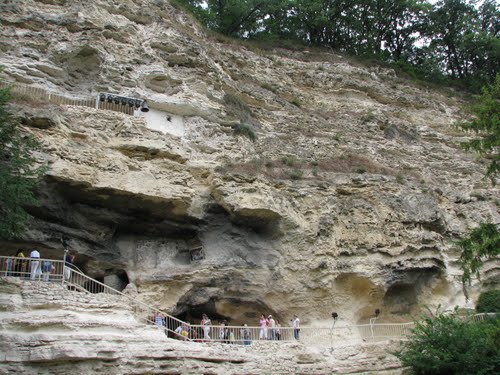
Aladzha Monastery (Bulgarian: Аладжа манастир) is a medieval Orthodox Christian cave monastery complex in northeastern Bulgaria, renowned as one of the most famous rock monasteries along the Bulgarian Black Sea coast. Dedicated to the Holy Trinity, it functioned as an active hesychast monastic community from the 12th century during the Second Bulgarian Empire, possibly enduring until the early 18th century. The name "Aladzha," derived from the Turkish word "alaca" meaning "motley" or "variegated," emerged in the late Ottoman period, referring to the once-vibrant, colorful murals that adorned its walls—now largely faded or destroyed. Legends suggest it may have been patronized by St. Spas (Christ the Saviour). As a unique example of rock-hewn architecture, it highlights early Christian monasticism in the region, with evidence of habitation dating back to the 4th–6th centuries in nearby catacombs. Today, it stands as a symbol of Bulgaria's religious heritage, blending natural beauty with historical intrigue, and attracts thousands of visitors annually for its cultural, religious, and ecological significance.
Location
Aladzha Monastery is nestled in a picturesque forested area 14–17 km north of central Varna, approximately 3 km west of the Golden Sands (Zlatni Pyasatsi) beach resort, within the protected Golden Sands Nature Park (Zlatni Pyasatsi Nature Park). It occupies the upper edge of the Franga Plateau, carved into a 25–40 m high vertical limestone karst cliff overlooking lush greenery and the Black Sea coast. The site's coordinates are around 43°16′39″N 28°00′59″E. Access is via a junction on the road from Varna to Golden Sands, with signposts guiding visitors; it's reachable by car (10–15 minutes from Golden Sands), taxi (about 10 leva from nearby hotels), or a 20–80 minute walk through the park following blue and yellow trail markers. The surrounding Hachuka (Mount of the Cross) or Latin hills, once considered sacred and mythical, add to its isolated, serene ambiance, though the approach involves stairs and paths that can challenge those with mobility issues.
Location and Architecture
The monastery occupies a 25–40 meter
high vertical karst cliff on the Franga Plateau, near the upper
edge, with chambers hewn on multiple levels (primarily two main
ones). The complex includes:
First level: Monastery church,
monastic cells, refectory (dining area), kitchen, a small cemetery
church, a crypt (ossuary/bone-vault), and farm premises.
Second
level: A natural cave recess with a chapel at the eastern end,
featuring some of the best-preserved frescoes.
Nearby features:
Two small catacombs (about 600–700 meters west) with stone tombs,
and evidence of even earlier cave use.
The caves were carved
by hand with chisels into the soft limestone, resulting in
remarkably smooth walls and ceilings in many areas. Wooden stairs
and walkways now allow visitors to explore safely.
Early
Origins and Predecessor Sites
Reliable written records about the
founding are scarce, but archaeological evidence points to a long
history of Christian activity in the area:
4th–6th centuries:
Nearby remains of an earlier cave monastery or hermitage exist,
dated by glassware fragments to as early as the 4th century, with
Justinian-era coins (6th century) indicating continued use.
10th–12th centuries: Some sources suggest a monastic presence on or
near the site during this period, though the current structures
primarily date to the 12th–13th or 13th–14th centuries.
The
main Aladzha complex became an active hesychast monastic community
during the Second Bulgarian Empire (1185–1396). Hesychasm, a
mystical tradition emphasizing inner prayer, silence, and
asceticism, was particularly influential in 14th-century Bulgaria
under figures like Gregory Palamas. Monks sought solitude in these
cliffside cells for spiritual reflection.
Peak Period
(13th–14th Centuries)
This was the monastery’s most vibrant era.
Surviving frescoes in the chapel (though now heavily faded or
destroyed) depict rich spiritual life, with colorful murals that
gave the site its name. It functioned as a dedicated community,
likely to the Holy Trinity (a common attribution, though the
original Christian name is unknown).
The monks lived ascetically:
small cells for prayer and rest, shared spaces for meals and
worship, and a crypt for the deceased. The remote, forested,
cliffside location provided natural protection and seclusion.
Ottoman Period and Decline (Late 14th–16th Centuries)
After
the Ottoman conquest of Bulgaria in the late 14th century, the
monastery gradually declined. It was likely fully abandoned by the
late 15th or early 16th century, though some sources suggest
possible sporadic use or survival into the early 18th century.
During the Ottoman era, the colorful murals led to its Turkish name
"Alaca" (or Aladzha), meaning “motley,” “variegated,” or “colorful.”
This name stuck and replaced any original Bulgarian designation.
Local folklore persisted: The surrounding hills (called Hachuka or
Mount of the Cross) were considered sacred into the early 20th
century. Legends spoke of hidden treasures, ghosts of wandering
monks, and a mythical chthonic daemon or treasure keeper named Imri
Pop or Rim-Papa.
Rediscovery and Modern Era
The site was
largely forgotten until the late 19th century, when the Shkorpil
brothers (Karel and Hermin), pioneers of Bulgarian archaeology,
began systematic study. Karel Shkorpil recorded local legends,
including one linking the patron saint to St. Spas (Christ the
Savior).
1927: Declared a public historical monument.
1968:
Recognized as an architectural and cultural monument of national
importance.
A small on-site museum now displays artifacts,
explanations of room functions, period artwork, and context on
Bulgarian Christian culture. A botanical park surrounds the area.
Today, it is a major tourist attraction, especially popular with
visitors to the Black Sea coast. Summer light shows enhance the
experience of the cliffs and caves.
Overall Architectural Character
Aladzha is a quintessential
example of rock-hewn monastic architecture, common in medieval
Bulgaria (especially during the Second Bulgarian Empire, 12th–14th
centuries). Unlike traditional freestanding monasteries, it was
carved by hand into the natural limestone rock using chisels and
other tools. Some larger spaces may have utilized or expanded
pre-existing natural cavities, but the smooth walls and ceilings
indicate extensive manual sculpting.
The complex is integrated
harmoniously with the dramatic natural cliff face, creating a
multi-level, troglodytic (cave-dwelling) structure that blends
seamlessly with the environment. Wooden stairs, walkways, and
railings (added for modern access) now help visitors navigate what
was originally a more isolated, ascetic setup. The monastery
emphasizes functionality, humility, and spiritual seclusion, typical
of hesychast (contemplative, silent prayer) monasticism practiced by
its hermit monks.
Layout and Structure: Two Main Levels
The monastery is organized primarily on two levels carved into the
cliff, with additional features nearby.
First (Lower) Level:
This is the main functional area, containing the core of monastic
life.
Monastery Church (Catholicon): Located in the westernmost
part. It features a semicircular apse (altar niche) at the eastern
end, typical of Orthodox churches. The altar area was likely
separated by a wooden iconostasis. A stone staircase cut into the
floor near the altar connects to other rooms. The church was richly
decorated with murals, though most have deteriorated.
Monastic
Cells: Small, simple living quarters for the monks, carved as
individual or grouped rooms.
Refectory (Dining Hall) and Kitchen:
Communal eating and food preparation areas.
Small Cemetery
Church: Used for requiem prayers; accessed via stone steps from the
refectory.
Crypt (Bone-vault/ossuary): Located below the cemetery
church for storing remains.
Farm and Auxiliary Premises: Storage
and utilitarian spaces.
The first level forms a cohesive
horizontal sequence of interconnected carved chambers, linked by
internal passages and steps.
Second (Upper) Level:
This
level is dominated by a larger chapel in a natural cave recess.
It is reached via a wooden staircase from the first level (original
access may have differed).
This chapel preserves the best
remaining frescoes, including a notable ceiling painting of the
Ascension of the Lord (Christ ascending, surrounded by angels and
apostles). Other fragments show Byzantine-influenced religious
scenes.
Nearby Features
Catacombs: About 600–700 meters
west, a group of earlier caves (likely 5th–6th century early
Christian) with evidence of habitation (ceramics, coins, graffiti).
These are associated with an even older monastic or Christian
presence in the area.
The complex includes tombs and other
rock-cut elements, underscoring its long use as a burial and
spiritual site.
Artistic and Decorative Elements
The
surviving frescoes (13th–14th centuries) reflect Byzantine Orthodox
traditions with vibrant colors (hence the name). Themes include the
Ascension, saints, and biblical scenes. Much has been lost to time,
exposure, and historical abandonment, but remnants in the upper
chapel give a sense of the original colorful, spiritual atmosphere.
Historical Context and Preservation
Inhabited mainly in the
13th–14th centuries by hesychast monks during the Second Bulgarian
Empire, it declined after the Ottoman conquest (late 14th century)
and was likely abandoned by the 15th–16th centuries. It was
"rediscovered" in the 19th century and studied by the Shkorpil
brothers. Declared a national monument in 1927 and an architectural
cultural monument of national importance in 1968. A small museum
on-site provides context.
Usage and Key Events
Primarily a hesychast monastic retreat, Aladzha served as a spiritual haven for hermit monks from the 12th to 14th centuries, focusing on prayer, contemplation, and communal living within its dedicated spaces for worship, daily chores, and burial. It was a shelter for anchorites amid economic hardships and invasions, with the catacombs used for hiding during Ottoman incursions. Key events include its establishment in the medieval period, decline post-Ottoman conquest (late 14th century), and abandonment by the 15th–16th centuries. In the 19th century, Karel Škorpil's research documented its legends and structures. The 20th century saw archaeological excavations revealing early Christian artifacts. Since 2009, it hosts the audio-visual show "Legends of Aladzha Monastery," blending history with entertainment. Declared a national monument in 1968, it has been preserved for tourism. Visitor accounts highlight its role in Orthodox history, with some noting its resilience despite destruction attempts.
Current Status
As of August 2025, Aladzha Monastery is a well-preserved national monument and popular tourist attraction, managed by the Varna Regional Museum of History. It draws visitors for its historical intrigue, beautiful gardens, and panoramic views from higher levels, ideal for cultural, religious, and eco-tourism in the rare-tree-filled Golden Sands Nature Park. Open daily from May–October (9 am–5 pm) and November–April (9 am–4 pm, closed weekends), entrance costs about 5 leva (€2.50), with curator-led tours in Bulgarian and Russian. A small on-site museum displays artifacts, miniature models, souvenirs, and informational materials; multilingual audio guides are available. Summer features thematic light shows and the "Legends" audio-visual spectacle. Reviews praise its affordability, serene forest setting, and educational value, though some criticize limited English signage, maintenance issues, and accessibility challenges (many stairs, not suitable for mobility-impaired or young children). Parking is limited, and visits typically last 1 hour. Contact: +359 52 35 54 60 or aladzha@museumvarna.com. It remains a must-see for those near Varna or Golden Sands, symbolizing Bulgaria's enduring monastic legacy.