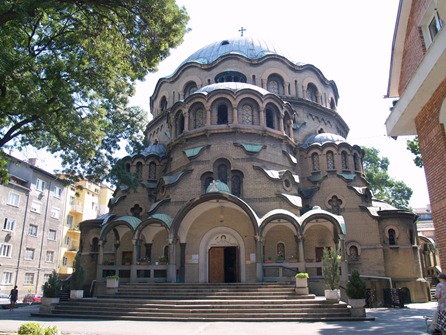
The Church of Saint Paraskeva (Bulgarian: Храм „Света Параскева“ or „Света Петка“) in Sofia is one of the most distinctive and largest Bulgarian Orthodox churches in the Bulgarian capital. It ranks as the third-largest church in Sofia and is renowned for its unique Neo-Byzantine architecture with Art Nouveau influences, exceptional acoustics, and its role in serving the growing urban population in the interwar period.
Historical Context and Origins
The church's history is tied to
Sofia's rapid urbanization and demographic changes after Bulgaria's
liberation from Ottoman rule in 1878. As the capital grew,
especially with waves of migrants and refugees, existing smaller
parish churches struggled to meet spiritual needs.
Early
Plans (1909–1910): The decision to build a new church was made on
April 4, 1909. The site, in what was then the old Jewish quarter on
Georgi Rakovski Street (No. 58), was chosen to serve newcomers. The
land (about 3,000 m²) was purchased for 70,000 leva from the Genovi
and Kotsevi brothers.
A design competition was announced on
November 2, 1910. It was won by Anton Tornyov (1868–1942), a
prominent Bulgarian architect educated in Stuttgart, Germany, known
for blending traditional Orthodox forms with modern elements.
Construction was delayed by the Balkan Wars (1912–1913) and
World War I, which strained Bulgaria's resources.
Construction (1920s–1940)
In 1922, the church board held another
competition, which Tornyov won again.
Building work began in 1926
and the main structure was largely completed by 1930. Finishing work
on the porticos and details continued until around 1940.
Funding
came primarily from local guilds (especially the saddlers' guild, or
samardzhii), parishioners, and generous donors such as Boris
Shterbanov, Ivan Rogachev, Sheryu Damyanov, and others.
Entrepreneurs like Mihail Grandzhe and Kiro Spasov also contributed.
The church was built to replace or supplement the older, smaller
Saint Petka of the Saddlers Church (Sveta Petka Samardzhiyska), a
much older structure in the area linked to the saddlers' guild. The
new church took on a similar dedication to Saint Paraskeva (also
known as Petka in Bulgarian tradition).
Consecration: The central
altar was consecrated on April 6, 1930, by Exarch Stefan I of
Bulgaria. Side altars followed later: one to Saint Charalambos in
1934 and one to the Presentation of the Virgin in 1960 by Patriarch
Kiril.
Dedication and Patron Saint
The church is dedicated
to Saint Paraskeva (Petka) of Iconium (also associated with Saint
Paraskeva of the Balkans/Epivates), a 10th–11th century ascetic,
healer, and wonderworker highly venerated in Eastern Orthodoxy,
especially in Bulgaria and the Balkans. Her feast day is October 28
(or 14 in some calendars). Side chapels honor other saints like
Saint Charalambos, Saint John the Theologian, and Saint Menas.
Significance and Modern Role
It symbolizes Bulgaria's
post-liberation national and spiritual revival, reflecting a desire
to create grand Orthodox temples in the capital during the interwar
Kingdom of Bulgaria.
During the communist era (after 1944), it
continued functioning as an active parish church.
Today, it
remains an active temple in the Sofia Eparchy of the Bulgarian
Orthodox Church, with a professional choir. It serves the local
community and attracts visitors for its architecture and serene
atmosphere.
Plans for the church date back to 1910, when Stuttgart-educated
Bulgarian architect Anton Tornyov (1868–1942) won a design
competition. Construction faced delays due to the Balkan Wars and
World War I. Building began in the mid-1920s (around 1926–1929) and
the main structure was completed and consecrated in 1930, with
porticos and finishing works continuing until around 1940.
The
church was built in the former Jewish quarter to serve Bulgarian
refugees and the growing Orthodox population in the interwar period,
funded largely by donations (including from the saddle-makers' guild
associated with the older St. Petka Samardzhiyska church).
Architectural Style
The church is primarily in a Neo-Byzantine
style with elements of late Art Nouveau (Secession). Tornyov sought
a distinctly Bulgarian national style inspired by historical
heritage while incorporating modern engineering.
Its most
striking feature is its unconventional, centralized plan for an
Eastern Orthodox church, which deviates from the more common
elongated basilica or cross-in-square forms. The overall appearance
is often described as resembling a huge bulb or a massive, organic
dome structure.
Exterior Architecture
Central Dome and
Form: The dominant feature is a large central dome (with a copper or
metal roof) rising above a complex, multi-level base. The structure
features a series of smaller semi-domes, apses, and curved forms
that create a fluid, sculptural silhouette.
Apses and
Transitions: Multiple apses (semi-circular projections) surround the
central volume. The nave (cella/naos) volume gradually
"disintegrates" or merges into these surrounding apses, creating a
balanced, unified mass without sharp separations. This contributes
to the bulbous, harmonious appearance.
Facade Details: The
exterior uses light-colored brick or stone with decorative arches,
windows (some with intricate tracery), and porticos at the
entrances. Greenish copper accents on smaller domes and roof
elements provide contrast. The main entrance features a prominent
arched narthex with steps leading up.
Bell Tower: Unusually, the
bells are housed in a covered tambour (drum) located under the main
dome and in a semi-dome over the western apse, rather than in a
separate tower.
Interior Architecture and Spatial Design
The interior is exceptionally innovative:
Round Cella/Naos: The
main worship space is a circular chamber with a diameter of over 20
meters (about 66 ft), making it feel vast and open. It is
column-free, which is rare for such a large span in traditional
church architecture.
Dome and Vaulting: The ceiling is a
reinforced concrete shell (designed by engineer Tsonev).
Half-cupolas or smaller semi-domes under the central cupola help
diffuse sound and light.
Acoustics: The design results in
outstanding acoustics, comparable to St. Alexander Nevsky Cathedral.
The lack of columns and the arrangement of half-domes allow sound to
spread beautifully, making it popular for concerts and recordings.
Apses Integration: The circular nave flows organically into the
surrounding apses (including the main eastern altar apse and side
ones), creating a unified spatial experience.
Interior
Highlights:
A grand, carved wooden iconostasis (icon screen),
bishop's throne, pulpit (ambo), choir lofts, and balcony paneling by
professors Ivan Travnitski and Todor Khristov.
Icons by notable
Bulgarian artists like Stefan Ivanov, Marin Drinov, D. Gyudzhenov,
and Sergei Shishkov.
Rich frescoes, murals, and decorative
elements covering walls and domes, typical of Orthodox tradition but
adapted to the unique circular space.
Dimensions and
Structure
Third-largest church in Sofia by volume/floor area.
Main nave: Circular, >20 m diameter.
Reinforced concrete elements
for the dome allow the large, open interior.
Total courtyard
area: Around 3,000 m².