RozafaCastle Museum
Open: 8:00 to 19:00
Entry fee: 150 LEK
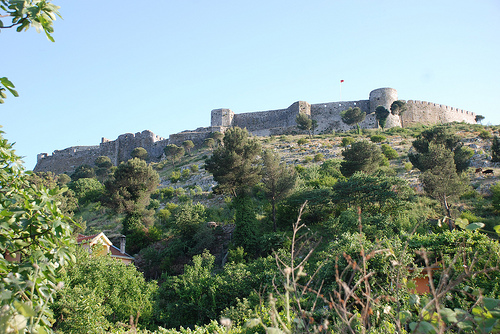
Rozafa Castle, also known as Shkodër
Castle, is a historic fortress located in northwestern Albania, just
south of the city of Shkodër. Perched on a rocky hill rising 130
meters (430 feet) above sea level, it overlooks the confluence of
the Buna and Drin rivers, with stunning views extending to Lake
Shkodra (also known as Lake Scutari). This strategic position has
made it a key defensive site for millennia, controlling vital trade
routes and waterways in the region. Today, it stands as one of
Albania's most iconic landmarks, blending ancient ruins with layers
of historical modifications, and serves as a symbol of Albanian
resilience and cultural heritage.
History and Legend
The castle’s origins date back to the Illyrians
(ancient times), with later expansions by the Romans, Venetians, and
Ottomans. It served as a strategic fortress overlooking the confluence
of the Buna (Bojana), Drin, and Kir rivers, as well as Lake Shkodër and
surrounding plains and mountains.
The most famous story is the Legend
of Rozafa: Three brothers were building the castle, but the walls
collapsed every night. A wise old man advised them to immure (wall up
alive) the first wife who brought them lunch the next day. The two older
brothers told their wives, but the youngest (married to Rozafa) did not.
Rozafa arrived and accepted her fate for the sake of her family and the
castle’s completion. She asked for one breast to remain free to nurse
her infant son, and holes for her arm and leg so she could continue
caring for him and the household. Her sacrifice supposedly stabilized
the walls. The legend symbolizes sacrifice, loyalty, and Albanian “Besa”
(a sacred promise). You’ll often see references to it on-site.
How to Get There
Location: About 2–3.5 km south of Shkodër city
center, on a hill (Rruga Rozafa).
Options:
Taxi/Ride-share: Quick
(5–10 minutes), inexpensive.
Car: Easy access; there’s parking near
the entrance or at the bottom (some visitors park lower and walk up the
cobbled path for views).
On foot or bike: A scenic 15–30 minute
uphill walk/hike from the city. Possible via marked paths.
Public
bus: Local buses from Shkodër center for very low cost (~30 Lek).
From farther away: Day trip from Tirana (~2 hours drive) or even
Podgorica, Montenegro (bus ~1+ hour).
The road up is narrow and can
be crowded with tour buses, so walking or a small vehicle is often
easier.
Opening Hours and Tickets (as of recent info)
Hours
vary seasonally:
High season (May–October): Typically ~8/9 AM – 7/8
PM (some sources note Sunday shorter).
Low season (November–April):
~9 AM – 4 PM (Monday often closed).
Tickets (cash preferred):
Adults: Around 400 Lek (~€3–4 / $3.50–4.50 USD).
Discounts: Students,
children (12–18 or reduced), groups. Kids under 12 often free.
Separate small fee for the on-site museum (~150–200 Lek).
Tickets are
cheap and worth it. You may get a simple map/brochure at the entrance.
What to Expect and See
The castle is largely ruins but
impressively extensive — not a fully restored fortress but an
atmospheric open-air site with thick stone walls, towers, gates,
underground passages/tunnels (bring a flashlight/torch for exploration),
barracks areas, and a small museum in the former commander’s house.
Highlights:
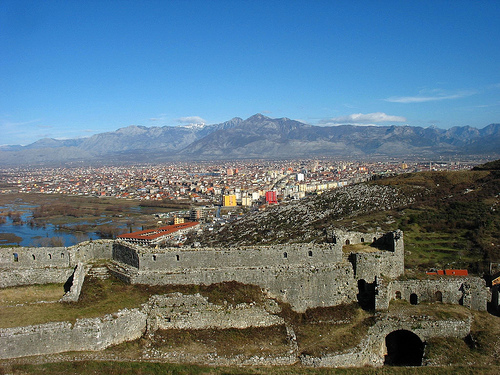
Panoramic views: 360° vistas of rivers, Lake Shkodër,
Shkodër city, plains, and Albanian Alps. Best from the walls and highest
points.
Wandering the perimeter and climbing towers (some areas have
no railings — caution with kids/pets).
Ruins of churches, mosques,
and Venetian/Ottoman architecture.
The museum (artifacts, history
displays).
Time needed: 1–3 hours. You can wander freely.
In-Depth Visiting Tips
Best time to visit:
Early morning: Cooler,
fewer crowds, soft light.
Late afternoon/sunset: Golden hour glow,
magical views (popular for tours). Avoid midday summer heat as the site
is very exposed.
Spring (green landscapes) or clear days for the best
panoramas.
What to wear/bring:
Sturdy, comfortable shoes —
lots of uneven stone, cobbles, grass, and climbing. The uphill approach
and interior paths can be slippery when wet.
Sun protection: Hat,
sunglasses, sunscreen (exposed site).
Water and light snacks (limited
facilities on top).
Camera/phone for photos; flashlight for tunnels.
Light jacket in cooler months or evenings.
Safety and
practicalities:
No railings in many spots — watch your step,
especially with children.
Toilets available but basic.
Limited
shade/food — plan accordingly.
Respect ruins; stay on paths where
indicated.
Photography is unrestricted and highly rewarding.
Enhance your visit:
Guided tour: Highly recommended for history,
legend details, and context (available via GetYourGuide, local
operators, or audio tours). Sunset tours are popular.
Combine with
Shkodër: Old Bazaar (Pedonale), Lake Shkodër boat trips, or other nearby
sites.
Weather check: Views are best on clear days.
Crowds: Can
get busy with tour groups in peak season; early/late visits help.
Off-season is quieter and atmospheric.
Ancient Origins: Illyrian Foundations (Bronze Age to Roman Conquest)
The hill was settled as early as the Early Bronze Age. The earliest
known fortification walls date to the 4th–3rd century BCE, forming the
citadel of the Illyrian city of Scodra (or Skodra), the capital of the
Labeatae tribe (and later associated with the Ardiaei).
This was a
thriving Illyrian political and military center. During the Third
Illyrian War (168 BCE), Illyrian King Gentius concentrated his forces
here but was defeated by the Romans under Lucius Anicius Gallus. The
Romans subsequently occupied and modified the fortress, using it as part
of their network in the region.
The site’s natural defenses—steep
slopes and river surroundings—made it nearly impregnable, a quality that
defined its history.
Roman, Byzantine, and Medieval Periods
After the Roman conquest, the fortress continued in use and likely saw
expansions. It passed to the Byzantine Empire following the division of
the Roman Empire.
In the medieval period, it served as a stronghold
for local Albanian noble families, including the Balšić and Dukagjini
families. By the late 14th century, it came under Venetian influence or
control, as Venice sought to secure its Adriatic and Balkan interests
against Ottoman expansion.
The Venetians significantly strengthened
the castle in the 15th century, rebuilding ruined sections, adding
impressive gates, towers, and a barbican. They also constructed or
expanded religious structures, such as St. Stephen’s Cathedral (13th
century origins), which became a key feature inside the walls.
The Famous Legend of Rozafa
One of the most enduring aspects of the
castle is the Albanian folk legend of Rozafa (or Rozafat), which
explains its name and symbolizes sacrifice, loyalty, and the Albanian
concept of besa (a sacred oath or promise).
According to the legend
(first attested in writing in 1505 by Marin Barleti):
Three brothers
were tasked with building the castle.
Each day they built walls, but
they collapsed overnight due to supernatural forces or an “evil eye.”
A wise old man advised them that the walls would stand only if they
immured (walled alive) the wife of whichever brother brought them food
the next day. They swore an oath not to tell their wives.
The two
older brothers broke the oath and warned their wives; the youngest
brother’s wife, Rozafa (the youngest and most beautiful), came the next
day.
She accepted her fate without protest but made three requests:
to leave a hole for her right eye to see her son, one for her right
breast to nurse him, and one for her right hand to rock his cradle.
Variations exist (sometimes linking the brothers to the Mrnjavčević
house), but the core tale emphasizes maternal devotion. A life-sized
sculpture by Skënder Kraja inside the castle depicts her half-buried in
the wall. The legend is a widespread motif of immurement in Balkan
folklore.
Ottoman Sieges and Conquest (15th–20th Centuries)
The castle’s most dramatic chapter came during the Ottoman-Venetian
conflicts. The Ottomans repeatedly targeted it due to its strategic
value.
In 1474, they besieged it for months but failed to capture it.
In 1478–1479, during the First Ottoman-Venetian War, Sultan Mehmed II
(the Conqueror) led a massive army (estimates vary widely, up to
150,000+). The defenders—roughly 1,600–2,000 Venetian, Albanian, and
Italian troops under commanders like Antonio Loredan—faced intense
bombardment and assaults. The Ottomans cast cannons on-site and launched
multiple attacks after 19 days of shelling, but the defenders repelled
them repeatedly.
The siege ended with a peace treaty in April
1479, under which Venice ceded Shkodër and Rozafa to the Ottomans. It
was one of the most notable episodes in the clash between Christian
Europe and the expanding Ottoman Empire.
Under Ottoman rule
(1479–1912/1913), the castle served as a military garrison and
administrative center. St. Stephen’s Cathedral was converted into a
mosque. Further modifications occurred in the 16th–19th centuries,
including during the semi-autonomous rule of the Bushatlli family in the
18th–19th centuries. Ottoman architectural traces remain visible.
The
castle remained Ottoman until the Siege of Scutari (1912–1913) during
the First Balkan War. Montenegrin and Balkan League forces besieged it
for about six months; the Ottomans finally surrendered in 1913, marking
the end of centuries of Ottoman control.
Modern Era and
Preservation
After Albanian independence and through the 20th
century, the castle transitioned into a cultural and historical site.
Excavations have uncovered artifacts from the Bronze Age onward,
highlighting continuous occupation. It suffered damage over time from
wars, earthquakes, and neglect but has been restored as a key heritage
monument.
Today, visitors can explore:
Illyrian and Venetian walls
Gates and towers
Remnants of churches/mosques
A small museum
Panoramic views of Shkodër, the rivers, and Lake Skadar
Overall Layout and Defensive Design
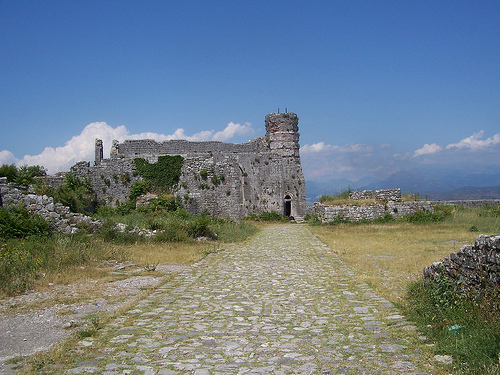
The castle occupies a roughly
triangular hilltop site (about 9 hectares), naturally fortified by steep
rocky slopes and nearly surrounded by rivers, making it exceptionally
defensible. The total perimeter of the main walls is around 880 meters.
It features three main walled enclosures (or courtyards/baileys), each
providing progressively stronger levels of protection and separated by
internal walls with gates:
First Courtyard (Outer/Primary
Defense): The largest and first area entered. It includes a system of
ramparts with sharp curves (built or reinforced 1407–1416 during the
Venetian period) for enfilading fire. This served as the primary line of
defense with extensive outer walls, towers, and a barbican (fortified
entrance).
Second Courtyard: Middle area, historically used for
military barracks, living quarters, and support facilities.
Third
Courtyard (Innermost): The most protected zone, likely housing the
garrison commander’s residence and critical facilities. This was the
last line of defense.
Access is via a series of gates, including
a main arched entrance (often described with Roman-influenced robust
stonework) leading through a covered L-shaped corridor into the first
courtyard. Multiple gates and internal passages create a layered,
confusing approach for attackers.
Materials and Construction
Techniques
Primary materials: Local limestone blocks (massive and
irregular in earlier layers) combined with brick, especially in Venetian
and later repairs. Mortar was used, and some sections show opus mixtum
or other Roman/Byzantine techniques.
Walls are thick and high
(varying but formidable), with some sections featuring battlements,
loopholes (arrow slits), and machicolations for dropping projectiles.
Foundations incorporate the natural bedrock for stability. Later
Venetian walls are more regular and robust, reflecting advanced military
engineering of the period.
Key Architectural Features
Towers
and Bastions: Several towers, including a prominent Venetian tower
offering panoramic views. Towers are typically round or polygonal,
integrated into the curtain walls for flanking fire. Some show layered
construction with different stonework indicating repairs across eras.
Walls and Ramparts: Multi-layered fortifications. Illyrian foundations
(4th–3rd century BCE) form the core citadel. Venetian expansions added
stronger, higher walls with better artillery resistance. Ottoman
modifications included adaptations for firearms.
Water Cisterns:
Essential underground reservoirs for withstanding long sieges,
demonstrating sophisticated logistical planning.
Arsenal/Gunpowder
Warehouse: Remnants highlight its military function.
Religious
Structures: Ruins of a 13th-century Venetian Catholic church (possibly
St. Stephen’s Cathedral), later converted into the Fatih Sultan Mehmet
Mosque after the Ottoman conquest in 1479. This building shows clear
transitions in architectural and religious use.
Other Elements:
Internal pathways, guard walks along the walls, barracks ruins, and
scattered foundations. Informational plaques and a small on-site museum
display artifacts, weapons, and models.
Historical Architectural
Evolution
Illyrian (4th–3rd century BCE): Earliest walls as the
citadel of ancient Shkodra (Skodra), capital of the Labeatae tribe under
King Gentius. Focused on basic but effective stone fortifications
leveraging the terrain.
Roman/Byzantine: Additions and repairs,
including possible gate structures with large stone blocks.
Venetian
(esp. 15th century): Major visible phase. Extensive rebuilding for
gunpowder-era warfare, with sophisticated ramparts, towers, and
enclosures. The castle was a key stronghold until the 1478–79 siege.
Ottoman: Post-1479 adaptations, including the church-to-mosque
conversion and further maintenance. Traces from the 16th–19th centuries,
including Bushatlli period elements.
The architecture prioritizes
military functionality over ornamentation, though some decorative
elements (e.g., in gates or the religious building) appear in later
phases.
Current State and Visitor Experience
Much of the
castle is in ruins, with overgrown sections and collapsed areas, but the
outer walls and key structures remain impressive and walkable. Visitors
explore the courtyards, climb ramparts for views, and see the legendary
“immured” sculpture in the museum.
The most widespread version of the legend goes like this:
Three
brothers (sometimes identified in variants as belonging to the House of
Mrnjavčević) were tasked with building a grand castle. They worked
tirelessly from dawn to dusk, laying strong stone foundations and
raising high walls. However, every night, while they slept, the walls
would mysteriously collapse or crumble, as if some unseen force—often
described as an “evil eye” or supernatural curse—was undoing their
labor.
Desperate and exhausted, the brothers encountered a wise old
man (in some tellings, a mysterious elder or even a figure with divine
insight). He revealed the solution: the castle would only stand firm if
a human sacrifice was made—specifically, one of their wives must be
immured (walled alive) into the foundations. To determine which wife,
they agreed that whichever one brought their lunch to the construction
site the next day would be the sacrifice. They swore a solemn oath
(besa) not to warn their wives, leaving the outcome to fate.
The two
older brothers, moved by love or guilt, broke their oath and secretly
told their wives to stay home the next day. The youngest brother,
however, kept his word and said nothing to his wife, Rozafa (sometimes
spelled Rozafa or Rosafa).
The following morning, Rozafa—young,
beautiful, and devoted—prepared food for her husband and brothers-in-law
and carried it up the hill. As she approached, the brothers looked upon
her with sorrow and explained the terrible fate that awaited her. Rozafa
did not protest or curse her destiny. She accepted it with dignity and
selflessness, understanding that her sacrifice would secure the castle
for her family, future generations, and the community.
Before being
sealed into the wall, she made three poignant requests (variations
exist, but these are the most common):
Her right breast be left
exposed so she could continue to nurse her infant son.
Her right hand
(or arm) be left free so she could caress and comfort her child.
Her
right foot (or leg) be left exposed so she could rock her baby’s cradle.
In some versions, she also asked for one eye to remain open to watch
over her son. As the stones were laid around her, her milk flowed from
her breast and trickled down the walls—a symbol of enduring maternal
love and nourishment that, according to legend, can still be seen
seeping from certain stones after rain.
Rozafa’s spirit is said to
live on within the castle, strengthening its walls and protecting the
region. The castle’s name is sometimes etymologically linked to her,
though scholars also connect “Rozafa” to ancient places like Resafa.
Cultural and Symbolic Significance
This legend is one of the most
famous examples of the immurement motif found across Balkan and broader
European folklore (similar to stories in Serbia, Romania, and beyond,
such as the Serbian epic The Building of Skadar). In Albanian culture,
it emphasizes:
Besa: Keeping one’s word even at great personal
cost.
Sacrifice for the greater good: Individual suffering for
collective strength and protection.
Maternal archetype: Rozafa
embodies the Earth Mother or nurturing goddess figure, with her breast
milk symbolizing fertility, life force, and the blending of human and
natural elements. Some interpretations link it to pre-Christian pagan
beliefs in Albania.
The story has been documented as early as
1505 by the Albanian humanist Marin Barleti in De obsidione Scodrensi.
It continues to be passed down orally and appears in art, literature,
and tourism.
At the castle site today, visitors can see sculptures
and reliefs depicting Rozafa’s sacrifice, including a life-sized artwork
showing her half-buried in the wall with her child.
Historical
Context of the Castle
The legend overlays a very real, ancient
fortress. Archaeological evidence shows Illyrian origins, with
fortifications strengthened over centuries. It was a key defensive
stronghold:
Besieged by Romans in 168 BCE.
Held by various
medieval Albanian noble families.
Famously defended against Ottoman
forces in the 1478–1479 siege under Venetian command.
Later
controlled by Ottomans, who left architectural traces.
The ruins
include massive stone walls, towers, a chapel, cisterns, and barracks,
blending Illyrian, medieval, and Ottoman styles.